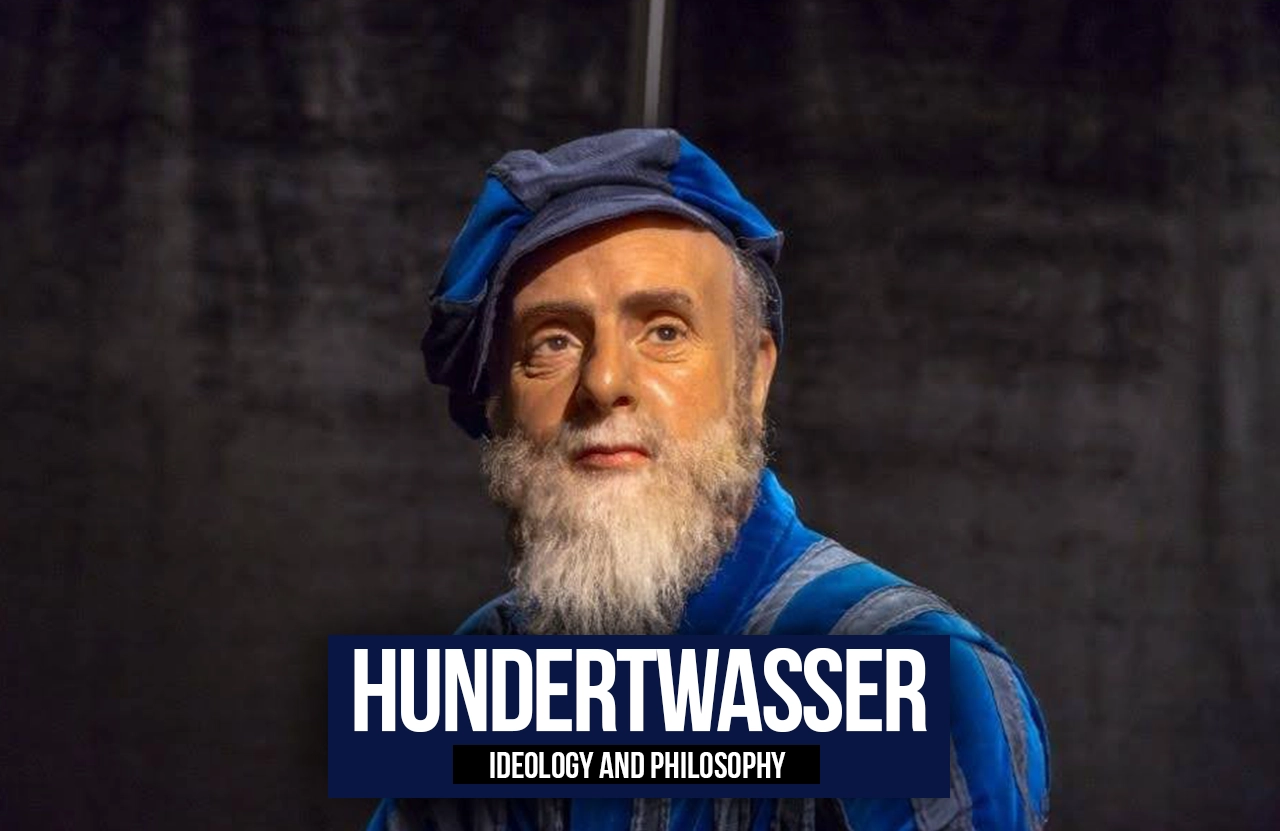
Born as Friedrich Stowasser, 1928-2000, Friedensreich Hundertwasser was an Austrian-born artist, architect, and visionary philosopher. His work questioned this Conventional modernism by distancing himself from straight lines, standard forms, and a minimalist approach. He stood out as a rebel in the rigid landscape of modern architecture dominated by glass boxes, sharp grids, and repetitive facades.
Hundertwasser’s vision extended far beyond art and architecture; he saw all of these as a greater vision of living in harmony between humans and nature. Can buildings breathe, or can design restore harmony between humans and ecology? This philosophy of his seems more like an urgent need rather than a utopian concept.

From Friedrich Stowasser to Hundertwasser
Born on December 15, 1928, in Vienna, Austria, Hundertwasser was born into a family with a mixed religious and cultural heritage. At a young age, he attended Montessori school in Vienna, where teachers noticed his unusual sense of color and form.
Due to his Jewish family background, he and his mother were under threat during the rise of Nazism. During the war, he made early drawings and sketched from nature. He even studied at the Academy of Fine Arts in Vienna after the war. However, after 3 months of learning, he left, rejecting the formal training.
In the early 1950s, he traveled through Italy and France, where he also developed friendships with various artists and gradually adopted his artist’s name, Hundertwasser, which translates to “hundred-water” in German/ Slavic roots. All this, together with political hardship and natural beauty, is combined to shape his ideology and philosophy.
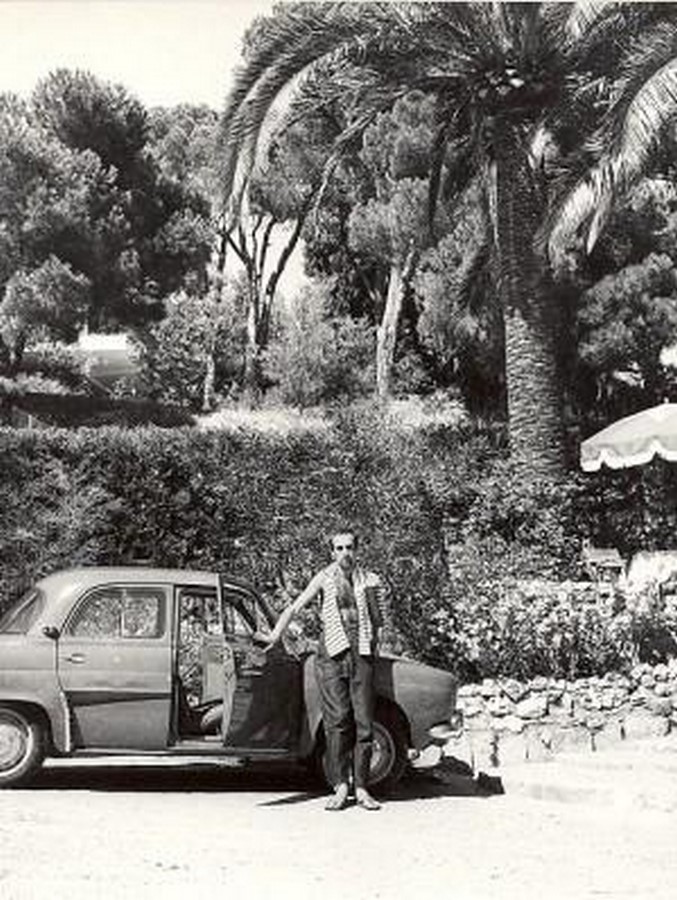
Hundertwasser as an artist
Bright colors, strong organic themes, spiral influence, and appreciation of texture and variation all together are essential components of Hundertwasser’s striking and recognizable artworks. He believed art should not just be exhibited, it should express itself. With this belief, all of his artwork, consisting of paintings, graphic prints, stamp design, flags, and posters, serves as self-expression and a manifesto that there is more than utility in what is seen, a surprise, and life’s irregularity that must be celebrated.
In the early 1950s, with his travels to Italy and France, he grew a friendship with artists like René Bro and was influenced by the exposure to the Viennese art circles and thus grew his opposition to the dominant functionalism in modern art and architecture. With nature as a backdrop, his art depicted various environmental awareness, spiritual concerns, and philosophical ideas, but all woven with human life.
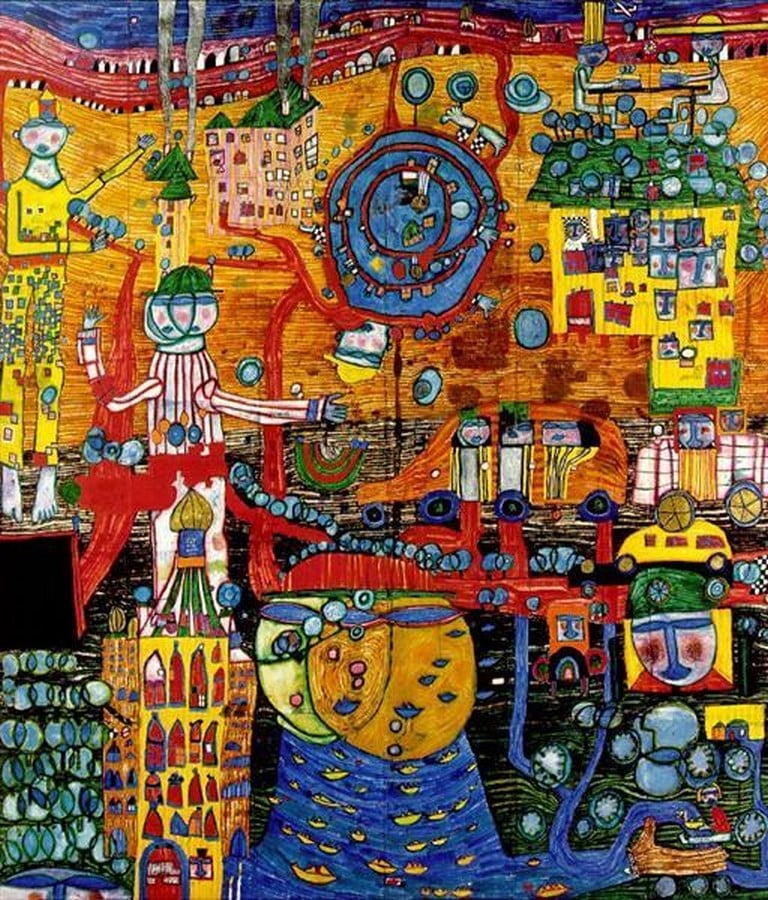
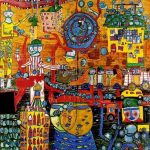
One of his iconic works is ‘The 30 Days Fax Picture’ in 1951. Reflecting his ideology with time, growth, and variation, this artwork consists of colorful spirals and organic forms created day by day. His belief in the spiral as a symbol of life’s constant movement and renewal is interestingly depicted in this painting.
Architect’s Life
Although Hundertwasser never had a formal degree in architecture, his architectural work is central to his ideology and beliefs. From the 1950s onwards, he formulated manifestos, models, and experiments with the idea of window rights, tree tenants, forests on the roof, uneven floors; all these elements later became his main characteristics of built structures.
He insisted that architecture is simply not just functional; it should be a healing force. He viewed each building as a living organism that is deeply connected with nature and its inhabitants. Beyond his architectural design, his architectural input ranged from the design of facades, interiors, and public art.
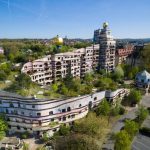
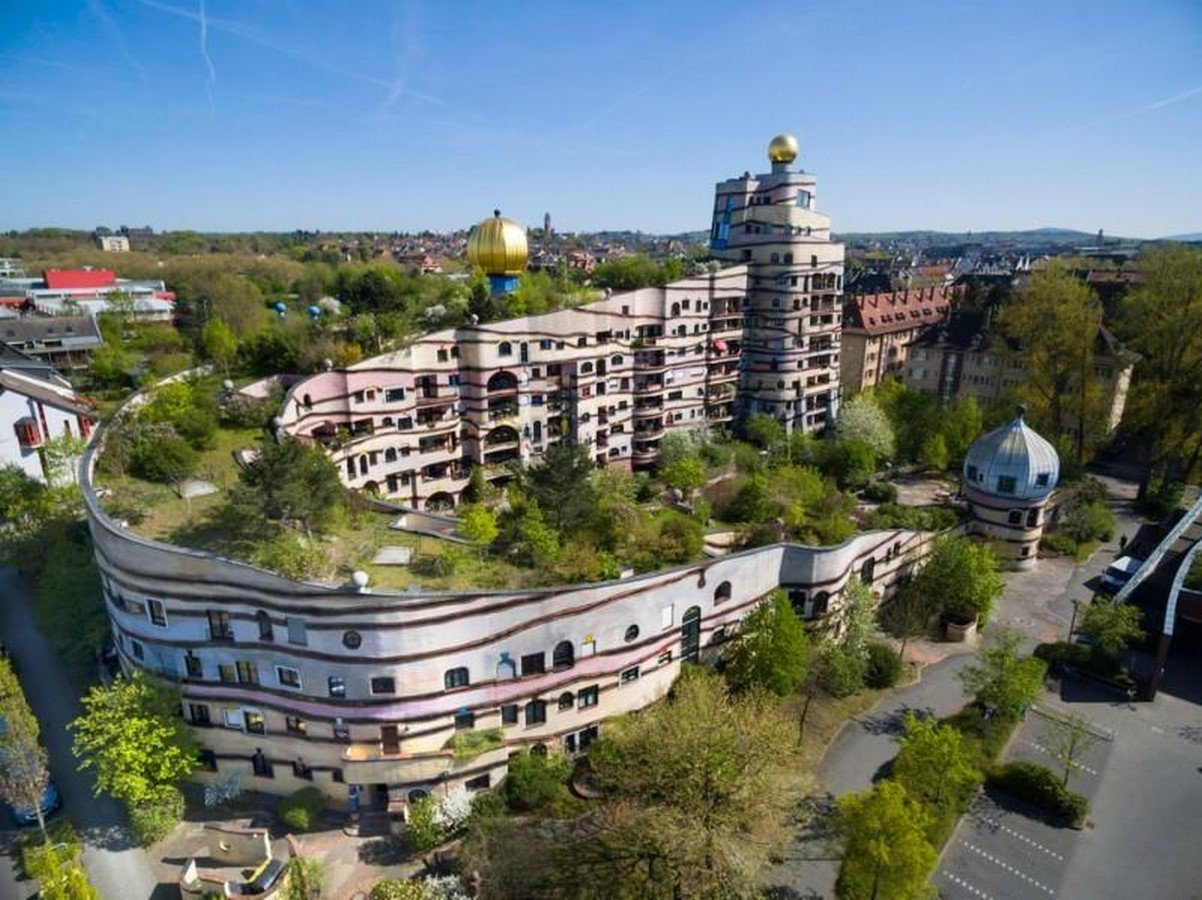
Hundertwasser’s most famous building, which captured many of his ideologies into reality, would be the apartment complex in Vienna’s 3rd district, Hundertwasserhaus [Hundertwasser House]. It features irregularly placed windows, terraces, undulating floors, green roofs, trees growing from terraces and balconies, mosaics, and bright color bands. Though the engineering of this project is conventional, its organic form, the skin, and the façade redefine this residential block.

Ideology and philosophy
Hundertwasser’s ideology was built around a fundamental rejection of uniformity and the straight line. For him, irregularity portrays freedom and life, while a straight line represents industrialization, control, and a lack of individuality. His manifesto also outlined his belief that every person should have the right to shape their living environment. His philosophy that humans and nature must co-exist harmoniously is beautifully portrayed in his concept of tree tenants, where trees grow from windows or rooftops.
Beyond rejecting modernist dogma, Hundertwasser saw architecture and art as healing forces that should restore balance between humans, society, and the natural world. Long before sustainability became a mainstream concern, his vision extended to ecological responsibility and advocating for green roofs. His philosophy was ultimately a call for freedom, diversity, and harmony, to live in rhythm with nature’s cycles, to celebrate differences, and to design a world where buildings, people, and ecosystems are intertwined in a continuous dialogue.
Citations:
Architecture Today. (2024). Still standing: Hundertwasserhaus Vienna, 1985. Retrieved from Architecture Today: https://architecturetoday.co.uk/still-standing-hundertwasserhaus-vienna-friedensreich-hundertwasser-1985/
dlubal. (2024, December 02). Wax figure of artist and architect Friedensreich Hundertwasser at Madame Tussauds Vienna. Retrieved from dlubal: https://www.dlubal.com/it/news-ed-eventi/news/blog/000168?srsltid=AfmBOop1pkva49byYCH99RbzokWvI9xF7I41XP9kr1Dd64b9G800Qecb
Markowski, M. (2024, August 02). A spiral building with a green roof. This is the Waldspirale from Darmstadt. Retrieved from White Mad: https://www.whitemad.pl/en/a-spiral-building-with-a-green-roof-this-is-the-waldspirale-from-darmstadt/
Singulart. (2024, March 07). The 30 Days Fax Painting by Friedensreich Hundertwasser. Retrieved from Singulart: https://www.singulart.com/blog/en/2024/03/07/the-30-days-fax-painting-by-friedensreich-hundertwasser/?srsltid=AfmBOoqP2XgCvPCSKyFt1XxrnLZwXvnsM5Sg4viK5MYmS5nW-RcAp0C-
The Hundertwasser Non-Profit Foundation. (2025). The Hundertwasser Biography. Retrieved from Hundertwasser: https://hundertwasser.com/en/biography