nes after editing and once the edits are made please inform us about the same).
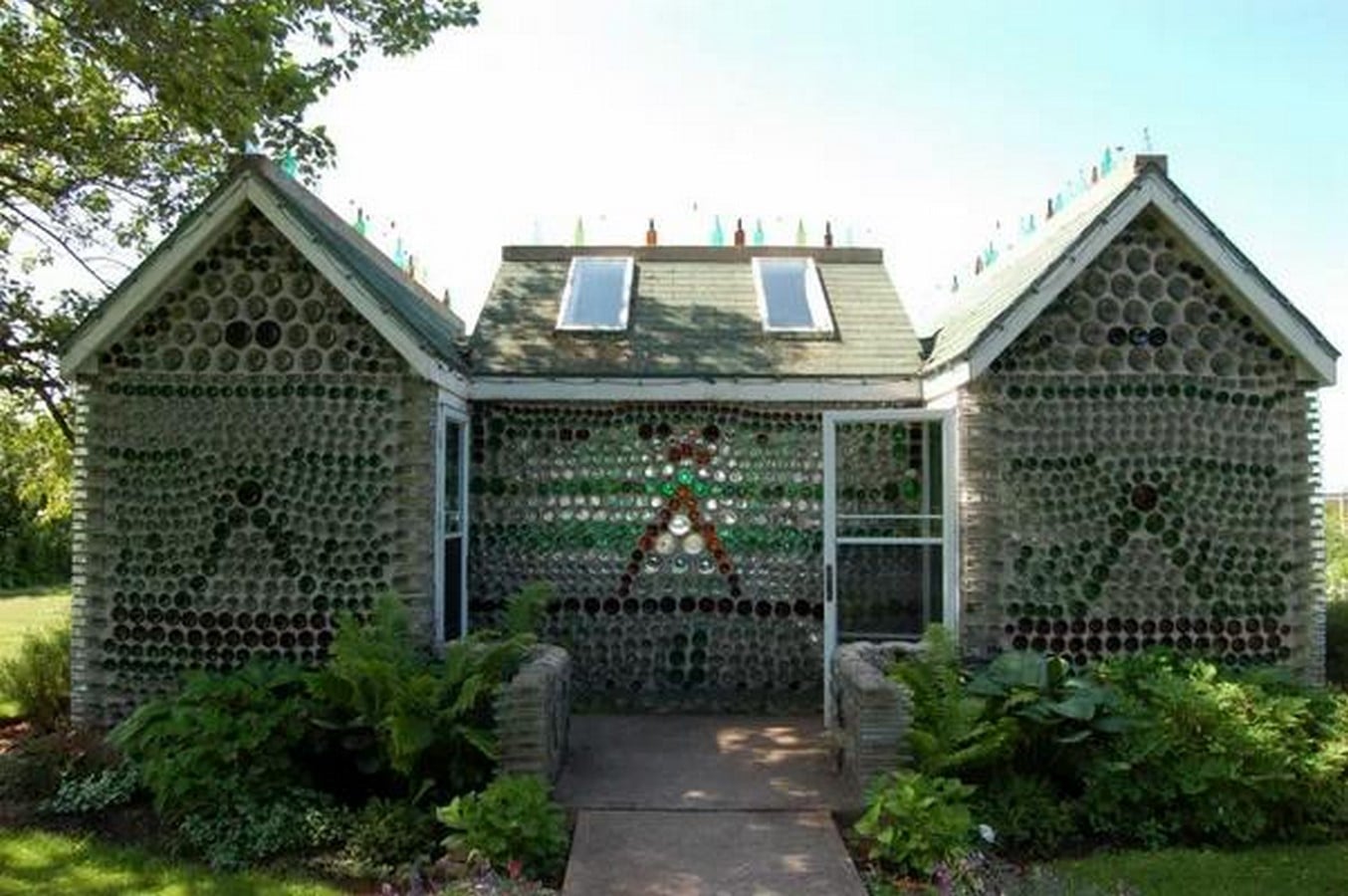
In the architectural canon, the names we celebrate often come with manifestos, statements of ambition backed by built form. But Edouard Arsenault, a retired lighthouse keeper from Prince Edward Island, built it with no such formal declaration. His bottle houses, constructed from thousands of discarded glass bottles, may appear more like personal curiosities than architectural landmarks. And yet, if we resist judging them by the metrics of architectural orthodoxy, form, innovation, and professional polish, we find in Arsenault’s work a deeply resonant ideology: a belief in creative resourcefulness, community participation, and quiet resilience.
This was not architecture driven by capital, political power, or even design fashion. It was driven by a man’s fascination with material reuse and his desire to create something beautiful from what others discarded. It’s easy to reduce the Bottle Houses to folk art, but there is something more quietly radical in their intent and execution: they are physical expressions of an alternative architectural philosophy, one that predates sustainability as a professional agenda and values presence, patience, and process over prestige.
Building with Intent, Not Instruction
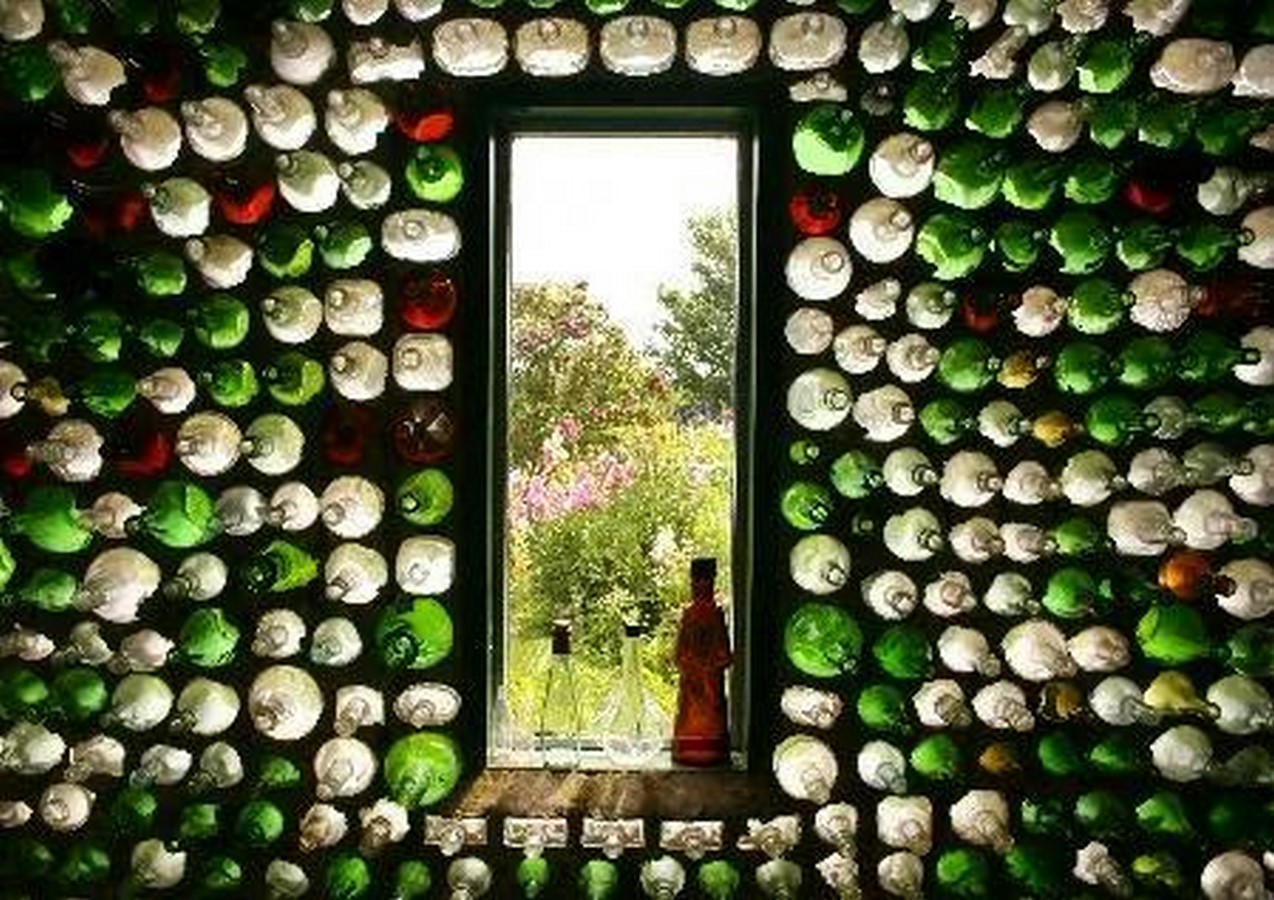
Arsenault began his project in 1980, inspired by a postcard of a bottle castle in British Columbia. He gathered more than 25,000 bottles from local recycling depots and community contributions. He spent hours soaking, scrubbing, and sorting them by colour and size. He wasn’t trained in structural engineering or environmental science, and yet his decisions demonstrate a kind of intuitive knowledge about pattern, light, and atmosphere.
His process might not pass today’s sustainability checklists. Concrete was used as the binding agent, and the thermal and structural performance of the bottle walls is questionable, but the underlying intent was restorative: giving waste new purpose, embedding personal and collective memory in each wall, and sharing it with the public as a gift of imagination.
A Vernacular of Waste and Wonder
Unlike modern architects working with digital tools and simulation models, Arsenault’s philosophy is rooted in what’s available, materially, culturally, and emotionally. He didn’t impose design onto place; he let the place, and its waste, guide him. The bottles were not symbolic. They were literal history: beer from the local tavern, soda from family picnics, wine from community dances.
His vernacular is not regional in the architectural sense, but emotional. In this way, his ideology aligns with what architectural theorist Kenneth Frampton called “critical regionalism”: a resistance to placeless architecture and a return to the embodied, the tactile, the local, except Arsenault did it without the jargon.
Architecture as Experience, Not Statement
Stepping into the bottle chapel, light floods in through green, amber, and clear walls, casting a soft, dappled effect across the floor. This is not just whimsy, it’s atmospheric design. It invites stillness. It invites reflection. It creates a spatial memory.
There is no authorial ego here. No signature move. No ambition for global relevance. And perhaps that’s the most telling aspect of Arsenault’s ideology: architecture not as performance, but as participation. He built these structures not to dazzle critics, but to engage neighbours, visitors, and curious minds.
Limits and Legacy
Of course, we must acknowledge the limitations. His use of concrete clashes with the ecological principles many now associate with bottle reuse, but also, the decision to bind them permanently in concrete means the structures cannot be disassembled or adapted without demolition. His designs, while poetic, aren’t replicable, disassembled or scalable in their current form. And yet, dismissing them on these grounds alone would be to mistake technical limitation for ideological failure.
His work didn’t set out to innovate. It set out to connect. And this is perhaps the most critical contribution of his philosophy: the belief that architecture can be made by anyone, with whatever they have, to create joy, community, and wonder. It’s not avant-garde, but it’s still visionary.
A Philosophy Rooted in Care, Not Capital
In a world where architecture is too often trapped between prestige commissions and climate despair, Arsenault’s work reminds us of an older, quieter way of building: using what we have, celebrating the humble, and letting light and memory shape space.
His ideology is not written in essays but in bottle walls and garden paths. It’s not theory-driven, but life-driven. And while his buildings may not shift the discipline forward in form or technology, they expand our understanding of architecture’s social and poetic responsibilities.
Reframing Value in Architecture
What does the profession do with figures like Arsenault? Do we archive them under folk art, or do we learn from them?
As someone trained in architecture but driven by questions of material justice and social inclusion, I see Arsenault as a useful provocateur. His work asks uncomfortable questions: Must architecture be ‘architect-designed’ to be meaningful? Can joy and reuse be design principles, even without metrics? Can care be enough?
Perhaps the true value of Edouard Arsenault’s work isn’t in what it achieves, but in what it proposes: a humble, local, joyful architecture made with care and community. That may not be the future of the profession, but it should be part of its soul.