One of the pioneers of modernism and the mastermind behind the philosophy of “less is more”, Ludwig Mies van der Rohe, commonly addressed as Mies, was a German-American architect and is one of the most influential figures in the history of architecture. His dedication to detail led him to invent a brand-new body of work itself – spanning from prominent corporate establishments to simple tubular structures – and epitomizing the internationally accustomed style of modern architecture.

The Idea: Berlin’s First Skyscraper
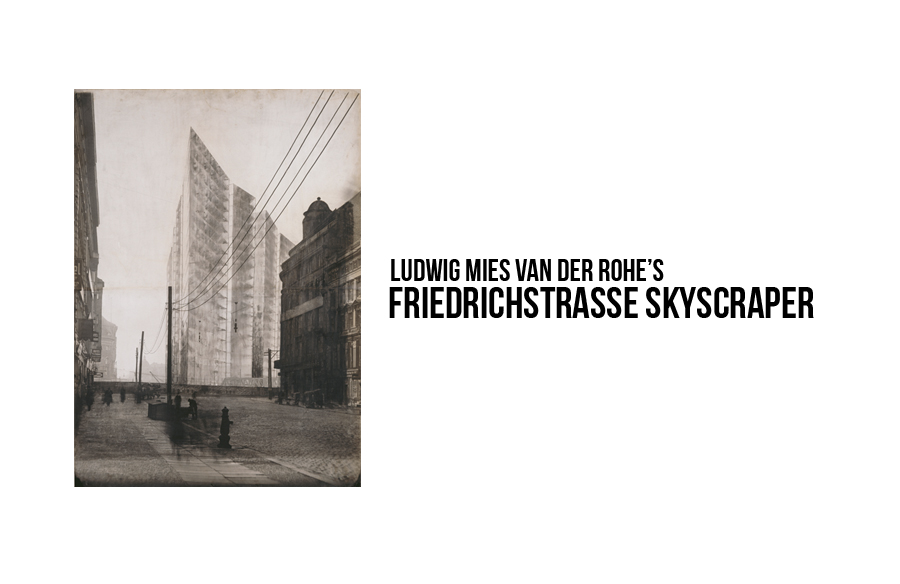
Having migrated to America from Germany after the growing denial of developing modern art and architecture under the nazi rule, Mies came up with the design for the Friedrichstrasse Skyscraper in response to the competition organized for designing Berlin’s first skyscraper in 1921. Titled “honeycomb” in his proposal, this ambitious project was named after the lively shopping street of Friedrichstrasse and a train station of the same name, set to stand on a triangular piece of land enclosed by the Spree River.1

Providing a landmark to the continuous growth of the city of Berlin, the competition attracted more than 140 entries, largely influenced by the Weimar-era architects of Germany. Mies’ idea for the project was for this building to not have the traditional solid walls as the load-bearing members, and to use the steel structure to carry that burden instead. He designed for it to be more transparent than usual, keeping large glass facades that reflect the concept of “skin and bones” as explained by Mies himself.2

Although wide expanses of glass had previously been introduced in several American architectural projects, Mies was arguably the first to propose a design that would exclude a masonry-based structural or decorative support. The crystal and triangular-shaped plan of the building represented expressionism in art and architecture, sharing their attraction towards glass as a symbol of purity and renaissance.1
Legacy: Importance and Influence
Mies’ Friedrichstrasse was way ahead of its time in terms of how he shaped it – angular perception and complete glass facades. It also had a lot of influence from Mies’ background and the economic and political changes taking their shapes around Germany ahead of the Second World War. Although few of the design ideas submitted could match the crafty superiority of Mies’ design, it was ultimately not chosen to go much further in the competition. It took decades for the admirers of art and architecture to recognize and ponder on the beauty of the modern takes that Mies took with this design.
In 1992, another similar opportunity arose when a similar contest was announced for designing an outstanding building in the same location. Mies van der Rohe’s designs for Friedrichstrasse were almost turned into reality, but a design for Ernst & Young by Berlin-based architect Mark Braun took the title instead; which was later built and named Spreedreieck after the Spree River running around the site.3

A century after Mies first proposed these designs, research-based practice ZUMO paid tribute to Friedrichstrasse and its contribution to modernist architecture as well its legacy in the form of digitally enhanced three-dimensional visuals of the original designs. Their motto was to not just create digital visualizations but to also demonstrate the importance of unbuilt architecture with the example of Mies and his legacy in the uprise of modernism and contemporary styles in architecture through the unmatched class that is expressed in his designs for Friedrichstrasse.4

REFERENCE LIST:
IMAGES :
- Scherschel, F. (1956). Architect Ludwig Mies van der Rohe peered between two large models of ultra-modern apartment buildings he designed for Chicago’s Lake Shore Drive, 1956, [Photograph]. The LIFE Picture Collection/Shutterstock. (https://www.life.com/arts-entertainment/mies-van-der-rohe-and-the-poetry-of-purpose/)
- Scholvien, W. Friedrichstraße. The Official Website of Berlin. (https://www.berlin.de/en/shopping/shopping-streets/1761655-5123158-friedrichstrasse.en.html)
- Rohe, M. (1921). friedrichstrasse skyscraper project, berlin-mitte, germany (exterior perspective from north). [Photograph]. New York : 2021 Artists Rights Society (ARS) / VG Bild-kunst, Bonn. (https://www.designboom.com/architecture/unbuilt-mies-van-der-rohe-skyscrapers-brought-to-life-zumo-04-27-2021/)
- diephotodesigner. (2009). Spreedreieck, Berlin. [Photograph]. (https://www.bollinger-fehlig.de/en/projekte/spreedreieck-berlin-2/)
- ZUMO. friedrichstrasse skyscraper, berlin. [Digitally rendered image]. (https://zumo.digital/)
BIBLIOGRAPHY/EXTERNAL LINKS :
- Riley, T. (2002). Envisioning Architecture: Drawings from The Museum of Modern Art. Matilda McQuaid, ed. New York: The Museum of Modern Art.
- (2019). MoMa Highlights: 375 Works from The Museum of Modern Art, New York. MoMa. (https://www.moma.org/collection/works/787)
- Berlin: The architectural icon that was never built. secretcitytravel. (http://www.secretcitytravel.com/2016/mies-van-der-rohe-friedrichstrasse-skyscraper-berlin-1921.shtml#topstuff)
- (2021). unbuilt mies van der rohe skyscrapers brought to life in ZUMO’s digital tribute. designboom. (https://www.designboom.com/architecture/unbuilt-mies-van-der-rohe-skyscrapers-brought-to-life-zumo-04-27-2021/)