The threat of climate change is a longstanding issue and continues to prompt responses as it is one of the most pressing matters of our time. From rising sea levels and food security to urban pollution, these escalating global issues demand creative and innovative solutions for a sustainable future. Many architects and designers around the world have dedicated their careers to addressing these challenges, with the idea of floating cities being one of the promising solutions. This article will focus on Vincent Callebaut, a visionary architect whose work exemplifies how cutting-edge and nature-inspired architecture can offer practical and resilient responses to climate change, providing hope for a climate-resilient and sustainable world.

Vincent Callebaut and Ecological Architecture
Vincent Callebaut specialises in futuristic and ecological designs. He finds inspiration in biomimicry, channelling the natural solutions into architecture, with a forward-thinking approach directly addressing climate-related issues. His portfolio features innovative concepts such as floating cities, vertical urban forests, and urban farming integrated into residential buildings, to name a few. Inspired by the Amazon rainforest, Vincent Callebaut also puts great interest in transforming waste into valuable resources, creating closed-loop systems that minimise environmental impact and foster a symbiotic relationship with the built environment (Beekmans, 2018). His proposals not only offer climate-resilient settlements but also strive to harmonise human habitats with surrounding natural ecosystems.
“We need to imagine projects which advocate the right symbiosis of the Humanity-Nature balance by drawing inspiration from the forms, structures, and feedback loops that exist in natural ecosystems.”
– Vincent Collebaut (Stevens, 2021)

Designing for Future on Water
Floating Cities
With the sea levels projected to rise by over a metre by the end of this century, coastal cities around the world are at risk of flooding. As a result, by 2050, hundreds of millions of people could be displaced and forced to relocate (United Nations,n.d.). The concept of floating cities arises as a promising solution, offering structures that rise with the sea and withstand tsunamis and floods, while also being sustainable and self-sufficient, capable of producing their own energy and food (Mutlu Avinc & Arslan Selcuk, 2023). This concept is supported by the United Nations which believes that this is an effective response to threats posed by climate change, also helping to reimagine how cities are built and lived in (United Nations, 2019).
Here comes Vincent Callebaut’s vision of Lilypad, a floating city designed for climate refugees, taking inspiration from a giant water lily that adapts to changing water levels. Each Lilypad accommodates 50,000 inhabitants and provides spaces for work and leisure, while also fostering biodiversity with flora and fauna developing around the structure. Fully self-sufficient, the proposal produces more energy than it consumes, processes waste and purifies water, creating a resilient ecosystem. The design also integrates aquaculture fields and ecological niches, both on and beneath the city, to support its food needs and further enhance its environmental harmony (Vincent Callebaut Architects, n.d., c). This is where technology and nature come together.

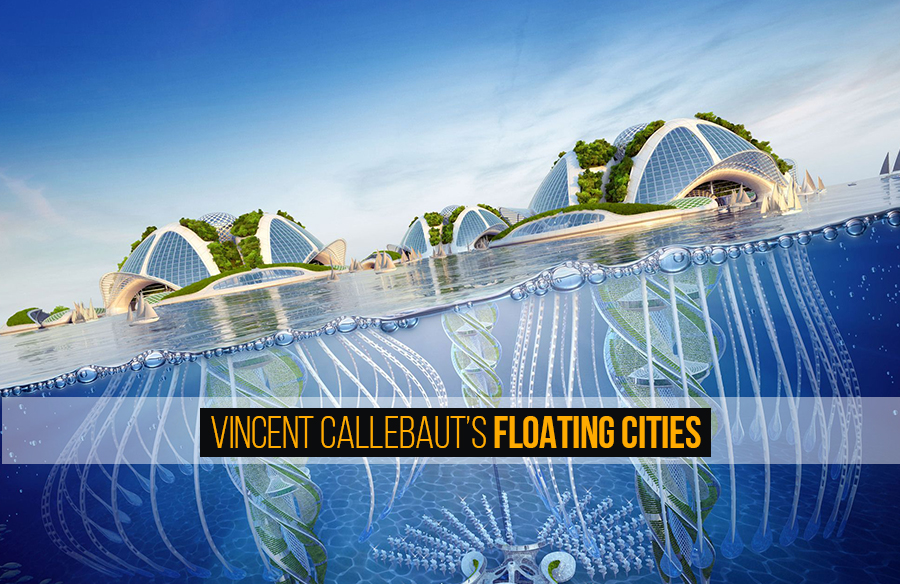
Another concept by Vincent Callebaut is an “oceanscraper”, Aequorea, that offers 10,000 housing units along with workspaces, community areas, sea farms and research labs, among others. This innovative structure is 3D-printed from algoplast, an invented composite material made from algae and recycled garbage. The form is inspired by jellyfish, and its “tentacles” not only ensure stability during earthquakes or storms but also generate renewable energy. Aequorea is entirely self-sustaining and includes integrated systems for water purification and waste recycling, powered by microalgae (Vincent Callebaut Architects, n.d., a). This underwater “oceanscraper” exemplifies how human habitation can evolve to thrive within the oceans, adjusting to the changing climate and environment, providing habitats for marine life and aiding in marine conservation.

Other Innovative Concepts
Beyond his floating cities, Vincent Callebaut has explored other diverse floating structures designed to address environmental and urban challenges. The Dragonfly project, for instance, envisions a vertical farm and advocates for the development of urban agriculture producing organic and local food for densely populated areas. This design addresses both food security and climate change by supporting the rapid growth of urban populations while also purifying polluted air (Vincent Callebaut Architects, n.d., b). Hydrogenase, on the other hand, is a vertical algae farm that focuses on converting sunlight and CO2 into oxygen and biomass, to produce clean energy and purify water, thus enhancing climate resilience.
Vincent Callebaut’s portfolio also includes other sustainable floating structures designed for places for culture, setting a precedent for future developments. The Oceaniums project proposes a series of floating World Cup stadiums, while Batwings features a 3D-printed pavilion designed as a private gallery.

Challenges and Feasibility
As promising as these concepts are, they face significant challenges related to finances, politics, as well as technological advancements. Moreover, the proposals must ensure they include forward-thinking solutions to withstand any sort of extreme weather conditions.
While various entrepreneurs and developers are working on innovations to make these proposals doable, policymakers should also start working on addressing the legal complexities around the freely floating structures in international waters, as there are gaps in national and international laws that present further obstacles (Bhatt, 2020).
Another barrier is the costs associated with the initial construction of such self-sufficient cities. This also poses a concern that people, like the climate refugees, may not be able to afford such a place without substantial government support, risking the exclusivity of these projects to the wealthy (Yogesh, 2022).

Conclusions: a Vision for the Climate Resilience
Floating cities offer a promising architectural solution to the discussed several global challenges. Vincent Callebaut’s visionary designs exemplify how integrating biomimicry with advanced technology can create sustainable urban environments. By drawing inspiration from nature’s adaptability, Callebaut’s floating cities provide a practical and visionary response to the threat of rising sea levels, demonstrating how urban spaces can coexist with and adapt to environmental changes.
Nevertheless, the feasibility of such proposals faces significant challenges, including high costs and complex regulatory issues, and addressing those are crucial for enabling the potential of floating structures. Continued exploration and support for innovative solutions is essential for the future of urban development, paving the way for resilient and adaptable habitats that meet the needs of people and respond to the changing climate.
Reference list:
Beekmans, J. (2018). Archibiotect Vincent Callebaut Explains What Cities Can Learn From Rainforests [online]. Available from: https://popupcity.net/insights/archibiotect-vincent-callebaut-explains-what-cities-can-learn-from-rainforests/ [Accessed date: 12 September 2024].
Bhatt, M. (2020). Modular Maritime Metropolis: A Review on Sustainable Floating City. International Journal of Engineering Research and Technology, Volume 9(5). doi: 10.17577/IJERTV9IS050600
Mutlu Avinc, G., & Arslan Selcuk, S. (2023). Floating cities: A solution for climate refugees?. PLANARCH – Design and Planning Research, Volume 7(1), 1-7.
Stevens, P. (2021). ‘Being an Archibiotect is like being an haute couture designer’ – Vincent Callebaut on building through biomimicry [online]. Available from: https://www.designboom.com/architecture/interview-vincent-callebaut-building-through-biomimicry-04-07-2021/ [Accessed date: 12 September 2024].
United Nations (n.d.). Climate Crisis – A Race We Can Win. Available at: https://www.un.org/en/un75/climate-crisis-race-we-can-win [Accessed date: 12 September 2024].
United Nations (2019). Sustainable floating cities can offer solutions to climate change threats facing urban areas, deputy secretary-general tells first high-level meeting. Available at: https://www.un.org/press/en/2019/ds gsm1269.doc.htm [Accessed date: 12 September 2024].
Vincent Callebaut Architects (n.d.). Aequorea [online]. Available from: https://vincent.callebaut.org/object/151223_aequorea/aequorea/projects [Accessed date: 12 September 2024].
Vincent Callebaut Architects (n.d.). Dragonfly [online]. Available from: https://vincent.callebaut.org/object/090429_dragonfly/dragonfly/projects [Accessed date: 12 September 2024].
Vincent Callebaut Architects (n.d.). Lilypad [online]. Available from: https://vincent.callebaut.org/object/080523_lilypad/lilypad/projects [Accessed date: 12 September 2024].
Yogesh, S. (2022). Are floating cities the urban future?. WIT Transactions on the Built Environment, Volume 2010, 215-224. doi: 10.2495/arc220181