Bangalore, a metropolitan city with 14 million population, the city is known for its IT hub and is also referred to as the Silicon Valley of India. Apart from that, it’s famous for its fashion, incredible food, filter kaapi, and not-so-controversial Sāmbhar and its breakfast. But the other main charm of Bangalore is its traditional heritage architecture, which stands out as super strong to this day. One of the most beautiful and strong among them is Tipu Sultan’s Summer Palace. So how did it get its name?
It is named after Tipu Sultan, the “Tiger of Mysore” for his fierce resistance against British colonial forces. The term “Summer Palace” indicates its primary function as a place for relaxation and respite during the summer months. It was designed to be a cooler, more comfortable residence for Tipu Sultan, away from the formalities of governance and the heat of the city.

The Begin of the Palace
The foundation stone of the palace was laid by the Sultan and the ruler of the kingdom of the palace, Haider Ali. After the death of Ali in 1782, the construction was taken over by his son. This construction was completed in 1791 and since then it has served as the summer residence of Tipu Sultan and his family. After his death, the palace was seized by the British Government and was used as their secretariat. Currently, the palace is under the Karnataka state Government, because of its architectural praise it has become a tourist spot in Bangalore. Tipu Sultan’s Summer Palace, in Bangalore, is an example of Indo-Islamic architecture.
The Insides of the Palace
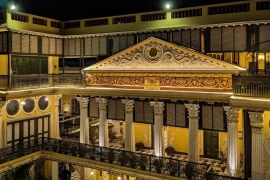
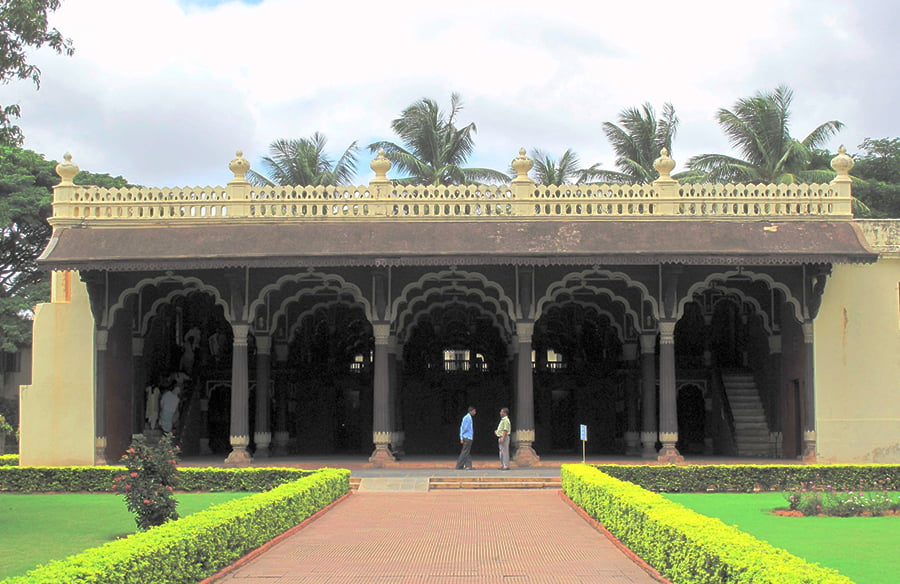
Tipu Sultan’s Palace is very beautiful Indo-Saracenic architecture with projecting balconies and great ornate decorative elements. The complex is submerged in the greenery of a beautiful, carefully manicured paradise garden. The two-story building is unique because it is made of teak wood. There is an open-air swimming pool on the upper level, and monumental columns, topped with carved arches on the lower one. Not only is the structure ornamented with them but also serves as support to the foundation of the building. The curvilinear wooden balcony and the grand staircase are renowned masterpieces of Muslim architectural art. It is believed that the sultan used both the east and the west balconies for holding masses and other important state affairs. The ornate ceilings and walls of the interior with glass chandeliers, colour frescoes, wood carvings, and floral patterns make these surroundings simply breathtaking.


Whereas the ground floor museum. From genuine arms and jewellery to various daily objects belonging to his family. Observe the paintings. They depict historic events in the life of Tipu Sultan and his father, Haidar Ali. Among the other interesting things on display is a toy or an instrument that Tipu Sultan designed. This has the name of a tiger killing a British soldier. This was a wind instrument and when one blew into it the tiger would roar while the soldier would whimper in pain. What you see here is not the original. The original is to be seen in the Victoria and Albert Museum, London.


Structurization of the Palace
The palace is built on a low stone platform and is a two-storeyed building with more audience chambers on all three sides of the palace. It was said that Tipu Sultan conducted his Durbar from both eastern and western Balconies on the second floor. There are four smaller rooms in the corners of the first floor which are in the Zenana Quarter. With a total of 160 pillars in the palace, some of them reach the second floor that supports the jhorakas.

On the ground floor, there are two rooms-one at each end where you see the beautiful inside walls and grandeur of the palace. They say it was covered with precious gems, which were removed after the British took over the palace. The paintings here are further testimony to the Indo-Islamic architecture of the Summer Palace of Tipu Sultan.

The Archaeological Survey of India maintains care for the palace. Since it is a heritage monument, commoners visit this palace. Restorations are carried out to restore its wooden framework, murals, and other carvings. The surroundings have been modernised, but the government and other heritage conservation bodies are keen to preserve the historical integrity of this palace.
Citation:
- Pande, A. and Kumari, S. (2012) The heritage of Tipu Sultan’s grandiose Bangalore fort and Summer Palace (no date) Onmanorama. Available at: https://www.onmanorama.com/travel/outside-kerala/2019/12/21/tipu-sultan Bangalore-fort-summer-palace.html (Accessed: 06 October 2024).
- Haider Ali and Tipu Sultan: Art and Architecture. New Delhi: Published by National Museum Institute of History of Art, Conservation and Museology in association with Aryan Books International.