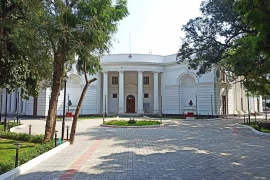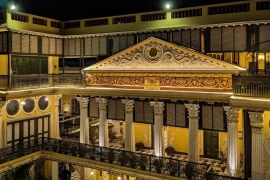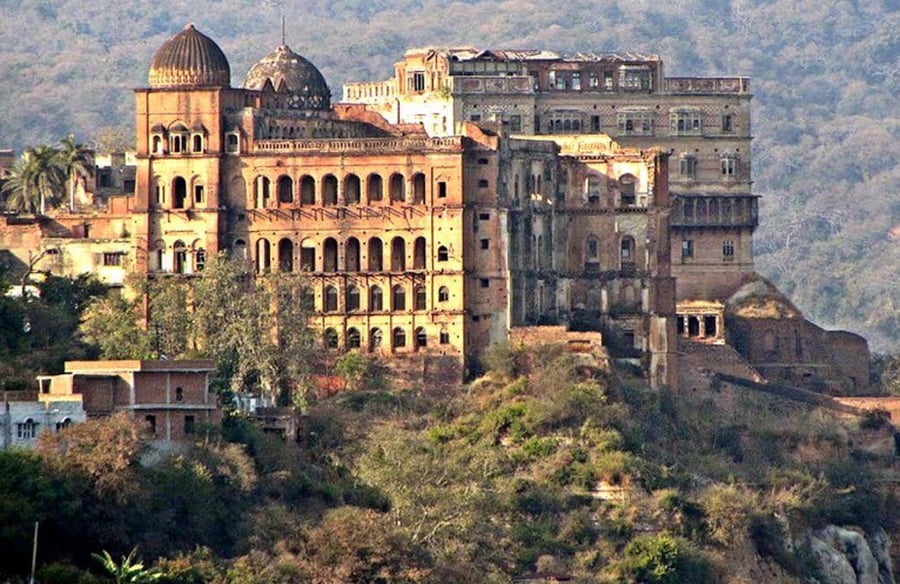
Built in the 18th century by Raja Dhruv Dev, expanded by later Dogra rulers, and abandoned by Maharaja Hari Singh in the 20th century, the Mubarak Mandi Palace, Jammu was not just a royal residence but the cultural heritage of Jammu. Its halls and courtyards hosted numerous events that brought together the people of the region. Despite its historical significance, the palace has suffered from natural disasters and neglect, necessitating immediate restoration efforts to preserve its grandeur for future generations.


Project Location
The Mubarak Mandi complex, a 12.5-acre heritage site, is situated on a hillock in the heart of Jammu city, overlooking the picturesque River Tawi. This royal palace is surrounded by the old Jammu city on all sides except the eastern side, which offers stunning views of the Tawi River and receives ample natural light and ventilation. Mubarak Mandi is easily accessible from major transportation hubs, including Jammu airport (9 km), Railway station (7 km), and Jammu bus stand (4 km).

A Gem of Dogra History
For 200 years, Mubarak Mandi was the center of the Dogra dynasty, which ruled from the Pir Panjal range to Ladakh and the Punjab plains. Construction began in the early 18th century under Raja Dhruv Dev, with expansions by successive rulers, including Raja Ranjit Dev and Gulab Singh. Devastated in 1783, the palace was further developed by Maharaja Ranbir Singh in 1874, who gave it its current form, and Maharaja Pratap Singh added the Rani Charak Palace. By the 20th century, it housed 25 buildings showcasing diverse architectural styles. Although once a center of social action, Mubarak Mandi’s regal period finished in 1925 when Maharaja Hari Singh moved to Hari Niwas Royal residence. Today, only the Dogra Art Museum is open, while the rest of the complex awaits restoration to revive Jammu’s heritage.
Master Planning
The Mubarak Mandi Palace Complex is organized around courtyards, locally known as “Ahattas,” which are categorized into public, semi-public, and private spaces based on their functions. The western section features government buildings and is enclosed by the ancient city, while the eastern side is home to private palaces with terrace gardens overlooking the Tawi River. The architectural layout of the complex is defined by its entrances, or “Deorhis.” External entrances, such as Chowk Chabutra, Panjtirthi, and Pakki Dhakki, connect the complex to the old city, while internal entrances, including Badhi Deorhi, Nikki Deorhi, and Vajra Deorhi, provide access to more private areas.


Major Components of the Master Plan
- The Central Courtyard
There were originally two gates to access the royal complex, but only one remains today. Upon entering, one would find themselves in a central courtyard that once featured a marble royal platform at the height of the Dogra era. The Diwan-e-Aam( King’s public court) was conducted in this courtyard. Maharaja Gulab Singh had commissioned its construction, but unfortunately, none of the original structure survives today.

2. Residential Palaces of Queens
- Rani Charaki Mahal: Built for Maharaja Pratap Singh’s favored queen, this palace sits on the eastern edge overlooking the Tawi River. Its rectangular design blends Rajputana and classical (Greek and Roman) architecture, featuring ornamental carvings, rosettes, jharokhas, and pilasters that add to its grandeur.

- Nawa Mahal: Surrounded by lush gardens, the Rani Kathari’s residence has three levels, a basement, and Art Deco windows. Its terracotta latticework and semicircular design elements stand out.

3. Gol Ghar,
Located on the banks of the River Tawi, the Gol Ghar reflects a blend of Roman and Islamic architectural influences. This five-story circular structure, with its prominent arches and domed roof, showcases Roman design in its form, while the domes bear clear Islamic influences. Despite a fire in 1984 and an earthquake in 2005 that caused extensive damage, the remnants of Gol Ghar still hint at its former grandeur. The structure is fragile, and due to its delicate state, entry into this part of the palace complex is restricted.

4. The Dogra Art Museum,
The Dogra art museum is located in the Pink Hall of Mubarak Mandi Palace, and highlights the cultural heritage of the Dogra dynasty and the regions of Jammu, Kashmir, and Ladakh. Its architecture, featuring five grand arches, adds to its public importance. The museum houses over 7,200 objects, including 18th-century miniature paintings, terracotta heads from Akhnoor, and a golden bow and arrow believed to have belonged to Mughal emperor Shah Jahan. Other exhibits include Dogra costumes, jewelry, armory, sculptures, Persian manuscripts, and a diverse collection of coins, preserving the region’s rich history.

5. The Darbar Hall, or Grey Hall,
The Grey Hall showcases the grandeur with its high ceilings, intricate designs, and a central chandelier. Stylized pillars with floral carvings line the hall, adding to its regal atmosphere. This grand space hosted royal ceremonies, official functions, and king’s cabinet meetings, while also serving as a ballroom, highlighting its dual role in the palace’s social and political life.

6. The Army Headquarters
It features a central clock tower and showcases Victorian architectural influences with carved stone columns, shaded cupolas, and arcades. Its exterior is adorned with late Mughal pebble work, adding distinct flair. Inside, corridors and verandahs served as visitor waiting areas, blending functionality with elaborate design.

Architectural Style Followed
The design of Mubarak Mandi Palace is a fusion of various architectural styles, including Rajputana, European Baroque, Mughal, Victorian, Greek, Roman, and regional influences. Structurally, the palace features three distinct dome types—bulbous, Rajputana, and hemispherical—each adding to its grandeur. Decorative arches highlight long verandas, while Rajputana-style jharokhas (bay windows) enhance the aesthetic appeal. Octagonal pillars and columns offer both structural strength and aesthetic appeal. Decorative elements like intricate motifs adorn pillars, brackets, dome crowns, and gravel stones creating geometric patterns on columns and arches that add artistic grandeur. Mosaic work adds complexity to the walls and floors, while stucco, particularly prominent in the Pink Hall, showcases detailed craftsmanship. Ceilings, decorated with Plaster of Paris and wood, complete the palace’s intricate interior design.


Conservation Struggles Faced
Jammu, despite its role as a transit hub for religious sites like Amarnath Ji and Vaishno Devi, has struggled to fully develop its tourism potential due to poor planning. The successful 2005 Jammu Festival showcased the Mubarak Mandi Palace complex’s potential, but neglect and mismanagement have led to its deterioration. Despite being declared a protected monument in 2005, restoration efforts have been slow and underfunded. The 2019 Master Plan envisioned a vibrant cultural center, but little progress has been made. The Mubarak Mandi Jammu Heritage Society’s recent proposal to convert part of the complex into a heritage hotel has sparked controversy, with critics arguing it undermines conservation goals and disrespects the site’s heritage value.
The Mubarak Mandi Palace complex, once the heart of Dogra royalty and a symbol of Jammu’s architectural and cultural legacy, has unfortunately become a haven for drug peddlers. Despite its captivating blend of architectural styles and historical significance, the palace’s current state of disrepair underscores the urgent need for comprehensive restoration and conservation. Reviving this historic gem is essential, and through adaptive reuse and active community involvement, Mubarak Mandi has the potential to transform into a vibrant cultural hub, fostering tourism and strengthening local engagement in Jammu’s rich heritage.
Sources:
Sharma, A. (2017) Rejuvenating a Space into World Class Environment through Potential Conservation and Energy Saving Techniques. Energy Procedia, Volume 115, pp 70-79 Available at: www.sciencedirect.com (accessed 7 September 2024)
Sahni, S. (2015) Heritage Conservation of Mubarak Mandi Complex, Jammu: Issues and Strategies. SAJTH, Vol 8(2). Available at https://www.researchgate.net ((accessed 7 September 2024)
Kalsotra,A. (2019) Mubarak Mandi Palace: Present State of Conservation and Prospects for Adaptive Reuse .Speaking Archaelogically,Vol2 (1) pp 78-100
https://www.trawell.in/jammu-kashmir/jammu/mubarak-mandi-palace
https://unacademy.com/content/ssc/study-material/general-awareness/mubarak-mandi-place-amar-mahal-palace/
https://waliaharry.wordpress.com/2021/07/17/mubarak-mandi-to-be-developed-as-heritage-hotel/
https://www.thedispatch.in/hotel-in-mubarak-mandi-why-hurt-jammu-sentiments/
https://www.peepultree.world/livehistoryindia/story/monuments/mubarak-mandi-once-jammus-grand-palace?srsltid=AfmBOoobAESAy2EU1sNAfHhbDOKbvSlKFsyXDMwr2dQqdhP6R0pi5TFr
https://waliaharry.wordpress.com/2021/08/08/jinxed-mubarak-mandi-iii-heritage-defenders-turn-desecrators/
https://www.travelogyindia.com/jammu-kashmir/jammu/mubarak-mandi-palace.html
https://www.travelure.in/mubarak-mandi-a-shining-imprint-of-dogra-dynasty-jammu-2/
https://solotraveler.co.in/mubarak-mandi-palace/
https://medium.com/@urshilabhat1501/mubarak-mandi-palace-complex-33cef3161582