Geo coordinates Latitude 21 degrees 13’07.68’’N and Longitude 81 degrees 28’24.43’’ E. The Shiv Temple at Village Deobaloda in Bhilai Charoda, Chhattisgarh, is a revered religious site with deep historical roots dating back to the Kalchuri dynasty in the 14th century AD. This ancient temple serves as a spiritual centre and a testament to the region’s rich cultural and architectural heritage.


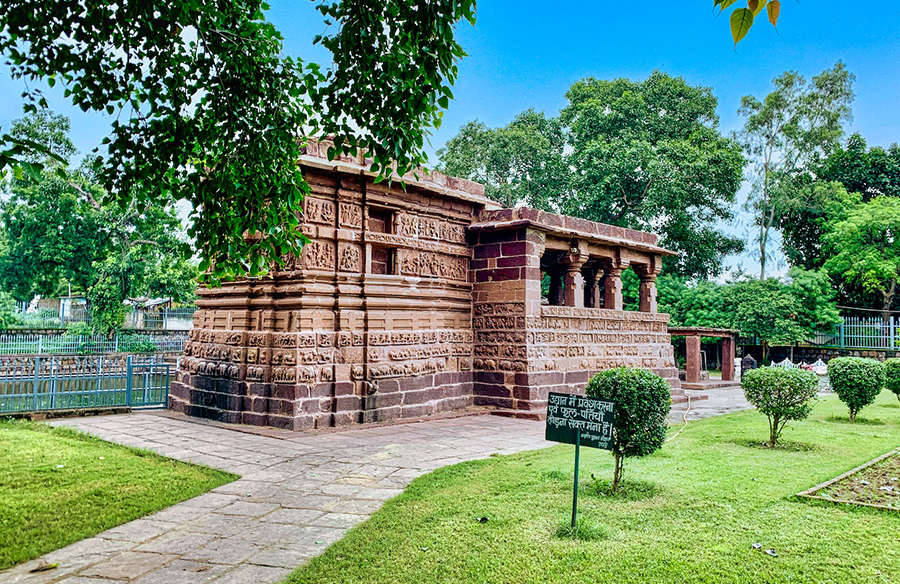
This east-facing edifice built of sandstone survives with Garbhagriha and a pillared Navaranga mandapa. The Sikhara is missing which was probably in Nagara style. The Garbhagriha houses a Siva linga and is approached through a highly ornate door entrance guarded by Saiva Dwarpalas accompanied by attendants. Ganesha is depicted on the Lalatabimba. The Mandapa pillars are adorned with images of Bhairava, Vishnu, Mahisasuramardhini, Tripurantaka Siva, Venu Gopala, Musicians, dancers, Keertimukha designs etc. On-site, the historic Shiv Temple stands at the centre, flanked by a traditional Baori (water Kund) that adds to the temple’s serene ambience. Adjacent to it is a smaller shrine adorned with sculptures of various gods and goddesses, enhancing the spiritual atmosphere and reflecting diverse aspects of Hindu mythology.

The exterior Adhisthana portion of the temple bears the decorative hand of Gaja, Asva and Nara.


The Bhitti portion has two decorative segments, adorned with images of Tripurantaka Siva, Narasimha, Nrvaraha, Parvati, Radha-Krishna, Ganesh, Mahisasuramardhini, Laxmi, Trvikrama, Venu Gopal, Kesivadh etc.


Social and Political Importance of Royal Heritage
The Shiv Temple in Deobaloda is a noteworthy representation of royal lineage that highlights the Kalchuri dynasty’s impact on society and politics. As a result of royal patronage, this temple embodies the architectural skill and religious fervour of the time and is essential to bringing communities together around a common cultural identity. The temple’s centuries-long maintenance emphasises how crucial it was as a political instrument that bolstered the dynasty’s authority and influence. It still acts as a symbol of the area’s glorious past, preserving the local people’s sense of pride and identity and strengthening the community via shared customs and history. The temple serves as a link between the past and present while highlighting the ongoing importance of legacy in forming social and political identities.
A Timeless Cultural Heritage
This temple, which dates back to the 14th century AD, has long been an important religious and cultural icon in the area. Historically, the temple functioned as a hub for communal events and a place of worship. This temple was built by the Kalchuri dynasty, who were renowned for their support of art and architecture, as a sign of their adoration for Lord Shiva and an assertion of their supremacy over the political and cultural spheres. Historians and believers alike are enthralled by the temple’s elaborate carvings and stones, which showcase the artistic brilliance of the time.
The Shiv Temple in Deobaloda has developed into a popular tourist destination today, bringing in visitors from all over the nation. For those interested in learning more about Chhattisgarh’s rich history, this location is a must-visit due to its historical and cultural significance. Thousands of devotees congregate at the temple on Maha Shivaratri to participate in rituals and festivities that preserve the temple’s age-old customs.

The temple, which is recognized as a cultural heritage site, is essential to the development of tourism in the area in addition to maintaining historical religious and architectural practices. As a symbol of the historical significance of the area, the Shiv Temple in Deobaloda bridges the gap between the ancient and modern worlds by inspiring awe and reverence.
What impact does this structure have on the urban fabric?
Being an old building, it blends the old and the new, providing a sense of continuity among urban change. The temple’s presence affects how the city is organised spatially, with the surrounding areas growing into a blend of residential, business, and religious zones. It is a cultural monument that draws tourists, stimulating the local economy in the process. The temple also promotes social cohesiveness by offering a common area for religious and cultural events that deepen links within the community.
What particular style was it built in and how is it relevant to the era it was constructed in?
The Shiv Temple in Deobaloda was constructed in the Nagara architectural style, which is distinguished by its elaborate stone carvings and Shikhara. This style, which is popular in North India, is characterised by a strong vertical emphasis, with the Shikhara of the temple towering over the sanctum sanctorum that is not completed yet. According to local people, the main architect or worker of this temple was missed one day due to some reason and after that night no one completed the Sikhara of the temple. During the Kalchuri dynasty (14th century), the Nagara style was especially significant since it represented the period’s accomplishments in both architecture and spirituality.

The vast creative and cultural diversity of the era is shown by the elaborate carvings on the temple walls, which feature a variety of deities and mythological scenarios. The temple’s incorporation into the surrounding terrain and use of locally accessible stone show how deeply connected the Kalchuri monarchs were to their surroundings and how much they wanted to build enduring spiritual monuments.


What historical importance does it hold?
In terms of history, the temple represents the pinnacle of Nagara-style construction, which is distinguished by its unique incomplete shikhara and intricate carvings. During the Kalchuri era, this architectural style played a crucial role in maintaining regional identity and cultural continuity. A variety of gods and mythological situations are shown in the temple’s sculptures, which shed light on the period’s artistic and religious customs.
Furthermore, the Shiv Temple at Deobaloda has supported social cohesiveness and continuity for centuries by acting as a hub for the neighbourhood. Because of its preservation, there is a physical link to the past that helps to understand the story of the Kalchuri dynasty and Chhattisgarh’s larger cultural legacy. The temple’s continued status as a destination for pilgrims demonstrates its enduring historical and cultural relevance even more.
Conclusion

In summary, the Shiv Temple at Deobaloda is a timeless relic that connects the past and present and provides a wealth of knowledge about the spiritual, cultural, and architectural legacy of the Kalchuri dynasty. Its continued existence in Bhilai Charoda serves as an essential cultural anchor for the locals as well as highlighting the historical significance of the area. The temple is a beloved landmark due to its elaborate Nagara-style construction and extensive historical background, which continue to arouse wonder and veneration. The Shiv Temple in Deobaloda is a historical gem and a spiritual sanctuary that bears witness to the lasting influence of Chhattisgarh’s royal lineage. It invites future generations to learn more about this legacy and its significant influence on the identity of the region.
Citation:
Book-
- Patel, R. (2023). Temples of Chhattisgarh: An Architectural and Historical Study. 2nd ed. Heritage Publishers, Raipur, pp. 45-48.
Article-
- Singh, A. (2022). The Architectural Heritage of the Kalchuri Dynasty: A Case Study of Shiv Temple, Deobaloda. Journal of South Asian Architecture, 14(3), pp. 112-120.
Website-
- Archaeological Survey of India. (2024). Shiv Temple, Deobaloda: A Cultural Landmark. ASI Heritage Portal. Available at: https://www.asi.gov.in/shiv-temple-deobaloda