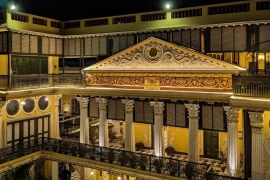
Death is considered eerie and frightening. Yet, when you step into Cimitero Monumentale, one of Milan’s largest cemeteries, you experience a quiet peace. The cemetery boldly and beautifully honours the dead, compelling one to reflect on the true meaning of life.
Home to roughly 220,000 burials across 25 hectares, Cimitero Monumentale (Monumental cemetery) is ornamented with a wide range of contemporary and classical Italian sculptures as well as Greek temples, elaborate obelisks, and other original works. It’s an exquisite exhibit of storytelling, with each gravestone telling a person’s memory, their family’s story, or stories from the religious scriptures immortalised in stone.
Historical Context
Back in the day, Milan was facing a serious health issue because of its small cemeteries getting too crowded. In addition to that, Milan, having become a capital during the Napoleonic and Austrian times, needed to upgrade its infrastructure in line with its new status. So, the Italian Municipality decided to hold a competition to build a new, bigger cemetery outside the city. This competition went on for almost 40 years, from 1837 to 1863. Finally, in 1863, Carlo Maciachini, an apprentice carpenter turned architecture student, won. Soon after the construction of the cemetery started, it finally opened on 2nd November 1866.
Architectural Plan
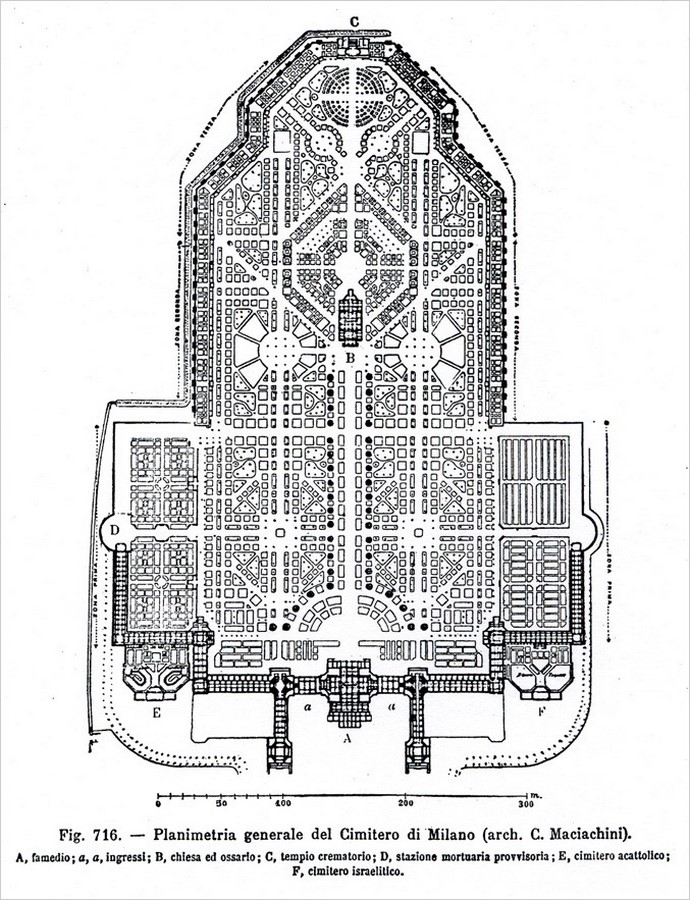
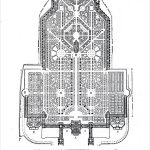
Axial plan
All major elements of the cemetery are built along a single linear axis. The entrance leads to the Famedio (hall-of-fame building), then followed by the Ossario Centrale (the space for relocated remains after burial leases expire or graves are reused) and finally leading to the Tempio Crematorio (crematorium), which is located at the end of the cemetery.
Zoning Systems as a design tool
Carlo Maciachini used bilateral symmetry and a zoning system that divides the cemetery into a central catholic area, which is the largest zone on the main axis, the non-Catholic area to one side, and the Jewish area to the other. Tombs in the main Catholic area are organized in a radial pattern.
Vertical burials
In addition to the ground burials, the cemetery also has loculi, which are coffin-size niches embedded directly into massive walls and covered by a marble stone, stacked and placed in the walls of the corridors of loculi galleries. Using vertical space as well as horizontal space for burials within the walls of the structure was a way of saving space.
Design Philosophy
This cemetery is a unique amalgamation of Romanesque architecture from Lombardy, Italy, mixed with Gothic style elements of Pisa, adorned with Byzantine details, and also includes Neoclassical, Art Nouveau, and Rationalist architecture. Each tombstone is unique since families commissioned them according to their personal preferences. Each one is a permanent expression of love rather than a symbol of loss.
The artistic trends vary depending on where in the cemetery one finds oneself. Older parts are classical or neo-Gothic; these include angels, columns, and triangular pediments taken from Greco-Roman temples. The newest parts embrace Art Nouveau and then transition to geometric Rationalist architecture of the 20th century.
Materials and Construction
This cemetery consists of a wide range of over 40 types of marble and granite, brick, and stone, which were taken from different areas of northern Italy. It is also famous for its unique use of bronze sculptures, metal work, stained glass, mosaics, and carved stones.
One of the reasons why Maciachini’s design won instead of the others was the fact that the project could be constructed in phases over time without requiring all the money at once. This allowed for a natural development of the cemetery for approximately 150 years.
Famous Tombs and Monuments
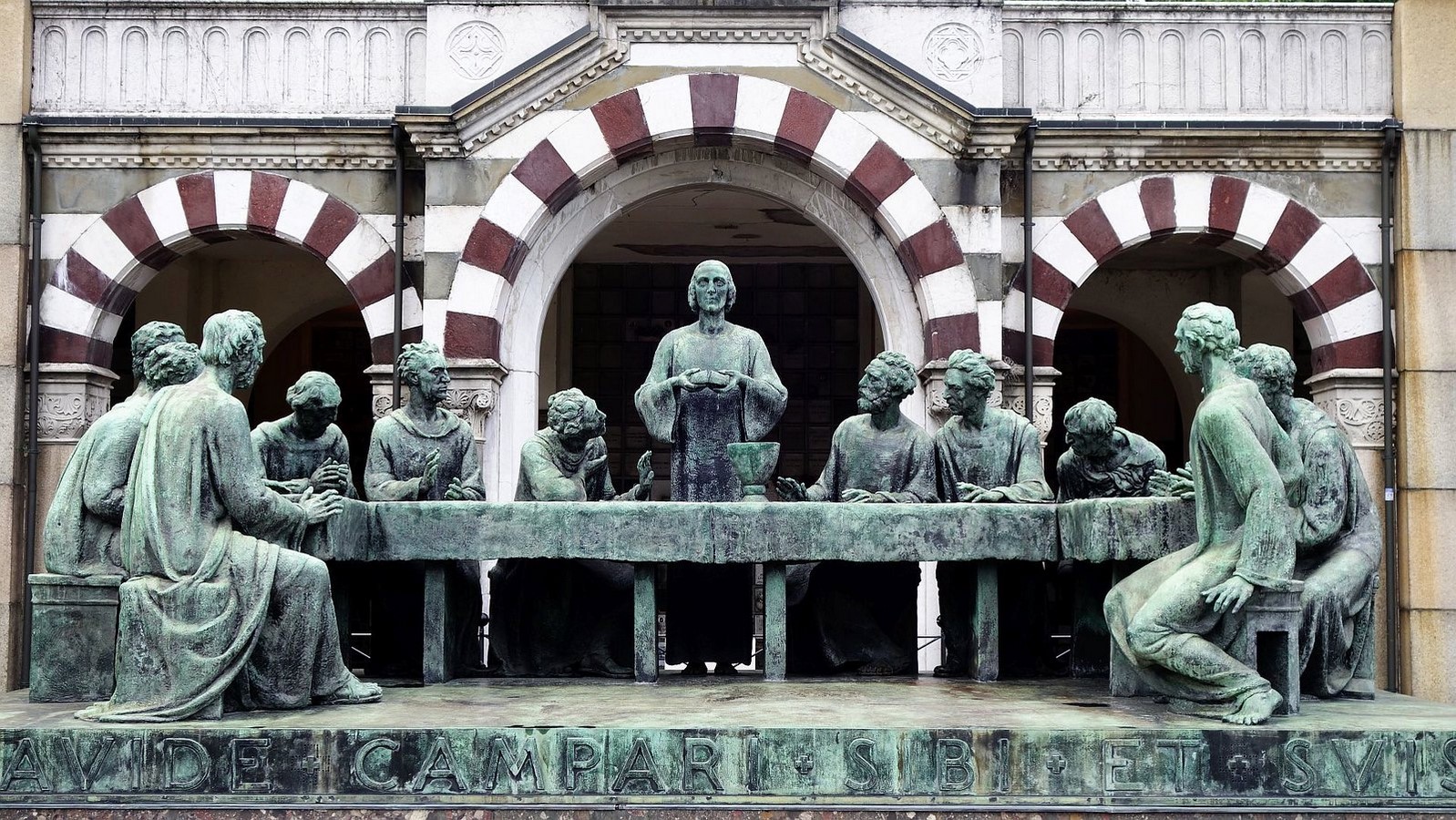
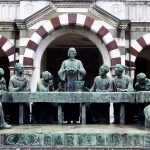
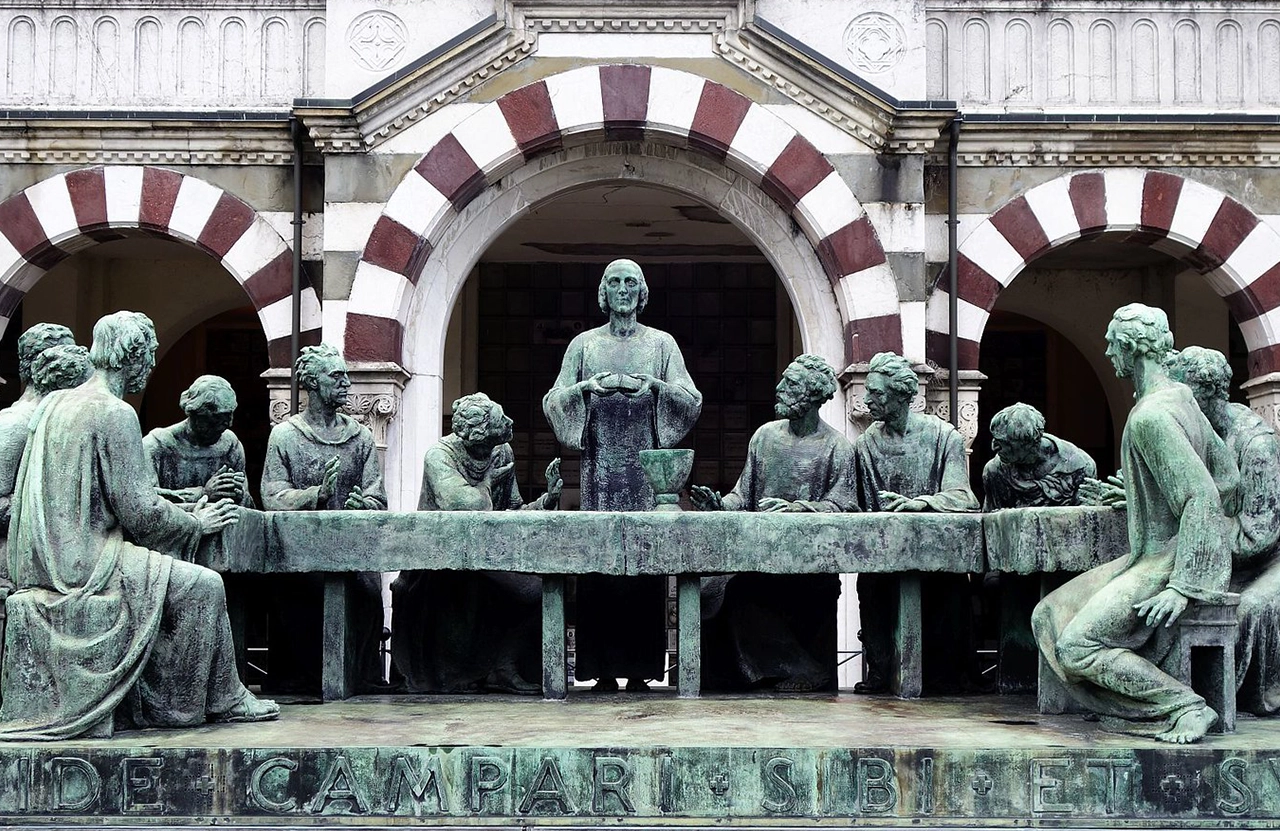
One very famous tombstone is of the Campari family; it’s a sculpture of the Last Supper.
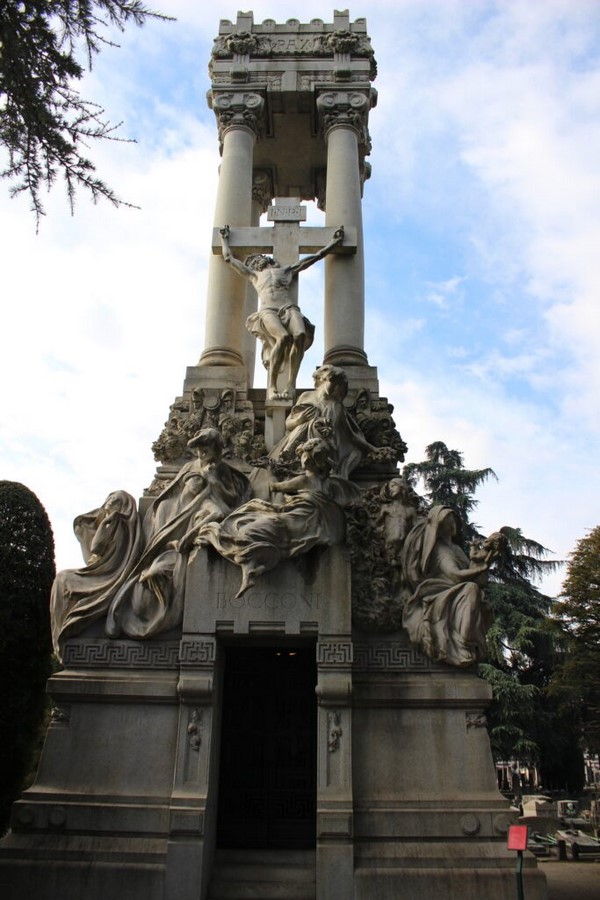
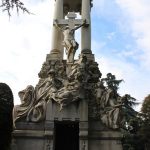
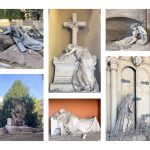
Another famous monument is the tomb of the Bocconi Family; it is richly decorated with a large crucified Christ, and surrounding it are five angelic figures representing Hope, Sorrow, Motherhood, Resignation, and Religion, all carved in the Italian Art Nouveau style.
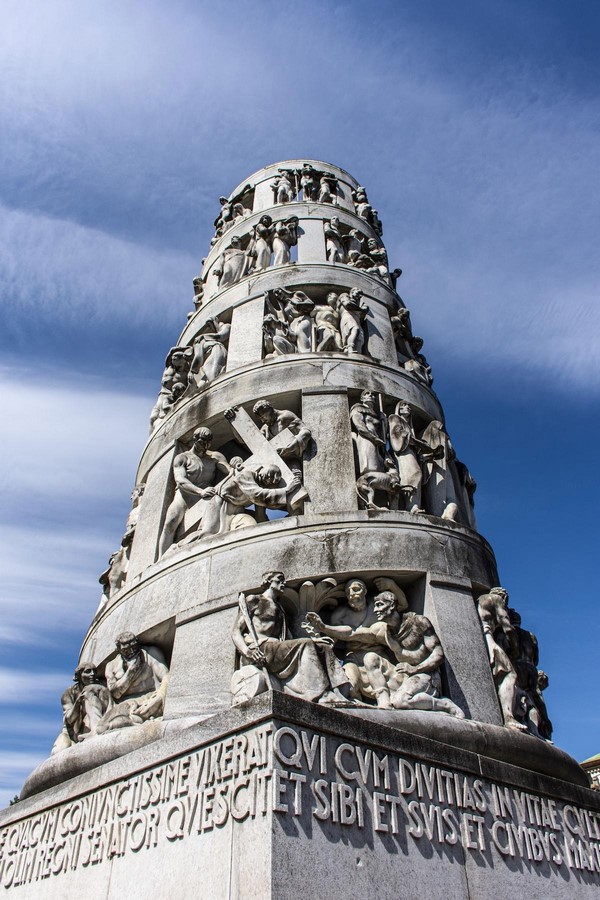
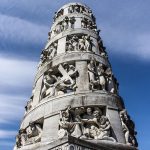
The Bernocchi monument depicts Christ’s path to crucifixion told across 110 carved marble panels stacked in a spiraling tower, using suffering-to-resurrection as its central story: grief transformed into triumph over death.
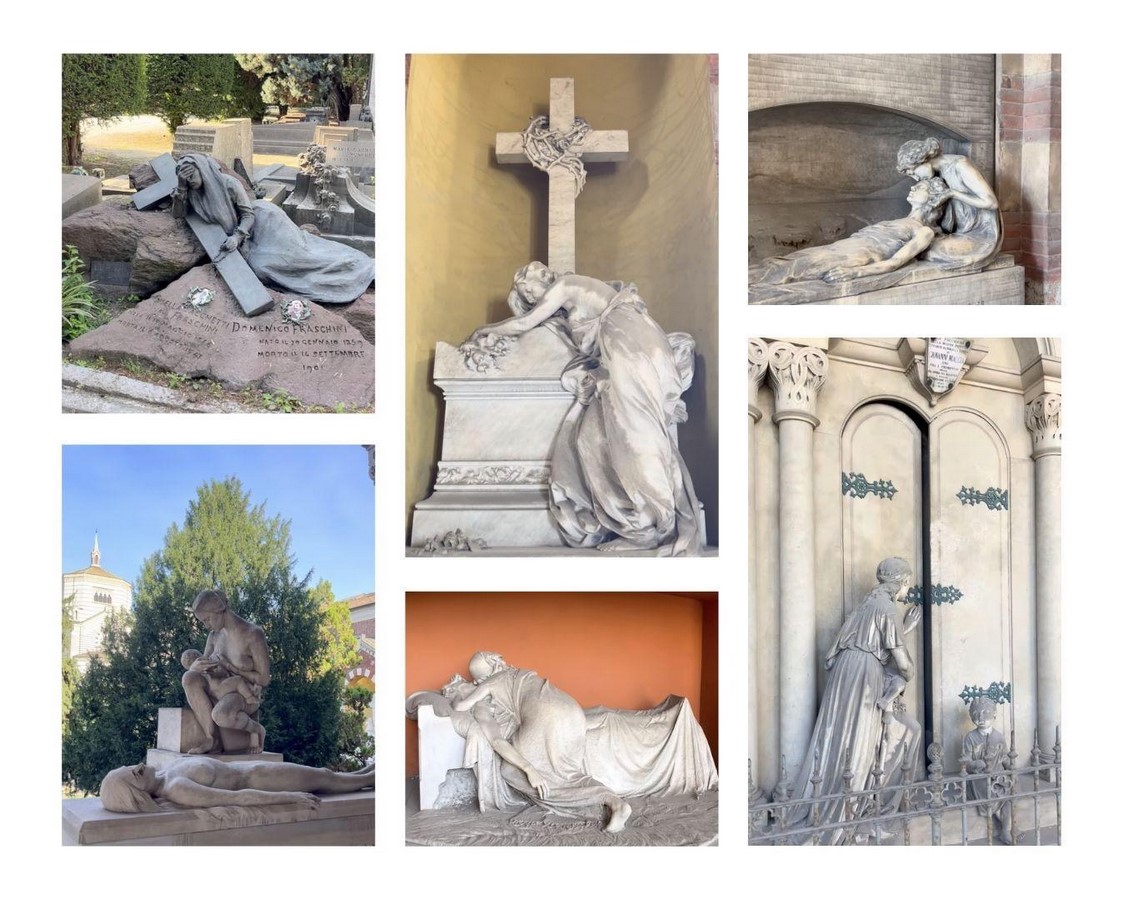
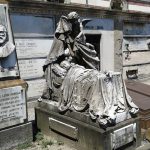
A woman collapsed against a cross. A mother feeding her child, small and still, in her arms. Another woman holding her own child, reaching toward a door that will never open again. A lover, kissing the one they’ve lost one last time.
You don’t need to know a single name carved into that marble to feel something. Standing in front of a stranger’s tomb, you find yourself grieving anyway, because the ache being carved isn’t really about who died. It’s about what it feels like to lose someone.
Social and political relevance
The Cimitero Monumentale was built with a democratic intention. When it opened in 1866, Milan’s municipal authorities called it a cemetery for “every form and every fortune” meant to bury Milanese of all social classes in one shared place.
What actually happened was pretty much the opposite of what was planned. In Milan, it was common for wealthy families to purchase burial plots in advance, often for the entire family at once. This practice was a luxury only the rich could afford, making burials a significant indicator of a family’s social standing and influence during a particular period. The affluent families of Milan, like the Campari, Falck, Bocconi, and Brambilla families, hired the best sculptors and architects to create elaborate monuments. Each family tried to outdo the others, and people even had a saying about ithere is a saying in Italy: “A pew in the Duomo, a box at La Scala, a tomb at the Monumentale” – this meant you had really made it in Milan’s high society. It was like a competition to see who could build the most impressive tomb. By examining the burial sites, you can instantly gauge who held the most power and wealth in Milan at any given time, offering a fascinating glimpse into the city’s historical hierarchy. The fact that only the affluent could secure these plots underscores the importance of burials as a reflection of Milan’s complex social landscape.
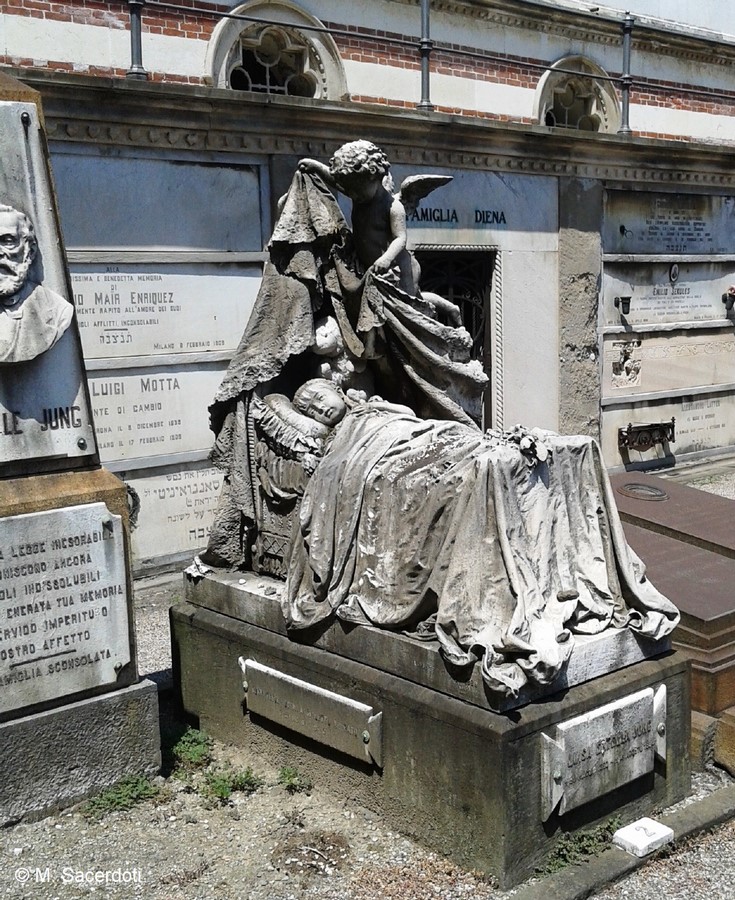
Keeping that aside, the cemetery did carry through on one genuinely progressive commitment: it included dedicated non-Catholic and Jewish sections, physically separate but built within the same unified masterplan. The Monumentale also holds a memorial to roughly 800 Milanese killed in Nazi concentration camps.
Considering all this, Cimitero Monumentale is so much more than a cemetery. It is an open-air exhibition. It’s about how the dead are honoured and remembered. A visit here is something visitors carry with them for a long time; surrounded by so many monumental tombs, one can’t help but feel how small one’s own worries really are. It leaves visitors with a quiet sense of how fully, and how deliberately, each day deserves to be lived.
References:
Fiocchi, F. (n.d.). The Bernocchi family monument [Photograph]. Art&Object. Available at: https://www.artandobject.com
Jain, N. (2025). [Untitled photograph, Cimitero Monumentale] [Photograph].
Monumental Cemetery Milan (n.d.). Bocconi family tomb, Cimitero Monumentale di Milano [Photograph]. Available at: https://www.monumentale.eu
Saxerdoti, M. (2018). Jewish Section [Photograph]. Flickr. Available at: https://www.visitjewishitaly.it
D’Anjou, B. (2018). The Last Aperitivo Campari Family Tomb [Photograph]. Flickr.
Introducing Milan (2026). Cimitero Monumentale. Available at: https://www.introducingmilan.com/cimitero-monumentale
Visit Jewish Italy (n.d.). Milan Monumental Cemetery: The Jewish Section. Available at: https://www.visitjewishitaly.it/en/listing/milan-monumental-cemetery-the-jewish-section/
Wikipedia (n.d.). Cimitero Monumentale di Milano. Available at: https://en.wikipedia.org/wiki/Cimitero_Monumentale_di_Milano
Grimm Life Collective (2023). We Visit a Haunting Cemetery in Milan – Cimitero Monumentale di Milano [Video]. YouTube. Available at: https://youtu.be/jCiPGe2uWYg