Gingee Fort (Senji Fort), is an unfamiliar fortification belonging to the Villupuram district of Tamil Nadu. In 1921, the fort was declared a national monument. It was given titles such as “The Most Impregnable Fortress” by the Maratha King, Shivaji, and “Troy of the East” by the British. Given its historical significance and striking architecture, the fort has been included in the preliminary UNESCO World Heritage Site list. The fort has been mentioned in numerous Tamil epics and historical records.
Origin:
Mysteries and stories surround Gingee’s early years. Formerly it was constructed by Anandakonar Rajagiri around 1190 AD and then reinforced by Krishna Kon, it was further rebuilt in the 13th century to elevate it to the position of an unbreakable fortress to safeguard the town of Gingee. Throughout its history, it has been governed by various notable political forces, beginning with the Cholas followed by the Vijayanagar Nayaks, the Bijapur Sultans, the Mughals, the Marathas, the Carnatic Nawabs the French, and finally the English.

Construction.
Since Gingee Fort had been under the rule of various monarchs, the architecture reflects the Indian, French, and Dutch styles. It has been primarily made of granite stones and lime mortar. The Gingee Fort complex is spread across three mountains, forming a rough triangle: Krishna Giri to the north, Rajagiri to the west, and Chandrayandurg to the southeast. Although the three hills are taken as a whole to form a fort complex, each mountain has its independent citadel with walls surrounded by a moat. The fort was constructed strategically to repel any troops that could invade Gingee City.
Fortifications and their Importance.
Raja Giri.
The primary fort is on the first hill, Raja Giri (also known as Ananda Giri or Kamala Giri). It is approximately 800 feet (240 metres) high. The mountain is reachable by a guarded route. One of the hill’s most notable characteristics is the 60-foot-deep gap that divides it from the surroundings. A wooden bridge spans this wide crack, controlling access to the slope.
There are seven gates to cross to get to the fortress. Beyond the royal residences, this fortress houses significant structures like public meeting rooms, stables, granaries, temples, mosques, shrines, and pavilions.
A castle and the now-empty shrine of Ranganatha’s temple are located atop the peak along with a bell tower, watch tower, cannon, and drawbridge. The goddess Kamalakanni’s shrine, which is said to be older than the fort, is located on the route that leads up to the hill. The deity Senji has another shrine.
Arcot Gate, Pondicherry Gate, the Prison atop Pondicherry Gate, the Royal Battery, Venkataramanaswami Temple, Pattabhi Ramaswami Temple, Sadatulla Khan’s mosque, and a tank named Anaikulam, known as Elephant tank because it was rumoured to have been used for bathing elephants, are all part of the lower fort. To the west of the Elephant tank are two other tanks, Chakrakulam and Chettikulam.
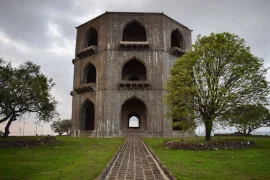
Architecturally considered a gem, one of the most important buildings in the Inner Fort region is the Kalyana Mahal (marriage hall). This building is made of an eight-story, elegant tower-like structure with a pyramid-shaped peak, or shikhara. The Fort complex’s plentiful water supply is one of its most noteworthy features.

Krishna Giri.
Considering strategic importance, the second significant hill with a magnificent fortress is Krishna Giri, which comes after Rajagiri. It’s also known as the English Mountain after the British briefly occupied the Fort. The KrishnaGiri Fort is smaller and lower than the Rajagiri Fort. A flight of granite stone steps leads up to the mountaintop.
This hill’s constructions show signs of Indo-Islamic architecture, particularly in one building assumed as the king’s audience hall. The construction is open on all sides, with a domed top and elegantly carved arches.
Chakkiliya Durg.
Chandrayan Durg, also known as Chandragiri or St. George’s Mountain, is another fort that is connected to Rajagiri by a short rocky ridge, which the Chamar warriors utilised. The Fort has very little military or strategic significance, although it does include some intriguing structures from a later era.

Socio-political, Historical and Cultural Influence.
The fort has Cholas, Bijapur Sultans, Marathas, Nawabs, Mughals, and French and British imprints. This illustrates the vast range of cultural transformations the now-ruined fortress has undergone.
In northern Tamil Nadu, it served as the headquarters for the local administrators and governors to manage the surrounding areas. The elaborate design of the fort served as a shield for several empires, including the Mughal, Vijayanagar, and Maratha empires, and functioned as a focal point for resistance to British colonial rule. Freedom fighters like Tipu Sultan and Marudhu Pandiyar used it as a base during wars. It served as a place to keep money and weaponry. The Fort operated as a prison for criminals and political offenders.
Within the Fort were several mosques and temples that addressed the people’s devotion to God. The ruling class and their family lived in the Fort. The Battle of Gingee (1750) and the Siege of Gingee (1761) are two notable wars that took place at the Fort.
The Gingee Fort Festival and the Chenjamman Temple Festival are two examples of the cultural events and festivals held in the Fort. The inscriptions and sculptures provide a cultural background to the city. Traditional arts and crafts, including stone cutting, sculpture, and building, are displayed at the fort complex. Gingee Fort, which preserves historical traditions and practices, is a monument to the area’s rich cultural legacy. The fort’s cultural value and appeal are increased by the numerous folktales and stories connected to it. For the people of Tamil Nadu and India, the fort represents pride in their cultural identity.

Impact on the Urban Fabric.
In recognition of the Gingee Fort’s importance, tourist attractions including galleries, museums, and performance venues have advanced. The rehabilitation of the urban fabric has been aided by the fort’s inspiration for a resurgence of interest in regional customs, culture, and the arts. It has brought antique and contemporary buildings into perfect harmony. Gingee Fort’s contributions to the tourist, hospitality, and other sectors have created jobs and boosted the local economy.
The infrastructure and the rate of urbanisation have grown significantly.
Gingee Fort has become a symbol of community pride, fostering engagement and involvement in cultural preservation efforts.
References:
- Wikipedia (2024). Gingee Fort [Online]Available at: https://en.wikipedia.org/wiki/Gingee_Fort [Accessed July 18, 2024]
- The Formidable Gingee Fort | INDIAN CULTURE. INDIAN CULTURE Discover, Learn, immerse, Connect [Online]Available at: https://nvli.in/node/2637478#:~:text=Gingee%20was%20finally%20captured%20in,the%20fort%20on%20his%20behalf. Accessed July 17, 2024]
- The News Minute (2016). Photo essay: The Gingee Fort- one of south India’s most magnificent citadels [Online] Available at: https://www.thenewsminute.com/features/photo-essay-gingee-fort-one-south-india-s-most-magnificent-citadels-40508 [Accessed July 19, 2024]
- PeepulTree (2019). Gingee Fort: ‘Troy of the East’ [Online]Available at: https://www.peepultree.world/livehistoryindia/story/monuments/gingee-fort-troy-of-the-east [Accessed July 18, 2024]
- Leverage Edu (2024). Gingee Fort History: Features, Facts, Timings & More [Online]Available at: https://leverageedu.com/discover/general-knowledge/indian-history-gingee-fort-history/ [Accessed July 17, 2024]
- Doordarshan National (2014). Forts Of India – Gingee Fort, Tamil Nadu – Ep#10 [YouTube Video]Available at: https://www.youtube.com/watch?v=SWS2e1TENxg [Accessed July 17,2024]