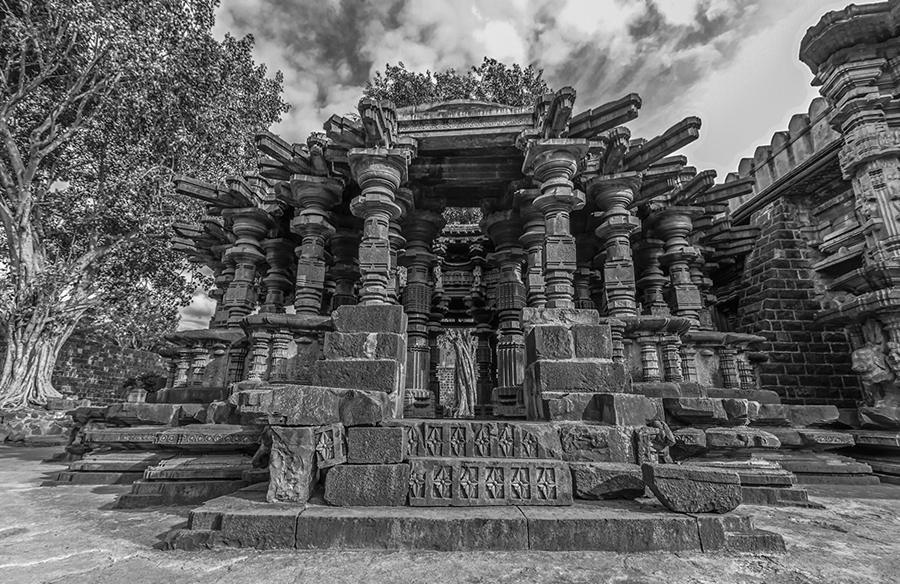
Located in a small village of Kolhapur District, Khidrapur (16° 40’N and 74° 35’N) lies a temple celebrated as the ‘Khajuraho of Maharashtra’, the Kopeshwar temple. Khidrapur, known as Koppan in ancient times, is a small village on the river Krishna’s bank. The river takes a horse-shoe turn (nalakar) at Khidrapur, giving the village its religious importance, thus becoming an ideal location for constructing a temple. [1]


The Kopeshwar temple is a Hindu temple which is dedicated to Lord Shiva It is believed the construction of the Kopeshwar temple began somewhere around the 7th century AD. However, due to constant skirmishes between rulers of the region, its work remained incomplete. It was completed by the 12th century by Silhara ruler Gandarditya and Yadava Kings. [2]
The temple is one of the most remarkable examples of the Bhumija-style architecture. In early mediaeval India, the Bhumija style was extensively in trend and had reached up to Gujrat, Rajasthan, Maharashtra, and some major temple complexes of Southern and Eastern India, even though it originated in Malwa. Bhumija style is a variation of Nagara and means ‘earth-born’ or ‘country-born’. The style is known for creating a visual effect or impression that the structure has arisen out of Earth. This type of temple consists of Antrala, Gudhamandapa, Mahamahdapa, Sabhamandapa and Grabhagriha. The most notable feature of the Bhumija style is the star-shaped plan that is created by a square being rotated on its central axis and stopped at regular intervals. Combined with richly ornamented wall faces and pillars. It is common to see triple-shrined temples and always have a Sabhamandapa (common hall). [1]

The Kopeshwar temple consists of four parts. Swargamandapa (hall of heavens), Sabhamandapa (conference hall), Antarala-kaksha also known as Antarala (Vestibule), and Garbhagruha (Sanctum Sanctorum).

The Swargamandapa is the dedicated entrance to the temple though the temple can be entered through the Sabhamandapa as well. The Swargamandapa is circular and is supported by 48 intricately carved stone pillars placed in 3 concentric circles. Each of the 48 pillars is carved in different spades from top to bottom (round, square, hexagonal & octagonal).

A circular cutout in the ceiling of the Swargamandapa gives the temple its distinct look. This cutout is referred to as Bramharandhra and it symbolises the cosmic axis of the universe or the door to the heavens. It is said that the opening was probably to let out the smoke formed during yagnas. [1][3]


The Sabhamandapa or conference hall can be entered through the Swargamandapa and it has other two entrances from the Northern and Southern sides. It is square in form and 60 intricately carved pillars support its weight. Antrala-kaksha or vestibule is square in plan as well and it is closed from sides leaving open only a path between the Sabhamandapa and Grabhagriha. The Garbhagriha or Sanctum is conical in form with a square plan and a sense of peace prevails in its cool interiors. [1]
The exterior of the temple is heavily carved. The Adhistana (plinth) has Gaja Patta (elephant strip), they are 92 in number and symbolise the carrying weight of the structure, and one is different from the other. Various deities are carved straddling them and these elephants are adorned with ornaments The band above it is Nara Patta (strip of men) which has statues of dancers, and enticers. Few Persian travellers are also seen in this strip as the trade flourished during this period with Persia and Iran. These statues have different expressions on their faces, some being very expressive and even clothes are seen to be carved out beautifully. The walls are richly ornamented with various animals (bull, horse, boar, monkey, tiger, etc), birds (swans, peacocks), reptiles (snakes, crocodiles), fruits (grapes, bananas, sugarcanes), and flowers (lotus). The original shrine of the temple is no longer present and a modern-day version constructed with bricks can be seen.[3]


The temple is constructed in black stone, which is not found anywhere in the vicinity of the location, and is said to be transported from Southern India using the Krishna River as a water channel. [3] The Kopeshwar temple also shows influences from various regional styles from its time of construction such as Yadava, Hoyasala, Solanki, Calukya, and Kadamba. Yet it is celebrated as one of the greatest Bhumija-style temples.

Centuries ago many artists and architects came together to create poetry on the black stone but later, so much of the structure was mutilated by Islamic invaders yet its grandeur can still be experienced. [3] Efforts for the preservation and protection of the structure are underway to ensure that its architecture and cultural heritage are endured for future generations.
Citations:
- Harad, P. (n.d.). Art and Architecture of Kopeśvara Temple at Khidrāpur. www.academia.edu. [online] Available at: https://www.academia.edu/50068257/Art_and_Architecture_of_Kope%C5%9Bvara_Temple_at_Khidr%C4%81pur [Accessed 26 May 2024].
- Wikipedia. (2024). Kopeshwar Temple. [online] Available at: https://en.wikipedia.org/wiki/Kopeshwar_Temple#:~:text=Kopeshwar%20Temple%20is%20at%20Khidrapur [Accessed 26 May 2024].
- Story at Every Corner. (2019). Experience Poetry in Stone at Kopeshwar temple – All You Need to Know. [online] Available at: https://storyateverycorner.com/khidrapur-kopeshwar-temple-places-to-visit-near-kohlapur/#:~:text=A%20long%20war%20with%20the [Accessed 26 May 2024].