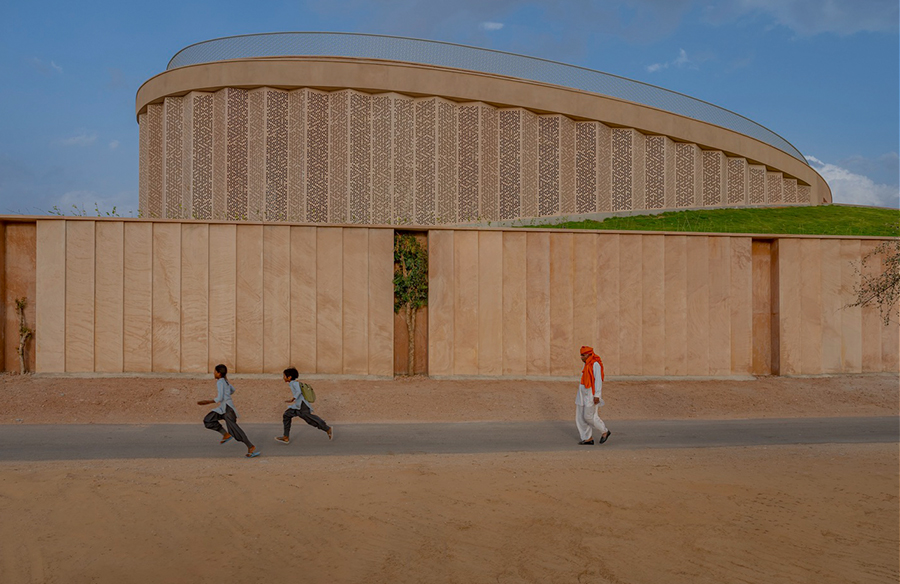
Picture an alluring and sweeping curvilinear form arising amidst barren desert land. It is a sight to behold and this is exactly something you’d stumble upon at Nokha, a rural district in Rajasthan, India that encompasses 144 villages. This community center built by one of the leading architects of India, Sanjay Puri is a structure you’d not want to miss the next time you are in Rajasthan.
The Nokha community center is envisioned to be a hub for people from all walks of life, a space to engage, interact, gather, and foster new connections. An extremely thoughtful design that takes care of sustainability aspects while also having a human-centric point of view attached to it for the users to commute better and have a hassle-free experience.

The client brief was quite simple, it was conceived as a memorial for the client’s father, Padmaraji Kularia. The community center has a built-up area of 9000 sq ft (810sqm) that is spiraled so that it seems inviting and dynamic to the eye. An engaging space was to be created filled with nothing but life and learning. Since a lot of spaces like library and museum were inaccessible to the villagers, the community center wanted to accommodate and cater to these spaces as well to help in the general well being of the people especially the children of Nokha.
The smooth curve rising throughout also makes it easier to be perceived by the user and hence allows a better experience. This sloping roof rises from the northeastern corner and goes in hand with the airflow pattern that allows for a naturally ventilated space. The idea was to create a north-facing open courtyard to help beat harsh solar radiation as well. Courtyards are also a traditional Indian element present in homes to create a stack effect and make the space cooler. This space is also a great spot for community gatherings and interactions.

Coming to the 9000 sq ft roof, the rooftop gardens are a great addition that helps reduce heat gain by the built structure hence reducing the energy load on the building making it far more energy efficient. The roof garden is a recreational zone that also provides views of the desert landscape. This rooftop blends beautifully with the structure and also provides a focal point while acting like a drop of freshness amidst the deserted landscape. Rainwater harvesting to harness the precious drops of water and a recycling system is also well integrated in the roof planes to help add more value to the sustainability levels of the building.

A small museum is located on the lower eastern side while a library is located on the western end right below the earth berm structure. Since libraries aren’t present nearby, this center becomes an excellent space to invite more people into the vibrant hub and engage and interact with the space The spaces have the provision of fenestrations on the upper end of the wall to help capture more daylight and increase daylight harvesting. It is well-sheathed in natural sandstone screens a vernacular element used in the construction industry in Rajasthan that also is well perforated to allow the flow of breeze. The stone is sourced locally from the immediate surroundings and is well crafted by the local craftsman.

The screens are a great addition as they also form alluring patterns throughout the day due to the movement of the sun creating intriguing patterns and engaging the users of the space. The smaller perforations replicating jaali work, one of the most used elements in traditional Indian architecture, give rise to a cooler breeze making the space cooler and more usable.

Along with the museum and library, the provision of the cafeteria, bathrooms, parking, and storage makes the community center more functional and user-friendly.
Sanjay Puri’s team has beautifully captured and created a community for the people of Nokha. A space that showcases the true essence of the region and makes it viable and accessible to every person. The design of the building was well thought with attention given to the sustainability aspects and making it more user-friendly. Not to forget the local craftsmen, laborers, and builders who crafted and carved out the space in such a way that this community center stands strong and true to its purpose. The vernacular style has helped decrease the energy demands and consumption on the building while also making it quite responsive to the extreme desert climatic conditions. The people of Nokha are living proof of how architecture could create more connections and help foster more talent within people of all age groups. Creating engaging and interactive spaces while having a cultural point of view has made this beautiful community center a successful story.

References:
1.amazingarchitecture.com. (n.d.). Community Center | AmazingArchitecture. [online] Available at: https://amazingarchitecture.com/community-center
- ArchDaily. (2018). Community Center architecture and design | ArchDaily. [online] Available at: https://www.archdaily.com/search/projects/categories/community-center.
3. Dezeen. (2024). Sanjay Puri Architects completes spiral community center informed by dunes. [online] Available at: https://www.dezeen.com/2024/03/29/nokha-village-community-centre-sanjay-puri-architects-india/ [Accessed 1 Apr. 2024].