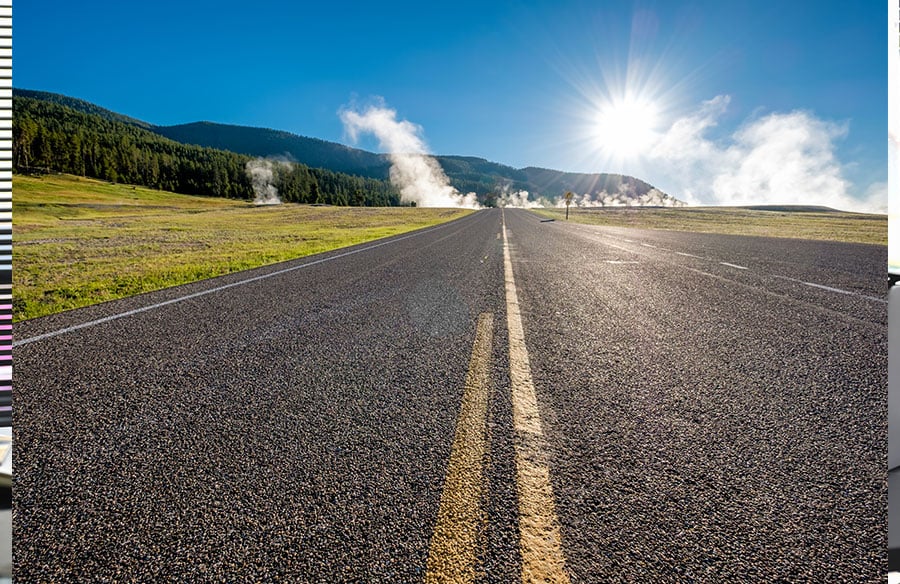
The first sign is often a dip that wasn’t there last summer.
A bus pulls in, the rear wheels settle into the same shallow grooves, and passengers barely notice. A few blocks away, the surface near a traffic light has begun to bunch up where cars brake. After a storm, water stays in one dark patch long after the rest of the road has dried. None of it looks urgent enough to close the street. It just gets a little worse every week.
Then a maintenance crew arrives, lays a fresh black surface, paints the lines, and moves on. For a while, the road looks fixed. By the next hot season, the grooves are back.
That cycle is common because asphalt problems are usually treated as surface problems. In hot cities, they rarely are. The weather matters, but so do the bus route, the drainage outlet, the utility trench under the lane, the mix chosen by the contractor, and the amount of shade the street gets at three in the afternoon.
A road can be technically acceptable on paper and still be badly suited to the place where it ends up.
The road is hottest where traffic is slowest
People tend to picture heat damage as a highway problem: long stretches of dark pavement baking under direct sun. In cities, some of the worst damage appears in much smaller places.
Bus stops are a good example. The vehicle is heavy; it approaches slowly, brakes in almost the same spot, and then sits there. When it leaves, the wheels push against the surface again. Do that hundreds of times on a hot day, and the road is dealing with a very different kind of stress from cars moving freely at a steady speed.
The same thing happens at loading bays, taxi ranks, traffic lights, steep junctions, and entrances used by refuse trucks. The pressure is concentrated. The surface has less time to recover between loads. If the asphalt is already soft from heat, it starts to move sideways or downward instead of springing back.
That movement is what creates the familiar ruts and ripples. Once they appear, they collect water, tug at the steering, and make the next round of deformation easier. The road has changed shape, so every vehicle that follows adds pressure to the same weak point.
The binder in asphalt is meant to hold aggregate together while remaining flexible enough to cope with temperature changes. In a hot climate, the balance becomes awkward. A binder that performs reasonably well through a mild year may soften too much during a long run of extreme heat, especially on an exposed street with heavy traffic.
Producers have several ways to adjust that behaviour. They can change the binder grade, use polymers, alter the aggregate structure, or evaluate chemical modifiers. ICL phosphate solutions include polyphosphoric acid used in asphalt applications where manufacturers are trying to improve high-temperature performance. That is one part of the mix decision, alongside the base binder, aggregate, expected traffic, and the conditions during paving.
The mistake is assuming that a more modified mix is automatically a better one. Asphalt is full of trade-offs. A change that increases stiffness in hot weather still has to work with the chosen binder and remain suitable when temperatures fall. It also has to be mixed, delivered, and compacted properly. A sophisticated specification does not survive careless construction.
The Federal Highway Administration’s guidance on polyphosphoric acid modification makes that point clearly. The material can improve high-temperature properties in some binders, but compatibility and dosage need to be checked rather than assumed. The useful lesson for cities is broader: performance has to be verified for the materials being used, not borrowed from a supplier’s best test result.
This is where road procurement often becomes too blunt. A city may have one standard mix for a large share of its streets because that is easier to tender, price, and inspect. Operationally, the simplicity is attractive. Physically, it ignores the obvious differences between a quiet residential block, a freight route, and a bus corridor.
A more sensible approach groups streets by what they actually endure. The Superpave design approach was built around matching pavement materials to climate and traffic rather than treating asphalt as a single recipe. Cities do not need to copy every part of that system to use the underlying idea. They need to stop specifying the same answer for streets that pose different questions.
A cooler-looking road can still be a poor choice
When cities begin talking about heat, reflective pavement usually enters the conversation quickly. The appeal is obvious. Dark surfaces absorb a great deal of solar energy, so making them lighter seems like a straightforward improvement.
Sometimes it is. A pale coating in a schoolyard, public square, or low-speed parking area can reduce the surface temperature people feel through their shoes and around their legs. A lighter cycleway may be more comfortable in full sun. A permeable surface can help water move through the pavement and support cooling through evaporation.
Those are useful tools. Problems begin when they are treated as interchangeable.
A reflective coating does not strengthen a weak road base. A permeable pavement is not suitable for every traffic load or soil condition. A mix that resists rutting may remain dark and hot to the touch. Each approach solves a different part of the problem.
The street also has a life after the launch photographs. Tyres leave marks. Dust dulls pale surfaces. Oil stains collect near kerbs and loading areas. Utility crews cut trenches through coatings. Patches rarely match the original colour, and repeated repairs can turn a carefully designed surface into a loose collection of rectangles.
None of this means reflective pavement is a bad idea. It means cities should ask ordinary maintenance questions before choosing it. How will the finish be renewed? Will a repaired section need a specialist contractor? Does the coating remain skid-resistant when wet? Will road markings still be easy to see? What happens after five years of buses, delivery vans and winter grime?
The US Environmental Protection Agency’s guidance on cool pavements describes several approaches, including reflective and permeable surfaces, and notes that “cool pavement” does not refer to one standard product. That distinction matters because temperature readings from one pilot can be difficult to compare with those from another. Shade, wind, pavement age, surrounding buildings, and the time of measurement all affect the result.
A city can spend heavily on a cooler surface and still leave people standing in full sun at the bus stop beside it. The road may register a lower temperature while the street remains uncomfortable because there are no trees, shelters, or shaded crossings.
The point is visible in RTF’s discussion of urban thermal design. Heat builds through a combination of paving, building form, limited vegetation, and restricted airflow. The pavement matters, but its effect is tied to everything around it.
Consider a wide avenue lined with low buildings and almost no trees. Making the surface more reflective may reduce some heat absorption. Adding shade at the pavement edge may change the experience more directly for pedestrians. Doing both may be worthwhile, but they should not be presented as the same intervention.
This is where the design brief needs to be more honest. A road project may be expected to reduce heat, manage runoff, carry heavy vehicles, improve pedestrian comfort, and cost very little to maintain. Those goals can clash. The better projects decide which parts of the street need which response rather than forcing one material to carry the whole argument.
Most road failures begin below the part we see
A newly resurfaced road is persuasive. It looks complete. The colour is even, the markings are sharp, and the ride is smooth.
The work underneath is harder to see and easier to postpone.
If the base is weak, if the soil below it moves, or if water is trapped under the surface, fresh asphalt buys time rather than solving the problem. Cracks eventually return along the same lines. Depression reforms above the same drain. The edge breaks away again beside the same kerb.
Water is often involved. It enters through open cracks, badly sealed joints, sunken utility covers, and the edges of old repairs. Once it reaches the supporting layers, it can reduce their strength. The vehicles above do the rest.
Heat makes this more visible because the upper layer is already under greater stress. A softer surface over a weakened base deforms more readily, especially under slow or stationary loads. What appears to be a heat problem may actually be heat exposing a drainage or construction problem that has been present for years.
Utility cuts deserve more attention than they usually receive. A trench is opened, a pipe or cable is repaired, and the road is closed again. If the fill is placed too quickly or compacted unevenly, the patch settles. The edge between the old and new material becomes a route for water. A year later, the road authority is dealing with a failure that began with work carried out by someone else.
The same is true at manholes and drainage covers. When the surrounding material is not compacted carefully, the metal cover remains fixed while the asphalt around it sinks or breaks. Drivers know the result well: a hard dip or raised edge that returns soon after each repair.
Smarter asphalt cannot compensate for this indefinitely. A better binder may slow deformation, but it will not rebuild an unstable base or redirect trapped water.
Good pavement design includes the unglamorous details: proper excavation, moisture control, layer thickness, compaction near edges, joint sealing and a reliable path for runoff. None of them attracts much public attention. Together, they decide how long the road lasts.
The whole street section also needs to be considered. The traffic lane may require dense asphalt able to carry buses. Parking bays may be suitable for a more permeable treatment. Tree trenches can take runoff from the carriageway. Kerbs and inlets need to direct water rather than trap it in the wheel path.
RTF’s discussion of water-sensitive urban infrastructure is useful here because it treats water as part of the design rather than a nuisance to be piped away after everything else is decided. A street built around that principle can distribute the work across planting, drainage and pavement instead of expecting asphalt alone to manage every condition.
Take a neighbourhood shopping street. It may have a bus lane, short-term parking, delivery vehicles, street trees, and shops sitting close to the kerb. The bus lane needs resistance to rutting. The parking strip may be able to collect or filter some runoff. Tree pits can be designed to receive water without flooding entrances. The footpath needs shade and an even surface. One standard pavement detail repeated from building line to building line is unlikely to do all of that well.
The shape of the damage is already in the inspection report
Road failures are rarely random. They appear in patterns, and those patterns are often more useful than a simple condition score.
Ruts in both wheel tracks point toward repeated traffic loading and a surface that is moving under pressure. A single depression near the kerb may suggest a drainage problem. Ripples at a traffic light usually reflect braking and turning forces. Cracks that follow the outline of a trench are telling a different story from fine cracking spread across the whole lane.
Maintenance systems often flatten those differences into broad categories such as poor, fair or good. That may help divide a budget, but it does not explain what repair is needed.
A road marked “poor” could require resurfacing, base reconstruction, drainage work, trench reinstatement or all four. If the underlying cause is not recorded, the next design team is likely to repeat the previous repair because it is the only history available.
Those observations quickly separate one-off damage from recurring trouble. A sunken patch that appears after every utility intervention belongs in one category. A bus stop that ruts each summer belongs in another. A road edge failing beside blocked drainage needs a different response again.
Laboratory work can then be used where it will answer a real question. Pavement cores may show whether the surface was laid too thinly or compacted poorly. Binder and mixture tests can help explain deformation. The base can be opened where repeated settlement suggests a deeper weakness.
The purpose is not to turn every repair into a research programme. It is to avoid resurfacing the same cause with the same solution.
Cities often focus on the initial price because that is the clearest number in a tender. The repeated costs arrive later: another closure, more traffic management, new line painting, emergency patching, complaints, and damage to vehicles. A road that needs attention every two years may have been cheaper to build, but it has not been cheap to own.
There are places where spending more on the asphalt mix is justified. A busy bus corridor or freight entrance may need higher resistance to heat and deformation. Elsewhere, the extra money may be better spent rebuilding the base, improving drainage, or enforcing better compaction around utility trenches.
The damage itself helps make that choice. A city that reads it carefully can stop buying pavement by habit.
Wrap-up takeaway
Hot roads do not fail for one neat reason. Better asphalt helps when it is chosen for the right street and laid over sound construction. The most useful next step is simple: visit a recurring failure after a hot afternoon and again after rain, then compare what is happening on the ground with the repair history before ordering another surface layer.