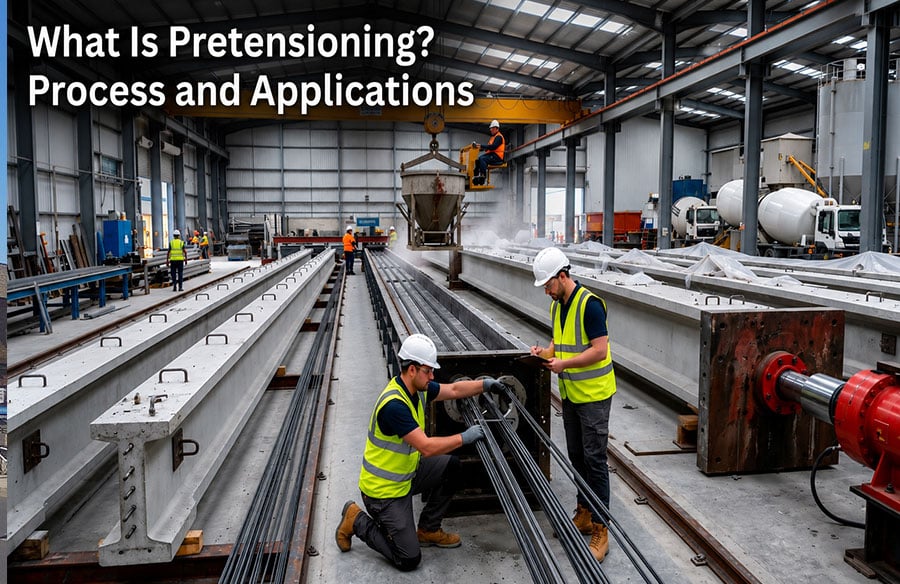
As a construction material, concrete performs exceptionally well under compressive loads, yet it carries a notable drawback — its resistance to tensile stress remains comparatively weak and often limited. To overcome this, engineers rely on prestressing concrete, and pretensioning stands out as one of the two core techniques used to accomplish it. Whether you’re trying to understand what is pretensioning, how the process works, or why it plays such a key role in bridges, railway sleepers, and precast concrete manufacturing, this guide walks you through it in clear, easy-to-follow terms.
Understanding Pretensioning
Pretensioning is a method of prestressing concrete in which high-strength steel tendons — typically PC Strand or PC Wire — are stretched (tensioned) before the concrete is cast around them. Once the concrete has cured and gained sufficient strength, the tendons are released, and the prestressing force is transferred into the concrete through bond. This process is what gives pretensioned concrete its superior strength, durability, and resistance to cracking.
In simple terms, pretensioning “pre-loads” the concrete with compression before service loads act on the structure, so that when tension forces develop later, the concrete doesn’t crack or fail prematurely.
Why Pretensioning Is Used
Pretensioning is used because it allows engineers to design structural elements — beams, slabs, piles, and girders — that are lighter, stronger, and capable of spanning greater distances than conventionally reinforced concrete. It is especially valuable in precast concrete manufacturing, where components are cast in a controlled factory environment, cured, and later transported to the job site.
Basic Concept of Prestressing Concrete
Prestressing concrete works on a simple engineering principle: apply a compressive force to the concrete in advance so that any tensile stresses generated by service loads are offset or neutralized. Since concrete handles compression well but cracks under tension, introducing artificial compression through tensioned steel tendons dramatically improves the material’s overall performance.
Difference Between Reinforcement and Prestressing
Conventional reinforcement (rebar) is embedded in concrete to resist tensile forces after cracking has already begun — the steel and concrete work together, but the concrete may still crack under load. Prestressing, on the other hand, actively compresses the concrete before loading, which significantly delays or prevents cracking altogether. This is the fundamental difference between ordinary reinforced concrete and pretensioned or post-tensioned concrete.
Why Is Pretensioning Necessary?
Understanding why pretensioning matters starts with understanding concrete’s natural behavior:
- Concrete is strong in compression — it can bear heavy compressive loads without failing.
- Concrete is weak in tension — even moderate tensile stress can cause cracking.
Because most structural elements experience some degree of bending (which creates both compression and tension zones), concrete alone isn’t sufficient for long-span or heavily loaded members. Pretensioning addresses this by:
- Reducing cracking — the pre-applied compression counteracts tensile stresses from service loads.
- Improving durability — fewer cracks mean less water and chemical infiltration, which protects embedded steel from corrosion.
- Enabling longer spans — pretensioned beams and girders can span greater distances with less material.
- Delivering better structural performance — pretensioned elements carry heavier loads with reduced deflection and improved stiffness.
This combination of benefits is why pretensioning in prestressed concrete has become a standard method for producing high-performance structural components across the construction and infrastructure industries.
How Does the Pretensioning Process Work?
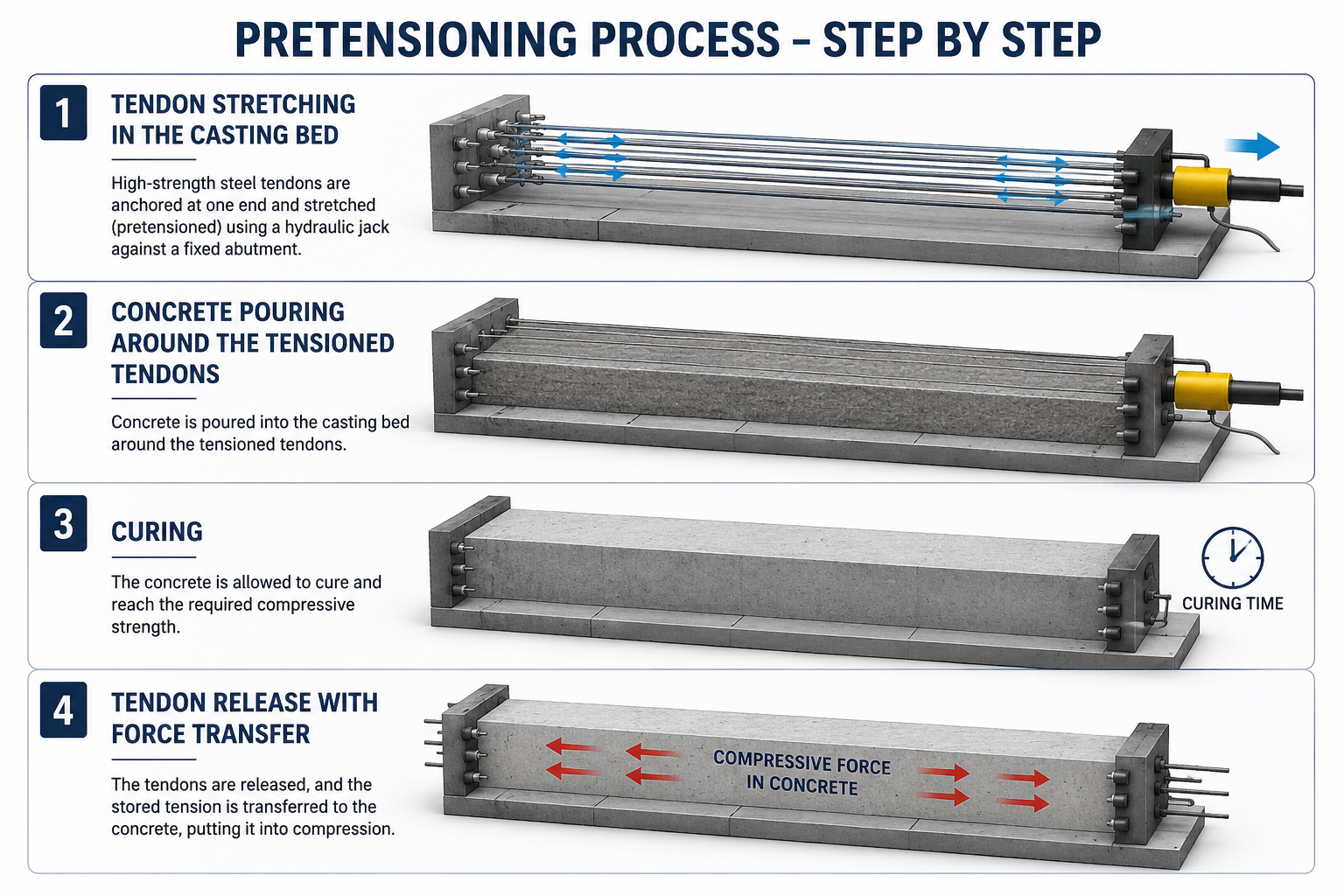
The pretensioning process follows a systematic sequence carried out in a precasting yard or factory using a fixed casting bed.
Step 1 – Stretching the PC Strand or PC Wire
High-tensile PC Strand or PC Wire is threaded through a long-line casting bed and anchored at both ends. Hydraulic jacks then stretch the tendons to a predetermined tension, based on the design requirements of the structural element being produced.
Step 2 – Casting Concrete
Once the tendons are tensioned and locked in place, formwork is set up around them, and concrete is poured into the mold. The concrete flows around and bonds directly to the tensioned strands or wires.
Step 3 – Concrete Curing
The concrete is allowed to cure until it reaches a specified compressive strength — often accelerated using steam curing in precast plants to speed up production cycles.
Step 4 – Releasing the Tendons
After the concrete has achieved adequate strength, the tendons are cut or released from the anchorages at the ends of the casting bed.
Step 5 – Transfer of Prestressing Force
As the tendons are released, they attempt to return to their original, unstretched length. Because they are already bonded to the surrounding concrete, this contraction transfers the compressive prestressing force into the concrete through bond — completing the pretensioning process.
 Materials Used in Pretensioning
The success of the pretensioning process depends heavily on the quality of the prestressing steel used. Two materials dominate this space: PC Strand and PC Wire.
 PC Strand
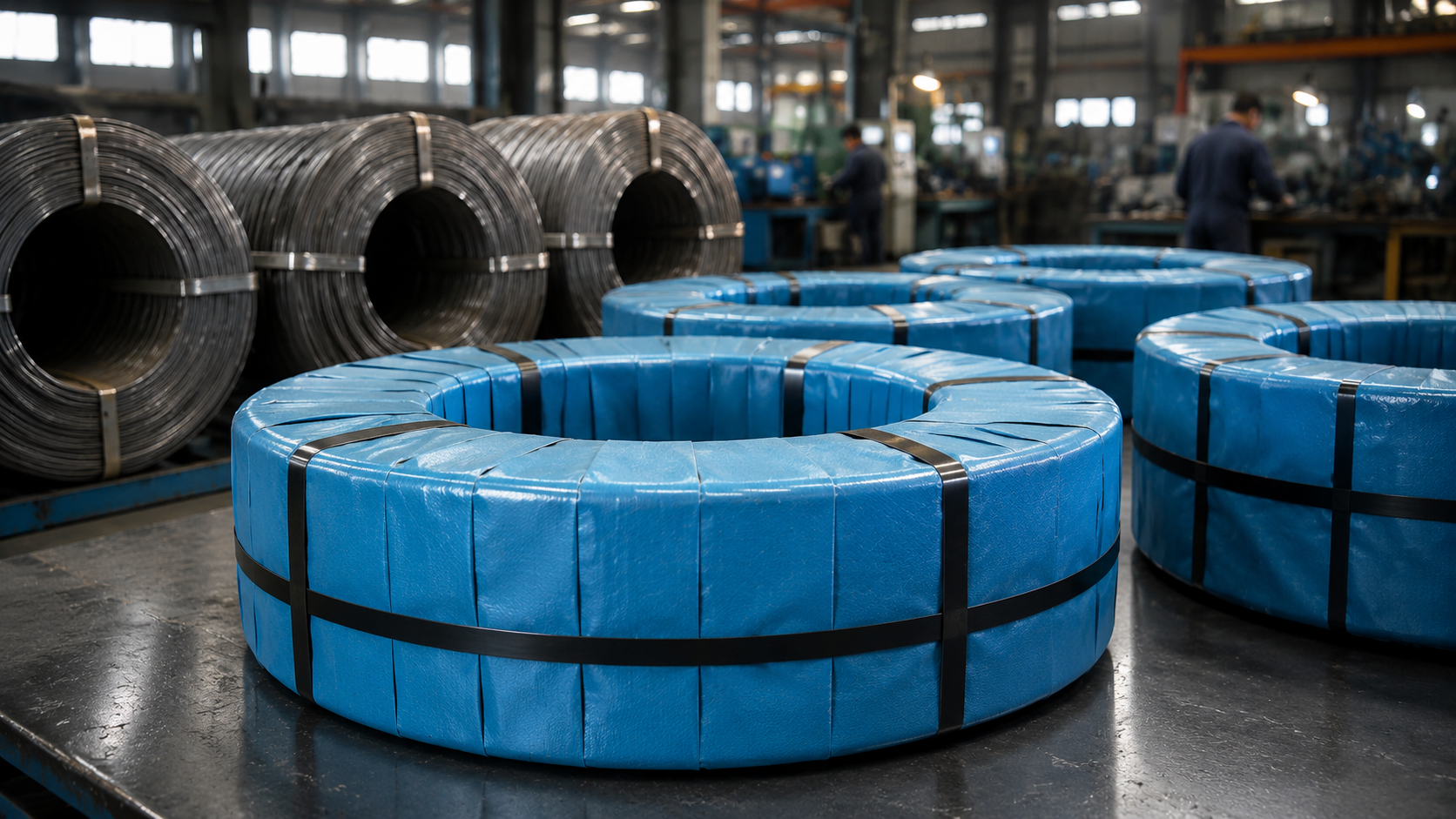
PC Strand is the most commonly used prestressing steel in pretensioned concrete production, valued for:
- High tensile strength — capable of withstanding substantial stretching forces without failure.
- Low relaxation — maintains prestressing force over time with minimal loss, ensuring long-term structural performance.
- Excellent bond — the helical configuration improves bond performance by increasing mechanical interlock and friction between the strand and the surrounding concrete, enabling efficient transfer of the prestressing force.
PC Strand is widely used in pretensioned concrete beams, bridge girders, hollow core slabs, and other structural precast elements where consistent, reliable prestressing force is critical.
PC Wire
PC Wire is another essential prestressing material, often used in smaller-scale or specific applications:
- Applications — commonly used in railway sleepers, utility poles, and certain precast panel products.
- Features — high tensile strength, consistent diameter tolerance, and good relaxation performance.
- International standards — PC Wire can be manufactured according to ASTM A421 (Uncoated Stress-Relieved Wire), ASTM A881 (Indented Prestressing Wire), EN 10138, BS 5896, GB/T 5223, KS D7002, TIS 95-2540, and other international standards depending on project requirements.
- Common diameters — available in a range of standard diameters to suit different load and design requirements.
As a manufacturer with extensive production capability, TJ Wasungen supplies both PC Strand and PC Wire engineered to meet international quality benchmarks, giving engineers and contractors confidence in every batch used for pretensioned concrete production.
Common Applications of Pretensioning
Because of its efficiency in factory-based production, pretensioning is used extensively across a wide range of structural and infrastructure applications, including:
- Railway sleepers
- Concrete piles
- Bridge girders
- Hollow core slabs
- Floor slabs
- Wall panels
- Utility poles
- Marine structures
- Parking structures
- Industrial buildings
These applications benefit from the strength, durability, and dimensional consistency that pretensioned concrete products offer, making pretensioning a preferred method wherever repetitive, high-quality precast elements are needed.
What Is a Pretensioned Concrete Beam?
A pretensioned concrete beam is a precast structural member cast around tensioned PC Strand or PC Wire, giving it the strength to span long distances while resisting bending and cracking under service loads. These beams are widely used in bridge construction, parking structures, and industrial buildings, where their combination of high load capacity and reduced deflection allows for slimmer profiles and fewer intermediate supports compared to conventionally reinforced beams.
What Is a Pretensioned Concrete Pile?
A pretensioned concrete pile is a precast foundation element manufactured with tensioned prestressing steel to provide high driving resistance and long-term durability. These piles are commonly used in deep foundation systems, marine structures, and pipe pile applications where exposure to moisture, soil stress, or wave action demands superior cracking resistance. Their factory-controlled production also ensures consistent quality across large project volumes.
What Is a Pretensioned Railway Sleeper?
A pretensioned railway sleeper is a precast concrete sleeper (tie) reinforced with tensioned PC Wire or PC Strand to withstand repeated dynamic loading from passing trains. Compared to timber or conventionally reinforced sleepers, pretensioned sleepers offer greater durability, longer service life, and better resistance to cracking from cyclic rail loads — making them the standard choice for modern railway infrastructure worldwide.
What Is a Pretensioned Girder?
A pretensioned girder is a large precast structural member, typically used in bridge construction, engineered to carry substantial loads across long spans. Manufactured using high-strength PC Strand in a fixed casting bed, pretensioned girders provide the load capacity and dimensional consistency required for highway overpasses, rail bridges, and other long-span infrastructure projects, while reducing on-site construction time compared to cast-in-place alternatives.
Advantages of Pretensioning
Pretensioning offers a long list of structural and economic benefits, including:
- Longer spans — enables structural elements to cover greater distances with less material.
- Reduced cracking — pre-applied compression minimizes tensile cracking under service loads.
- Better durability — fewer cracks translate to longer service life and reduced corrosion risk.
- Lower maintenance — durable, crack-resistant elements require less repair over their lifespan.
- Higher load capacity — pretensioned members can carry heavier loads relative to their size.
- Reduced deflection — the prestressing force counteracts bending, keeping members stiffer under load.
- Improved structural efficiency — allows for slimmer, lighter pretensioned concrete slabs and beams without sacrificing strength.
- Factory quality control — production in controlled precast plants ensures consistent quality and dimensional accuracy.
- Faster installation — precast pretensioned elements can be manufactured off-site and installed quickly, reducing on-site construction time.
Limitations of Pretensioning
While highly effective, pretensioning does have certain limitations that engineers and manufacturers should consider:
- Requires a casting bed — pretensioning depends on a fixed, long-line casting bed, making it less flexible for one-off or custom shapes.
- Mainly suitable for precast products — because of the casting bed requirement, pretensioning is generally limited to factory or yard production rather than on-site casting.
- Transportation limitations — precast pretensioned elements must be transported from the factory to the job site, which can limit size and add logistical costs.
- High initial equipment cost — setting up a casting bed and hydraulic tensioning equipment requires significant upfront investment.
- Requires skilled production — consistent quality depends on trained personnel and precise process control.
Why Low-Relaxation PC Strand Matters
After the tendons are released, the prestressing force must remain stable throughout the service life of the structure. Low-relaxation (LR) PC Strand minimizes prestress loss over time, allowing bridges, railway sleepers, and pretensioned concrete slabs to maintain their structural performance for decades. This is why LR strand is specified under ASTM A416 Grade 270 and is widely used in modern infrastructure projects — it directly affects long-term load capacity, deflection control, and overall service life, making it a critical specification point for engineers and buyers alike.
Pretensioning vs Post-Tensioning
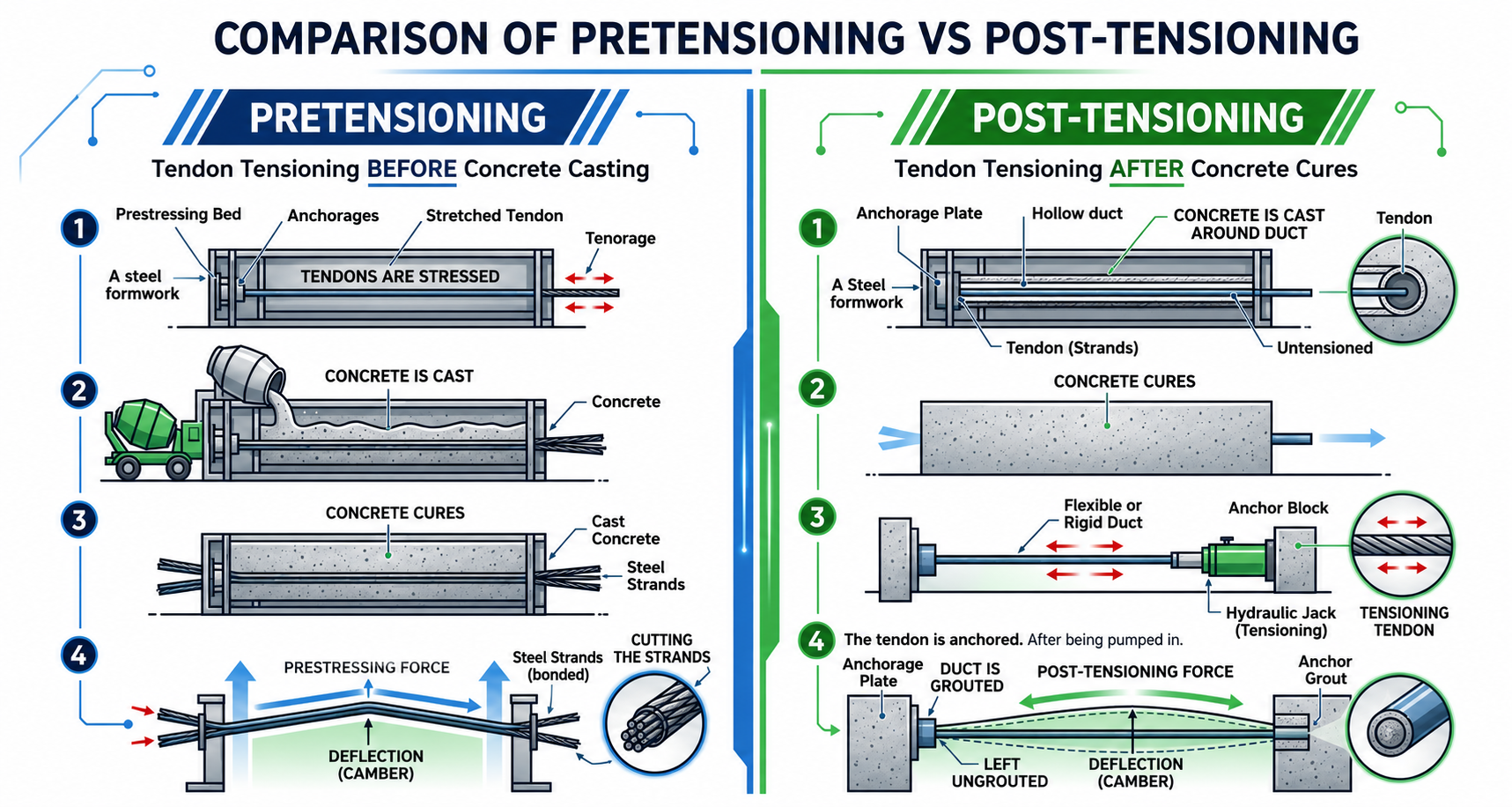 Both pretensioning and post-tensioning are prestressing methods, but they differ significantly in execution, application, and cost structure.
| Feature | Pretensioning | Post-Tensioning |
| Timing | Tendons tensioned before concrete is cast | Tendons tensioned after concrete has cured |
| Tendon Location | Bonded directly within the concrete | Placed in ducts, often unbonded until grouted |
| Construction Method | Factory/precast production using casting beds | Can be done on-site or in precast settings |
| Equipment | Hydraulic jacks and fixed casting bed | Anchorage systems and stressing jacks at the site |
| Applications | Beams, slabs, piles, railway sleepers | Bridges, large-span structures, slabs on grade |
| Cost | Lower cost for mass precast production | Higher cost due to on-site equipment and labor |
| Flexibility | Limited to standard precast shapes | Greater design flexibility for complex structures |
| Maintenance | Minimal, factory-quality consistency | May require monitoring of anchorages and grouting |
How to Choose the Right Prestressing Steel
Selecting the right prestressing steel is critical to the performance and safety of any pretensioned structure. Key factors to consider include:
- PC Strand — ideal for applications requiring high tensile strength and strong bonding with concrete, such as bridge girders and hollow core slabs.
- PC Wire — well-suited for applications like railway sleepers and utility poles where specific diameter and strength profiles are needed.
- Diameter selection — should align with the structural load calculations and design specifications of the project.
- Strength grades — higher-grade steel may be required for long-span or heavy-load applications.
- Project requirements — span length, load conditions, and exposure environment all influence material selection.
- International standards — ensure the chosen PC Strand or PC Wire complies with relevant standards such as ASTM, EN, or GB specifications, depending on the project’s regulatory requirements.
Working with an experienced manufacturer ensures that the prestressing steel supplied meets both technical specifications and international quality expectations.
Why Choose TJ Wasungen Prestressing Products?
With more than 20 years of manufacturing experience, TJ Wasungen produces prestressing steel for precast plants, bridge projects, concrete pipe piles, railway infrastructure, and industrial construction worldwide. When it comes to sourcing reliable prestressing steel for pretensioned concrete projects, material quality and manufacturing consistency make all the difference. TJ Wasungen offers:
- High-quality PC Strand engineered for high tensile strength and low relaxation performance.
- High-quality PC Wire manufactured to precise diameter tolerances for consistent structural performance.
- International quality standards compliance, including ISO-certified manufacturing, ASTM-compliant production, and third-party SGS inspections, ensuring products meet the demands of global construction and infrastructure projects.
- Strong manufacturing capability, supporting large-volume annual production for precast producers and infrastructure companies worldwide.
- Extensive export experience, delivering prestressing steel to clients across multiple countries and regions.
- Custom specifications, tailored to project-specific diameter, strength grade, and packaging requirements.
- Engineering support and quality control, helping engineers and buyers select the right specification for their application.
- Global delivery, ensuring reliable supply chains for contractors and manufacturers worldwide.
Looking for high-quality prestressing steel for your next project?
TJ Wasungen manufactures premium PC Strand and PC Wire that comply with ASTM, BS, EN, GB, KS, and other international standards. Whether you produce railway sleepers, bridge girders, spun piles, or hollow core slabs, our engineering team can recommend the right specification for your application. Contact us today for technical support, competitive pricing, or a free quotation.
FAQ Section
- What is pretensioning in concrete?
Pretensioning is a prestressing method where steel tendons (PC Strand or PC Wire) are tensioned before concrete is cast around them. Once the concrete cures, the tendons are released, transferring compressive force into the concrete to improve its strength and crack resistance.
- What is the difference between pretensioning and post-tensioning?
Pretensioning tensions the steel tendons before casting the concrete, typically in a factory setting using a fixed casting bed. Post-tensioning tensions the tendons after the concrete has cured, often on-site, using anchorage and duct systems. Each method suits different applications and project scales.
- Why is PC Strand used in pretensioning?
PC Strand is used because of its high tensile strength, low relaxation properties, and excellent bonding characteristics with concrete — all of which ensure efficient and long-lasting transfer of prestressing force.
- What is PC Wire used for?
PC Wire is commonly used in applications such as railway sleepers, utility poles, and select precast panel products, offering high tensile strength and consistent mechanical properties.
- Where is pretensioning commonly used?
Pretensioning is widely used in precast concrete products such as bridge girders, hollow core slabs, floor slabs, wall panels, railway sleepers, concrete piles, and utility poles.
- What are the advantages of pretensioning?
Key advantages include longer spans, reduced cracking, better durability, lower maintenance, higher load capacity, reduced deflection, improved structural efficiency, factory-controlled quality, and faster on-site installation.
- Can pretensioning be done on-site?
Pretensioning generally requires a fixed casting bed, making it best suited to factory or precast yard production rather than typical on-site construction.
- Which is better: pretensioning or post-tensioning?
Neither method is universally “better” — the right choice depends on the project. Pretensioning is more economical for mass-produced precast elements, while post-tensioning offers greater flexibility for large-span, on-site, or complex structural applications.
- Does pretensioning require grouting?
No. Unlike post-tensioning, pretensioning relies on the direct bond between the prestressing steel and the surrounding concrete, so grouting is generally unnecessary.
- Is pretensioning stronger than reinforced concrete?
Pretensioned concrete generally outperforms conventionally reinforced concrete in tension resistance, cracking control, and load capacity, since the prestressing force actively counteracts tensile stresses before service loads are applied.
- How long can pretensioned beams span?
Span capability depends on the beam’s design, depth, and the prestressing force applied, but pretensioned beams typically achieve significantly longer spans than conventionally reinforced beams of comparable size — making them well suited to bridges and long-span industrial buildings.
- Can pretensioning reduce concrete cracking?
Yes. By introducing compressive prestressing force into the concrete before service loads are applied, pretensioning substantially reduces tensile cracking, which in turn improves durability and reduces long-term maintenance.