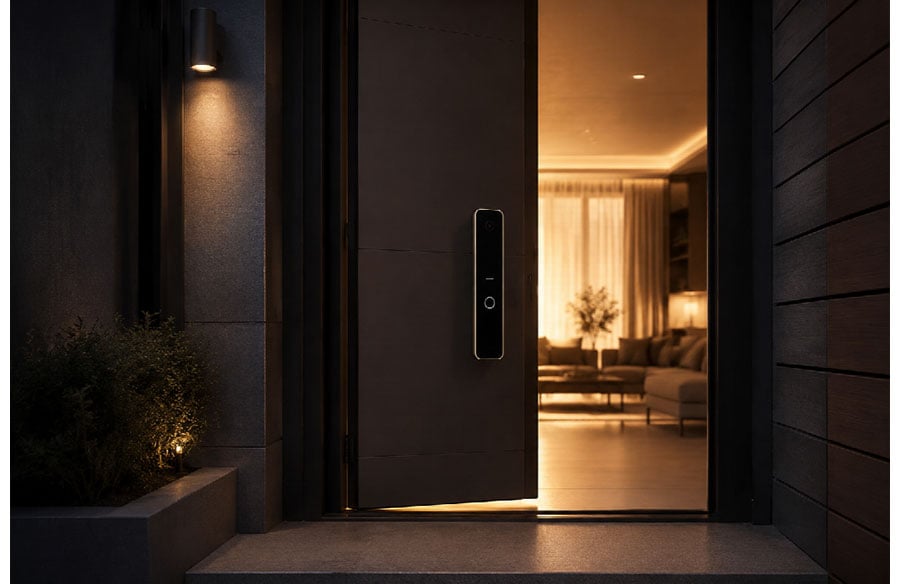
We used to think of the front door as a boundary — a line between the public world and the private one. You locked it, you unlocked it, and that was the extent of the relationship. But as homes get smarter, the lock on the front door is quietly becoming something far more interesting: the first point of contact between a person and an intelligent living space.
The Shift from Mechanical to Experiential
For decades, lock design was a purely mechanical conversation. Better deadbolts, harder-to-pick cylinders, more durable materials. These mattered, and they still do. But the question homeowners and architects are asking now is different. It is not just “Is this door secure?” but “What happens when this door opens?”
That is a subtle but significant shift. A smart lock does not only guard the entrance — it orchestrates what comes next. The lights come on. The thermostat adjusts. The curtains part. The entry becomes an experience rather than a transaction. This is the idea of “scenario linkage,” and it reframes the lock from a standalone security device into the trigger for everything a smart home can do.
Designing for the Way People Actually Live
The appeal goes beyond convenience, though that is part of it. Keyless entry — through fingerprint, facial recognition, or a temporary password sent to a guest’s phone — removes the small frictions that accumulate over years of fumbling for keys. For families, it means the kids never get locked out. For Airbnb hosts or property managers, it means access control without physical key handoffs.
What makes this work at scale is the ecosystem around the lock. Voice control through Amazon Alexa or Google Assistant means the lock does not live in isolation. A video doorbell paired with the lock lets you see who is there and speak to them from anywhere. For commercial settings — apartment buildings, co-living spaces, boutique hotels — the same hardware supports member management for thousands of users, with access logs and real-time alerts.
The Infrastructure That Makes It Invisible
The reason smart locks can feel this seamless is that the underlying plumbing has matured. Multi-protocol support — Wi-Fi, Zigbee, Bluetooth, even NB-IoT — means a lock can fit into whatever network a building already runs. Encryption standards and secure chip integration have reached the point where the security of the digital lock can genuinely match, and in some cases exceed, that of a traditional deadbolt.
For the architects and designers reading this, the takeaway is practical: smart locks are no longer a gadget you add after the fact. They are a design decision that shapes how a space feels from the very first interaction. The front door is still a boundary, but it is now a porous one — intelligent, responsive, and quietly setting the tone for everything inside.