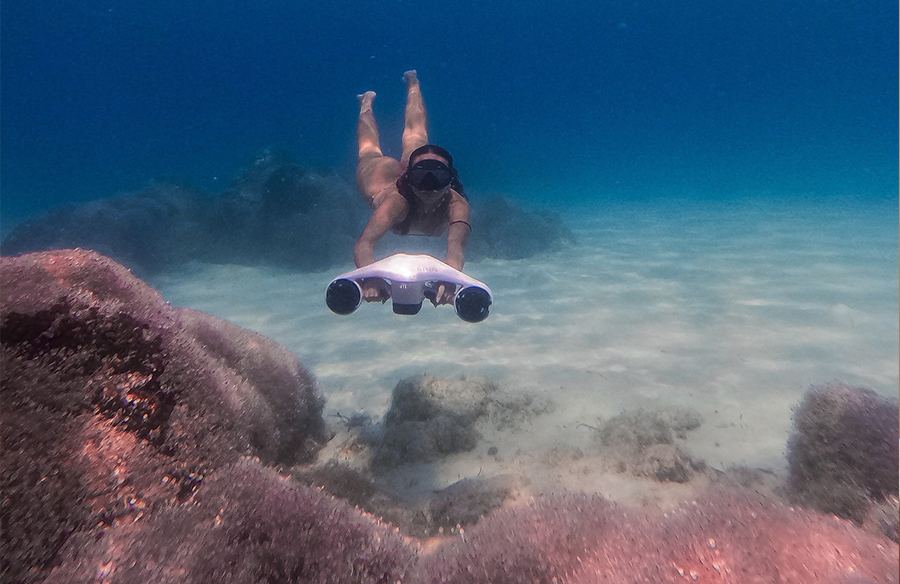
An underwater scooter can look deceptively simple: start the motor, the propellers spin, and the user moves through the water. But creating a device that provides useful thrust while remaining stable, controllable, and resistant to repeated submersion requires fluid dynamics, human-centered controls, battery management, and structural sealing to work together.
A well-designed underwater scooter does not achieve better performance by relying on more power alone. The motor, propellers, body shape, buoyancy, and controls form one system. If any one of those elements is poorly balanced, runtime, handling, or the overall experience can suffer.
1. Thrust Comes From Accelerating Water Backward
An underwater scooter moves according to the same basic principle as a marine propeller. The motor turns the blades, which accelerate the surrounding water backward. As the water is pushed in one direction, the reaction force moves the scooter and user in the opposite direction.
Thrust depends on more than motor output. Propeller diameter, blade pitch, rotational speed, and the volume of water moved each second all affect the result. Well-designed blades can move water more efficiently while reducing unwanted turbulence and wasted energy.
That is why two underwater scooters with similar motor ratings may feel very different in the water. The user does not experience a wattage figure directly. What matters is how effectively the complete propulsion system turns electrical energy into usable, predictable thrust.
2. Water Resistance Shapes Both Speed and Runtime
Water is much denser than air. As speed rises, resistance against the user, the scooter, and any equipment increases rapidly. Pushing faster therefore demands much more power, and the battery drains faster as a result.
Maximum speed and maximum runtime generally cannot be achieved at the same time. A low-speed setting is better suited to observing underwater surroundings, practicing control, or covering a longer session. A high-speed setting provides a shorter burst of movement and should not be used to estimate low-speed endurance.
Body position also affects efficiency. Holding the arms too wide, failing to maintain a streamlined posture, or carrying equipment with a large frontal area creates additional drag. In many situations, better posture and a sensible speed setting extend useful runtime more effectively than simply increasing motor output.
3. Human-Centered Controls Matter More Than Peak Power
Controlling a device underwater is different from operating one on land. Users may be managing breathing, direction, depth, and awareness of the surrounding environment at the same time. The more intuitive the controls are, the more attention can stay on the water rather than on the machine.
A two-handed grip keeps thrust more symmetrical and allows the user to steer by changing the direction of the arms. A one-handed operating option can add flexibility in specific situations, but the remaining hand still needs to control the scooter securely.
Multiple speed modes do more than create different top speeds. A lower setting reduces the initial pull and helps a new user learn to start, steer, and stop. Moving to a faster mode after control becomes consistent is more sensible than beginning at maximum output.
Automatic shutoff when the controls are released can prevent the scooter from continuing to run after it slips from the user’s hands. A safety lock also reduces the chance of accidental startup while the device is being carried, handed over, or taken into the water.
4. Sealing, Buoyancy, and Propeller Protection Must Work Together
An underwater scooter must protect its motor, battery, and control electronics from water intrusion. Housing seams, charging ports, buttons, and the areas around rotating shafts are all critical parts of the sealing system. A rated operating depth describes the device’s performance under specified test conditions; it does not mean a person is automatically qualified to dive to that depth.
Propeller guards are another important structural feature. A fully or partially enclosed guard can reduce the chance that fingers, hair, or loose equipment will contact the moving blades. It can also help keep some debris out of the propulsion area. A guard does not replace a pre-use inspection, however, and long hair, straps, and other loose items should still be secured.
Buoyancy affects what happens if the user lets go. A positively buoyant design can make a scooter easier to see and recover as it rises. Fresh water, salt water, and attached accessories such as a camera may change how the complete setup behaves, so buoyancy should still be tested in shallow water before a full session.
5. Battery Capacity Must Be Read in Context
Battery capacity describes how much energy can be stored, but it cannot predict runtime by itself. Speed mode, water temperature, user drag, battery condition, and frequent starts and stops all influence how long the scooter will operate.
For most users, runtime at each speed is more informative than one headline claim for “maximum runtime.” A clear difference between low-speed and high-speed endurance shows how power demand changes under realistic operating modes.
Charging time also needs to be part of the plan. After a session, the scooter should be cleaned and dried according to the manufacturer’s instructions. The charging port must be dry before charging begins. During long-term storage, the battery should be kept away from high heat and maintained according to the manufacturer’s guidance rather than left fully depleted for an extended period.
6. How to Judge Whether the Design Is Well Resolved
Start by checking whether the propellers are properly guarded, whether releasing the controls stops propulsion, whether speed modes are easy to change, and whether the scooter stays balanced in a two-handed grip. Then compare runtime by speed, total weight, charging time, and water-resistance rating with the way the device will actually be used.
The relationship between speed and runtime is especially revealing. If a product advertises only its top speed and a best-case maximum runtime without explaining whether those figures can occur together, it is difficult to predict real-world performance. Mode-by-mode data makes the design tradeoffs much easier to understand.
The ASIWO MANTA 2 offers a concrete example. The scooter weighs about 9.9 pounds with its battery and has three modes: approximately 2 ft/s for up to 90 minutes, 6.5 ft/s for up to 30 minutes, and 8.2 ft/s for up to 13 minutes. It also combines fully enclosed propellers, automatic shutoff when released, a safety lock, and positive buoyancy. These features are most meaningful as a coordinated system that balances thrust, control, and useful operating time, not as isolated numbers on a specification sheet.
Once the basic mechanics are clear, choosing an underwater scooter becomes less about chasing the highest speed. Propulsion efficiency, low-speed control, protective design, transparent runtime data, and the user’s ability to operate the device confidently are the factors that determine whether it works well in practice.