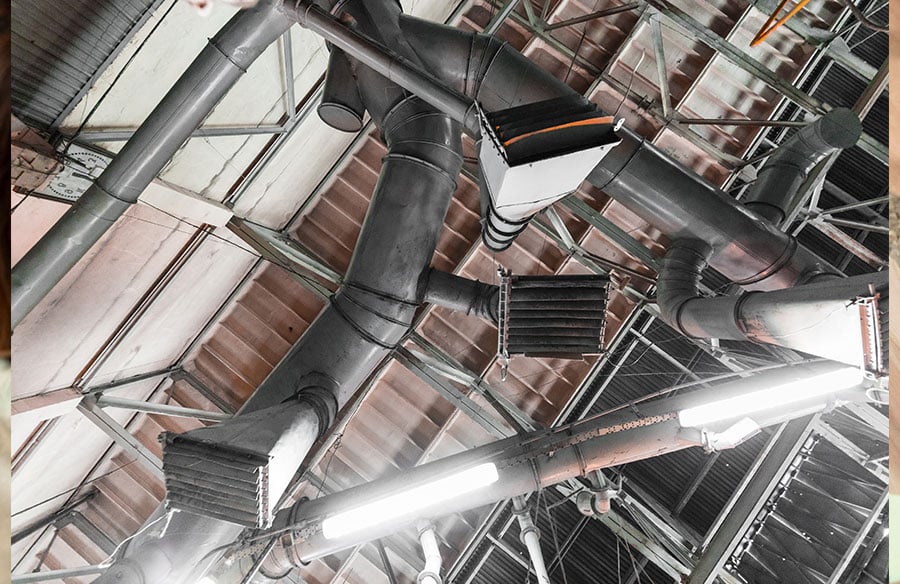
Most welding shops start with a solid extraction plan. Equipment is installed, air flow is tested, and initial air quality looks acceptable. Then production ramps up. Within weeks or months, shop managers notice that air quality has degraded, workers are coughing more than they used to, and the extraction system that looked good on paper no longer performs as intended. The problem rarely lies with the equipment itself, but with how the system was designed for normal conditions instead of the peak demand that actually defines daily operations.
Key Takeaways
- Fume extraction systems designed around average production volumes fail when shops hit sustained high-volume runs, a stress that most initial installations never anticipate.
- Dead zones, uneven extraction coverage, and insufficient makeup air are the three most common design failures that emerge only under production pressure.
- Rebuilding for high-volume performance requires systematic diagnosis: measuring actual air velocity during peak welding, mapping worker positions, and adjusting ductwork and equipment placement accordingly.
- Filter saturation accelerates under high production, so maintenance intervals must scale with volume, not remain fixed to initial planning assumptions.
Why It Matters
Fume extraction is not a one-time installation decision. It is an operational system that either sustains worker safety or gradually fails under the conditions that define real production life. When shops operate at 70 percent capacity, even a poorly designed system may appear functional because air movement and extraction can handle the lower volume. But when the same shop runs at 95 percent capacity for weeks at a time, that same system hits saturation. Ductwork cannot deliver air fast enough, extraction arms cannot reach all welders simultaneously, and makeup air intake cannot replenish the volume being pulled out of the space.
The consequences are visible and measurable: rising particulate levels, worker fatigue, health complaints, and regulatory scrutiny. Yet many shop owners treat these symptoms as inevitable costs of growth instead of recognizing them as signals of design failure. The truth is that portable fume extractors and permanent shop systems can be optimized for high-volume operation, but only if facility managers understand where the original design falls short and what specific changes restore performance during peak demand.
The Three Design Failures That Emerge Under Production Stress
Dead Zones and Incomplete Coverage
Fume extraction systems are typically designed based on shop layout at the time of installation. Welders are positioned at stations A, B, and C. Extraction arms or wall-mounted units are located to serve those spots. Initial testing shows acceptable air velocity at each station. But production pressure drives layout changes: temporary work surfaces are added, welders rotate to new positions, or multiple workers occupy spaces that were designed for one person at a time. The original extraction geometry no longer matches reality.
Dead zones form in corners and alcoves where air circulation is poor. Welders working near these areas experience fume concentrations that the extraction system cannot reach because the ductwork path and extraction point location were never designed to handle that worker position. The system functions fine for the original layout but fails for the actual layout under heavy production.
Inadequate Makeup Air and Negative Pressure Collapse
Every cubic foot of air pulled out of a shop must be replaced, or the space collapses into negative pressure. Negative pressure causes fumes to linger, air quality to deteriorate, and the extraction system to work harder than it should. Many shops address fume extraction without addressing makeup air. During normal production, the effect is subtle. During high-volume runs, it becomes acute.
Shops with single-point extraction or insufficient intake pathways experience a cascading problem: as production volume increases, extraction demand increases, negative pressure worsens, and extraction efficiency decreases because the system cannot draw fresh air in fast enough to replace what is being pulled out. The system hits a ceiling beyond which it cannot perform better, no matter how powerful the fan.
Filter Saturation and Maintenance Interval Misalignment
Filter replacement schedules are typically based on manufacturer recommendations and initial production volumes. A filter rated for 500 hours of use at 50 percent shop capacity may only last 250 hours at 95 percent capacity because the volume of fumes being collected is significantly higher. Shops that do not adjust maintenance intervals end up running saturated filters that restrict airflow and reduce extraction performance without realizing it.
Saturated filters look similar to healthy filters to the naked eye. Performance drops gradually, so workers adapt rather than report it. By the time air quality becomes noticeably poor, the filter has been compromised for weeks. Productivity suffers, and the extraction system gets blamed for being underpowered when the real problem is deferred maintenance under higher-than-anticipated load.
Diagnosing High-Volume Performance Failures
Measure Actual Air Velocity During Peak Production
Initial testing is always done under controlled conditions, often when the shop is not running at full capacity. A proper diagnosis requires measurement during a high-volume production run: actual welders at actual positions generating actual fume load. Use a handheld anemometer to measure air velocity at extraction points and worker breathing zones during peak demand.
Look for readings below 100 feet per minute at worker stations; this typically indicates insufficient extraction for that location. Compare readings across multiple stations to identify which areas are underperforming. The data reveals whether the problem is system-wide inadequacy or localized coverage failure.
Map Actual Worker Positions and Movement Patterns
Where do welders actually stand during high-volume production? This is rarely identical to the initial installation assumption. Map current positions, including temporary stations and rotation patterns. Identify any locations where workers spend significant time but are not directly in front of an extraction arm or source.
This map becomes the reference for identifying coverage gaps. If a high-volume run involves welders working in a corner of the shop that extraction was never designed to serve, that is a design problem, not an equipment problem.
Test Makeup Air Balance
Measure intake air volume and compare it to extraction volume. They should be roughly equal. If extraction significantly exceeds intake, the space is being drained faster than it is being replenished. Run this test during peak production. If negative pressure is present, it will become obvious and the magnitude can be quantified.
Rebuilding for High-Volume Performance
Adjust Ductwork and Add Coverage Points
Once dead zones are identified, ductwork routing and extraction point placement can be modified. This may involve extending ductwork to cover additional areas, repositioning wall-mounted units, or adding supplemental portable extraction capacity where permanent systems cannot reach. The goal is extraction coverage that matches actual high-volume operations, not theoretical layout.
Upgrade Makeup Air Systems
If negative pressure is confirmed, add or enlarge makeup air intake pathways. This can be as simple as installing fresh air louvers in roof or wall spaces, or as involved as adding a dedicated makeup air unit. The investment pays back immediately through improved extraction efficiency and worker air quality.
Align Filter Maintenance to Actual Production Volume
Once the shop operates at high volume as a sustained condition, calculate filter replacement intervals based on that volume, not on initial capacity assumptions. Some shops need filter changes twice as often during peak season. This is not a system failure; it is proper maintenance at higher demand. Tracking and scheduling these changes prevents the gradual performance degradation that occurs when filters run saturated.
Concrete Example: A Mid-Size Fabrication Shop
A 15-person fabrication shop installed a wall-mounted welding fume extraction system designed around three primary welding stations. Initial air quality testing showed acceptable extraction. The system ran smoothly for six months at 60 percent utilization.
Then a large order arrived. The shop ramped to 90 percent utilization for 12 weeks straight. Within three weeks, workers reported increased eye and throat irritation. The shop owner assumed the extraction system was underpowered and considered purchasing additional equipment.
A diagnostic inspection revealed three problems: (1) two welders had moved to a temporary station in the back corner, far from the extraction arm coverage; (2) the shop had added intake from the production floor without adding dedicated makeup air, creating subtle negative pressure that worsened during peak welding; (3) the filter had not been changed in four months, and saturation was restricting airflow.
The solution was not a new extractor. It was repositioning one extraction arm to cover the new temporary station, adding two fresh air louvers to the roof to provide makeup air, and immediately changing the filter with a plan to change it every six weeks during high-volume seasons. Within days, air quality improved noticeably.
The shop learned that fume extraction performance is not static. It changes with production volume, worker layout, and maintenance discipline. The system that worked well at 60 percent utilization needed adjustment at 90 percent. Recognizing this difference, rather than blaming the equipment, allowed the owner to rebuild the system for sustainable high-volume performance.
Actionable Takeaways
- During your next peak production run, measure air velocity at all extraction points and worker breathing zones using an anemometer. Document where velocity falls below 100 feet per minute.
- Map actual worker positions and movement patterns during high-volume operation. Compare this to the original system design to identify coverage gaps.
- Test makeup air balance: measure intake volume and compare it to extraction volume. If intake is significantly lower, negative pressure is degrading extraction efficiency.
- Calculate filter replacement intervals based on high-volume production conditions, not initial assumptions. Plan filter changes more frequently during peak demand.
- Prioritize ductwork adjustments and coverage additions that address the specific dead zones your shop experiences under high-volume operation.
Conclusion
Fume extraction system failures under high-volume production are predictable and preventable. They stem from design decisions made during normal conditions, applied unchanged to peak demand. By diagnosing actual performance during production stress, identifying where coverage and makeup air fall short, and rebuilding the system to match reality instead of theory, shop owners can maintain air quality and worker safety even as production scales. The system that works at 50 percent capacity requires deliberate adjustment to work at 90 percent capacity. That adjustment is not an upgrade or expansion; it is simply good engineering applied to the conditions that actually define daily operations.
FAQ
Why does my fume extraction system perform worse during high-volume production runs?
Fume extraction systems are typically designed and tested under average production conditions, not peak demand. As volume increases, the system hits saturation points: extraction coverage cannot reach all workers simultaneously, makeup air intake cannot replenish volume fast enough, and filters become saturated with fume particles. These limitations emerge only when the shop operates at high volume for sustained periods, creating conditions the original design never anticipated.
What is a dead zone in fume extraction?
A dead zone is an area of the shop where air circulation is poor and fume extraction is inadequate. These form when workers occupy positions the extraction system was not designed to serve, such as corners, temporary work areas, or spaces added after the original installation. During high-volume production, dead zones become obvious as certain workers experience worse air quality than others.
How do I know if my shop has negative pressure problems?
Negative pressure occurs when extraction volume exceeds makeup air intake. Signs include difficulty opening doors, air being sucked in from unexpected places, and reduced extraction performance even though the fan is running at full power. A handheld anemometer measuring air velocity at intake points will confirm whether intake is balanced with extraction volume.
Should I change my extraction filters more often during high-volume production?
Yes. Filter replacement schedules based on manufacturer recommendations are typically calculated for average production conditions. When production volume doubles or triples, the rate of fume collection increases proportionally, saturating filters much faster. Track actual filter condition during peak production and adjust replacement intervals accordingly, often to twice the initial frequency.
Can I fix fume extraction design problems without replacing my entire system?
Most high-volume performance failures can be addressed through targeted adjustments: repositioning extraction arms, extending ductwork to cover new worker positions, adding makeup air intake, and aligning maintenance intervals to actual volume. Full system replacement is rarely necessary. Diagnosis reveals where the original design falls short, and surgical fixes address those specific gaps.
What is the first step to improving fume extraction under production stress?
Measure actual performance during a high-volume production run. Use an anemometer to check air velocity at extraction points and worker breathing zones. This measurement reveals where the system is underperforming and provides a baseline for evaluating adjustments. Without data from peak conditions, you are guessing at solutions.