
Short-term rentals are still booming, and so is the work of running one. Between pricing, marketing, guest messaging, cleaning coordination and compliance, hosting has quietly become a 24/7 job. Industry trackers put average occupancy in the mid-50s, which means filling a calendar takes real effort, and roughly half of owners now hand that effort to a property manager.
The catch is that the word “manager” hides wildly different price tags and business models. The single biggest decision you will make is not which brand to pick, but which type of manager fits your property. Get that wrong and the fee alone can erase your profit.
The Three Types of Property Managers
Before comparing companies, it helps to know the three models on the market, because their fees are not remotely comparable.
Traditional full-service managers do everything, from marketing to cleaning to maintenance, and charge for it. Expect 20 to 30 percent of gross rent, and sometimes as high as 35 percent. This is the classic hands-off option, and also the most expensive.
Hybrid or half-service managers cover only the marketing and guest-facing side, usually around 10 to 15 percent, and leave cleaning and maintenance to you. You save money but take on the operational headaches.
AI property management is the newer category. Software and AI automate the same tasks a traditional manager handles, which drops the price dramatically while keeping you in control. This is where the economics have shifted most, and it is why a full-service option can now cost a fraction of the traditional rate.
How We Compared These Companies
We weighed the factors that actually decide whether a manager is worth it: value and fee transparency, since your take-home matters more than gross bookings. Technology and marketing, meaning dynamic pricing and wide channel distribution. Guest and owner satisfaction from public review scores. Service breadth across cleaning, maintenance and compliance. And scale, as proof a company can deliver beyond one market.
Here is how the field stacks up, starting with the option that changes the math the most.
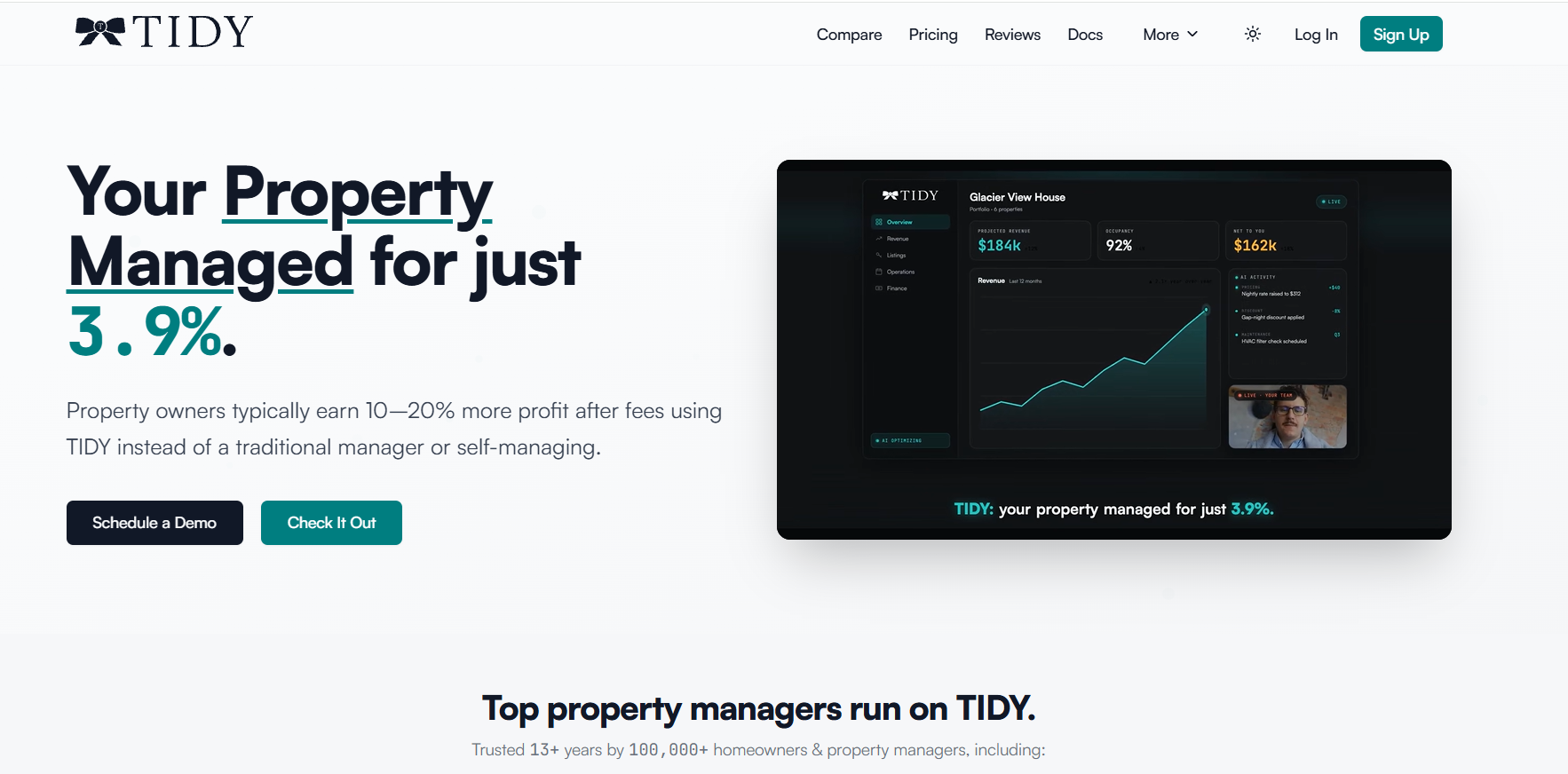 1. TIDY: Best AI Property Manager (and Most Affordable Full Service)
TIDY tops this list because it delivers what a traditional manager does, but at 3.9 percent of gross bookings, or of rent on long-term units, instead of up to 35 percent. That is the same full scope of work, cleaning, maintenance, revenue, guests and tenants, automated rather than staffed, which is how the price drops so far. TIDY reports that owners typically keep 10 to 20 percent more profit after fees than they would with a traditional manager or by self-managing.
What sets it apart is where it starts. Before pricing a single night, TIDY models what the property would earn as a short-term, mid-term or long-term rental, or a mix, then recommends the winner and makes switching affordable as markets change.
It calls this often the single biggest profit lever, and it is a step most tools skip, since a dynamic market price is only layer three of seven. From there it lists and syncs across Airbnb, VRBO, Booking.com, Zillow, Apartments.com and more, layering in dynamic pricing, rank tracking, discount tuning and listing refreshes.
The control model is unusual too. AI handles the routine, human specialists handle edge cases under your direction, a dedicated Account Manager handles setup, and you can override any decision. You also keep your own Airbnb and bank accounts, so your money comes straight to you, and TIDY works with your existing cleaners rather than forcing a switch.
Pricing is transparent: 3.9 percent of gross bookings, or of rent on long-term rentals, with a $19 monthly minimum in each billing period. Cleaning and maintenance management is an optional add-on at a flat $39 per unit per month with no per-job markups, waived for qualifying long-term units, and there are no setup or hidden fees.
One line item to budget for is that paying your pros through TIDY carries a processing fee, 1.7 percent on ACH debit and 3.9 percent on credit cards, while ACH and wire transfers into your own account are free. Setup takes about 90 minutes with an Account Manager walking you through it.
TIDY also backs the service with a profit increase guarantee, measured over 12 months against your previous manager’s actual fees, or against your own prior 12 months if you have been self-managing. The first 90 days are excluded, and if TIDY misses the mark, you receive account credit for the difference rather than a cash refund. It is trusted by more than 100,000 owners over 13-plus years, with a 4.5 rating on Google and 5.0 on G2.
Best for: owners who want true full-service management without surrendering up to 30 percent of revenue or control of their accounts.
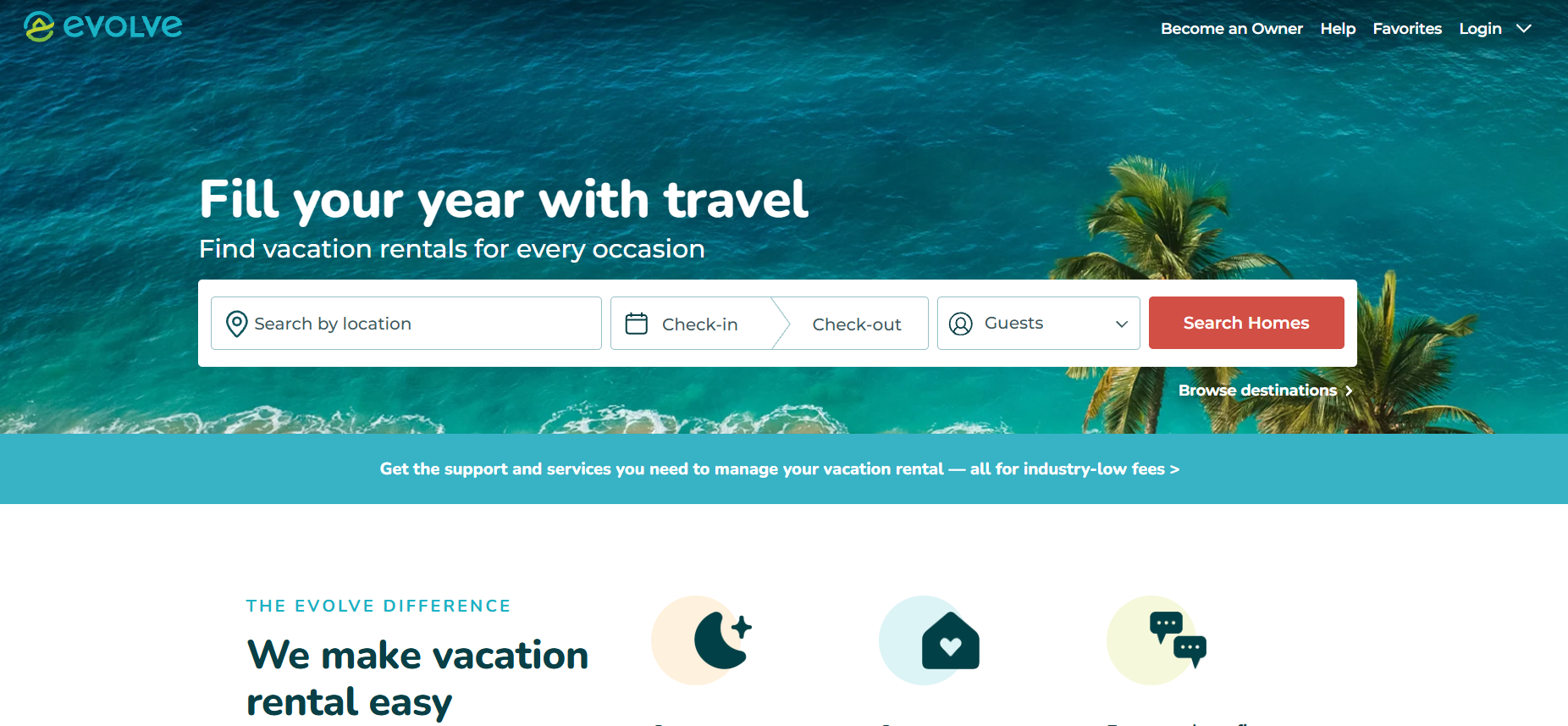 2. Evolve: Best Hybrid for Hands-On Hosts
Evolve flips the traditional model by charging 10 percent on its basic plan, or 15 percent for Evolve Plus, and focusing on marketing, dynamic pricing and 24/7 guest communication. You arrange cleaning and maintenance yourself, which is the tradeoff for keeping more of each booking.
The reach is solid, with more than 30,000 homes across 500-plus North American destinations and listings on Airbnb, Vrbo, Booking.com and its own site. Support includes payment processing, $1,000 in damage protection per stay and a Risk-Free Guarantee that refunds fees if you leave within six months. It holds a 4.1-star Trustpilot average across more than 5,000 reviews.
Best for: nearby or hands-on hosts who enjoy running operations but want help with marketing.
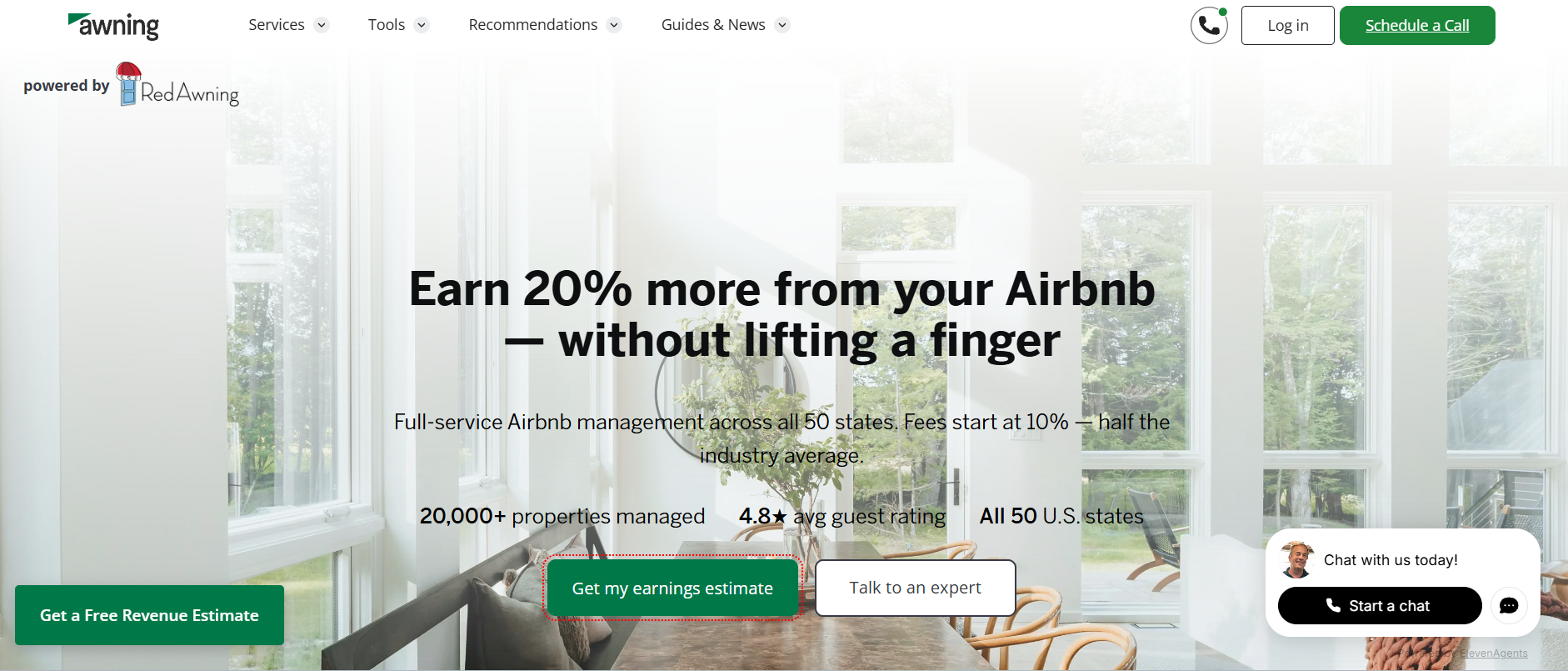 3. Awning: Best for Investors Who Want the Numbers
Awning began as an analytics platform steering investors toward high-yield markets, then added management. Full-service starts at 10 percent of booking revenue, with most homes landing in the 10 to 15 percent band, covering photography, multi-channel marketing, dynamic pricing, 24/7 guest support and coordination of local cleaners and handymen, with cleaning and repair costs passed through at cost.
Investors like the dashboard, which pairs nightly performance with loan amortization, refinance math and neighborhood appreciation. Service is still maturing, reflected in a 2.8-star Trustpilot average across 31 reviews, so it is worth asking how many homes it runs in your market.
Best for: investors and portfolio owners who want financial modeling alongside management.
 4. Grand Welcome: Best for a Local Touch With a Revenue Floor
Grand Welcome grew from 750 homes in 2022 to about 2,200 properties across more than 60 US markets by late 2025, with each territory run by a local franchisee. Its signature hook is confidence, since many franchisees offer a revenue guarantee. One Lake Tahoe office, for example, promises at least $5,000 more than the prior year or pays the difference.
Full-service commission averages around 20 percent, onboarding is free, and contracts typically run a year with an early exit on notice. Listings feed Airbnb, Vrbo, Expedia and 30-plus niche sites. Consistency varies by location, and its Trustpilot average sits at 2.6 stars from just 12 reviews, so interview the local franchisee first.
Best for: owners who want a local relationship plus a revenue safety net.
 5. SkyRun Vacation Rentals: Best for Personal Attention
Founded in Colorado in 2004, SkyRun is a franchise network managing about 1,200 homes across more than 40 US destinations. Each location is locally owned but runs on one booking engine and one pricing brain, giving owners a nearby point of contact backed by national marketing muscle.
Full-service management runs 20 to 25 percent of gross rent, dropping to around 15 percent on a hybrid plan, with no onboarding fee and a 30-day walk-away clause. Listings syndicate to 40-plus channels including Marriott Homes and Villas, and company data cites an average 4.8-star guest rating across Airbnb and Vrbo.
Best for: second-home owners who want personal attention without leaving money on the table.
 6. Vacasa: Best for Maximum Scale and a Hands-Off Experience
After merging with Casago in May 2025, Vacasa now manages roughly 43,000 vacation homes across North America, Belize and Costa Rica, making it the largest operator here. Its pricing engine recalibrates several times a day, and listings reach 40-plus channels, so shoulder-season gaps close quickly.
Full-service fees run 25 to 30 percent of gross rent, the highest on this list, though the Guestworks program offers a flat 10 percent for owners who arrange their own cleaning. Contracts typically run a year with a 90-day exit window, and Trustpilot shows a 4.4-star average from more than 16,000 reviews, with quality varying by local market.
Best for: owners who want maximum reach and a truly hands-off experience and will pay a premium for it.
How to Choose the Right One
Start with the fee model, not the logo. Match how much you pay to how much you actually want to do, because a 25 percent full-service manager and a 10 percent hybrid solve different problems, and an AI manager can now cover the full job for far less than either.
Then think about strategy. Whether your property earns most as a short-term, mid-term or long-term rental is often the biggest single lever on profit, so a manager that helps you get that right is worth more than one that only tweaks nightly prices. Finally, read the exit terms, check public reviews for your specific market and always compare take-home income rather than gross bookings.
The Bottom Line
Traditional management still suits owners who want a local handshake and will pay up to 30 percent for it, and hybrid options like Evolve reward hosts happy to handle operations. But the reason so many properties never turn a profit is that the old fees were simply too high for the math to work.
That is what makes the AI category worth a serious look. If you want everything a property manager does without handing over a fifth of your revenue or your accounts, start there and compare the numbers against the rest of this list.