Construction schedules are under constant strain. Labor prices are skyrocketing, the dense urban job site has ever less available crane time, and high-rise tenants demand no difference in quality between the first and last floor. Aluminum formwork systems are a logical and tested solution to those demands.
This article explains how modular aluminum formwork systems work, the key benefits they offer in the field, the differences between forms of aluminum formwork and traditional timber and steel systems, and factors to consider in determining whether the time is right to move to these high-performing modular formwork systems.
Understanding Aluminum Formwork Systems in Modern Construction
Modular aluminum formwork is a game changer in concrete forming. Instead of creating new timber or plywood forming on every floor, trades build from preengineered panel system that are manufactured to be recycled (sometimes hundreds of times) in the same or similar structural configuration.
What Is an Aluminum Formwork System?
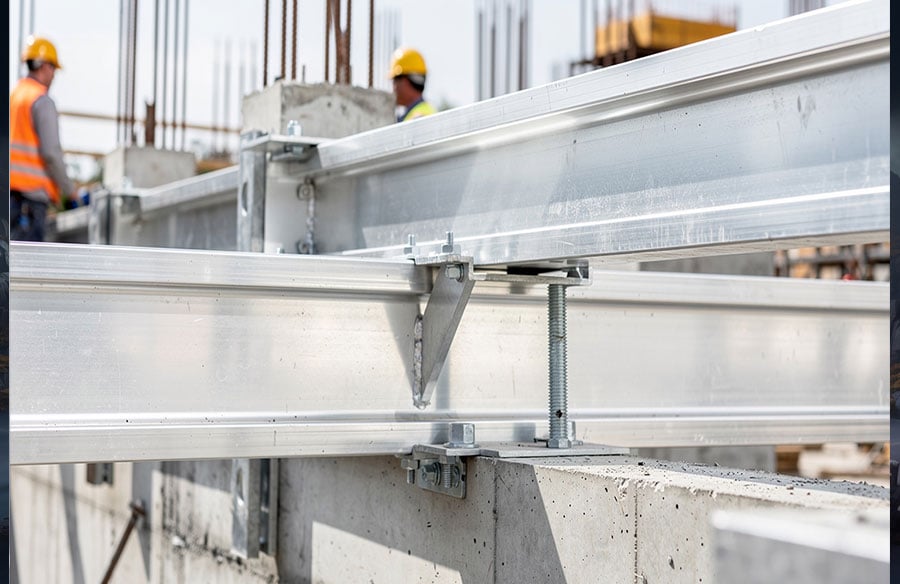
Aluminum Formwork Systems: An aluminum formwork system is essentially comprised of interlocking panels, props, walers and tie systems. These are manufactured from high-strength aluminum alloy and the panels are constructed to specific structural dimensions, allowing them to be easily erected on-site without requiring heavy machining, cutting or adjustment. Each panel of a typical aluminum formwork system weighs around 15-25kg (33-55lbs), so can be easily lifted into position by just one worker with a crane or other lifting device, and locked into place with ease.
The outcome of the arrangement is a robust, monolithic form work for all walls, slabs, columns and beams to be cast at the same time.
Key Applications in Commercial and Residential Projects
All of this is real value on volume projects – projects with repetitive floor plans. You might design a high-rise apartment building, affordable housing project, university dormitory, or hotel tower, and benefit from a set of custom panels that you can reuse on 20, 30, 50 floors or more. Mass housing programs, where hundreds or thousands of identical units are built, are arguably the best application of aluminum panel formwork, as the formwork cost per m2 approaches zero as reuse numbers increase into the hundreds.
Performance Benefits of Aluminum Formwork Systems
Aluminum formwork systems on a well managed project will more than pay for themselves in savings. The construction savings they deliver on well managed projects are high enough to entirely alter the commercial viability of concrete construction.
Faster Concrete Cycles and Construction Schedules
Conventional timber formwork generally takes seven to 10 days per floor cycle. Aluminum formwork systems – which strip cleanly, can be quickly reerected with little to no remedial work required – routinely achieve four to seven-day cycles on high-rise projects, providing schedule compression that equates to an earlier finish date, lower initial costs and quicker time to cash for the developer. A shorter overall program is achieved because it is possible to cast walls and slabs simultaneously.
Leaner Labor Models and Minimal Crane Usage
This is where aluminum formwork gives you a real operational advantage. In terms of panel weight, aluminum formwork panels are light enough so that semi-skilled crews can assemble and strip by hand without the crane rigged up most of the time. A typical steel or heavyweight timber formwork project where panels are strip and restacked in place means a lot of crane time – panels must be lifted, placed, stripped, picked up again and moved into position again and again.
Aluminum system panels can be handled by hand – freeing the crane for more important work and dramatically reducing the number of crane hours you need on every floor.
Quality, Consistency, and Safety on Site
Speed and labor savings are significant, but there are no compromises when it comes to concrete quality – and that’s where aluminum formwork systems really shine.
Surface Finish, Structural Integrity, and Repetition
Since aluminum panels are precision-machined, and retain their shape through repeated re-use, the surface quality of concrete cast in them is always ideal, and features high accuracy. Straight, monolithic pours – whole walls or slabs cast in one pour – are optimum, with no cold joints or empty patches in the building. As a result, concrete is usually nearly ready to accept finishes, and because it performs consistently room-to-room, the benefits increase with each repeat floor.
Built-In Safety, Ergonomics, and On-Site Productivity
Structured formwork design removes the uncertainty that leads to safety issues on site. For reference, OSHA’s requirements for cast-in-place concrete and formwork set out core requirements for formwork design, support, bracing, and removal. Assembly sequences are planned, components are standardised and workers repeat a logical order on each floor. There’s no fly-by-night cutting, no-bodged propping arrangements, no waiting for a panel to be cut down, patched back together and sent over.
Ergonomically, the panels are lightweight. Moving them around the slab has been shown to reduce manual handling injuries – which is a significant cost on many longer duration projects. Predictable workflows lead to easier supervision and faster training when increasing the size of teams on larger developments.
Aluminum vs Traditional Formwork: Cost, Flexibility, and Risk
Not easy to compare with timber, plywood and steel formwork – Contexts are so important.
Cost Structure and When Modular Formwork Is Most Cost-Effective
You’ll pay a premium for a custom aluminum panel set compared to equivalent timber or plywood shuttering. But the long term math adds up quickly. Aluminum systems should return 200-300 uses if well maintained.
Timber formwork typically gets used up in 10-15 uses when the inherent quality starts to break down. Doing the per m 2 of formed concrete cost over the entire project – including the aluminum panel up-front cost, panel fabrication labor, replacement costs, concrete waste, and labor – aluminum formwork should prove to be cost-competitive from around 20-30 reuse cycles on. And for any project with 15 or more repetitive floors, the economics are usually worth it.
– Timber: low upfront cost, high replacement frequency, significant waste
– Steel: durable but heavy, crane-dependent, higher handling cost
– Aluminum: higher initial cost, 200+ reuse cycles, minimal crane dependency, lower lifecycle cost per use
Design Flexibility, Modifications, and Project Constraints
Aluminium formwork is most effective when the structural system is significantly developed prior to assembly. Making late architectural modifications is much more problematic, since panels are fabricated to precise specifications. To a degree this is unavoidable, and requires a strategic approach by the project teams: structural drawings need to be pin-locked in as early as possible.
For projects with very irregular geometry, curved walls or intricate cantilevers, a hybrid solution of panels plus supplemental formwork may be more suitable.
Strategic Selection and Engineering of Modular Formwork Solutions
The decision to use a certain system has to be based on realistic project conditions rather than a desire to be using the latest technology.
Evaluating Project Suitability for Aluminum Formwork Systems
Decision makers should evaluate these factors before committing:
– Number of repetitive floors or structural bays
– Degree of layout standardization across the building
– Local labor market conditions and skill availability
– Site crane capacity and scheduling constraints
– Project schedule pressure and penalty clauses for delay
For markets with low labor rates and less than 15 repetitive floors, projects may not produce enough savings to offset the cost of the aluminum system. Beyond that point, the business case is much stronger.
Specialized Formwork Engineering and Collaborative Delivery Models
Upstream engineering quality is critical to successfully deploying formwork systems (as is the case with any engineered system). The American Concrete Institute’s Guide to Formwork for Concrete (ACI 347) is a widely used technical reference covering formwork safety, quality, economy, planning, and design. Formwork engineering (design) providers (such as Alumlight, which specialises in engineered aluminium formwork) are up front designing panel sets that are suited to the structural shape, capacity and site logistics of the project. This is not a ‘box of off the shelf formwork’, it is a process of collaborative engineering.
The best results are obtained by involving the formwork provider early on, in or soon after structural design is completed, so the formwork system can be ‘designed in’ rather than ‘designed on’.
Conclusion: Leveraging Aluminum Formwork Systems for Competitive Advantage
This formwork would be a real operational advantage for a contractor – quicker floor cycles, leaner crews, less reliance on the crane, more uniform concrete – but would pay out best only with forethought and early commitment. Economics are maximized on repetitive, high-cycle projects where reuse cycles are high and schedule compression translates into bottom-line impact. Those who approach formwork as a strategic differentiator, rather than a purely sourcing decision, will reap its rewards.
For developers and construction managers evaluating their next major project, the practical takeaways are clear:
– Lock in structural drawings early to enable precise panel engineering
– Calculate lifecycle cost per square meter, not just upfront procurement cost
– Engage specialized modular formwork solutions providers at the design stage
– Assess labor market and crane logistics before selecting a system
The pressure to deliver on schedule, costs and quality within the construction sector continues to grow. Aluminum formwork systems, when correctly designed and implemented, provide contractors a long-lasting competitive advantage to deliver on all three.