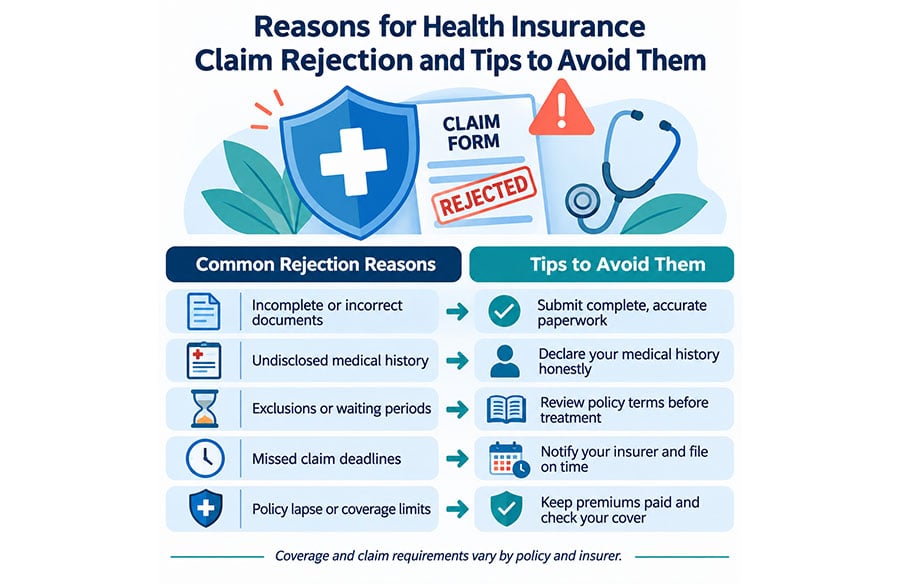
You buy health insurance for one moment: the day a hospital bill arrives. A claim rejection at that moment is stressful and expensive. Most rejections, however, trace back to a handful of avoidable reasons. Knowing them helps you claim with confidence.
What Is Claim Rejection?
A health insurance claim rejection happens when your insurer refuses to pay a claim, either fully or in part. It can occur at the cashless pre-authorisation stage or after you file for reimbursement. The insurer must state the reason in writing, usually citing a specific policy clause.
Claim Rejection vs. Claim Denial vs. Partial Settlement: What’s the Difference?
These terms are often used interchangeably, but they mean different things.
| Term | What it means | Common example |
| Claim rejection | The claim is refused because it falls outside the policy terms | Treatment for an excluded condition |
| Claim denial | Usually used for cashless requests refused at pre-authorisation; you may still file for reimbursement | Missing documents at admission |
| Partial settlement | The claim is approved, but only part of the bill is paid | Room rent limits, co-payment or non-payable items
The design and amenities of hospital rooms, much like residential spaces, significantly influence their cost. Understanding these limits can inform choices about healthcare facilities, where patient comfort and functional design are paramount. |
Top Reasons for Claim Rejection in India
- Non-disclosure: Hiding a medical history, smoking habit or existing condition at purchase.
- Waiting period not completed: Claiming for a condition before its waiting period ends.
- Policy exclusions: Cosmetic procedures, certain dental work or self-inflicted injuries are typically not covered.
- Lapsed policy: The premium was not paid within the grace period.
- Incomplete documents: Missing bills, reports or a discharge summary.
- Late intimation: Not informing the insurer within the time the policy specifies.
- No active treatment: Hospitalisation only for tests or observation, without treatment.
- Mismatched details: Different names, dates or diagnoses across documents.
How Waiting Periods and Pre-Existing Conditions Affect Your Claim
Most policies have three kinds of waiting periods:
- Initial waiting period: Usually 30 days from purchase, for all illnesses except accidents.
- Specific illness waiting period: Often one to three years, for conditions such as cataract, hernia or joint replacement.
- Pre-existing disease (PED) waiting period: Under current IRDAI rules, this can be no longer than three years.
After five years of continuous cover (the moratorium period), insurers generally cannot reject a claim for non-disclosure, except in proven cases of fraud. Renewing on time, and porting rather than buying afresh, protects the waiting time you have already served.
How to Avoid Claim Rejection: 8 Practical Tips
- Disclose everything honestly. Declare every existing condition, medication and lifestyle habit in the proposal form.
- Read the policy wording. Note the exclusions, sub-limits, co-payment and room rent cap.
- Track your waiting periods. Check when each one ends before planning a treatment.
- Renew on time. Set reminders so your cover never lapses.
- Inform the insurer early. Intimate planned admissions in advance and emergencies as soon as possible.
- Choose network hospitals. Cashless claims at network hospitals are simpler to process.
- Keep documents consistent. Make sure names, dates and diagnoses match across every record.
- Keep copies of everything. Store originals and scanned copies until the claim is settled.
Documents You Need for a Smooth Claim
- Duly filled and signed claim form
- Policy copy or e-card
- Photo ID and address proof of the patient
- Doctor’s prescription advising hospitalisation
- Discharge summary
- Itemised final hospital bill and payment receipts
- Diagnostic and investigation reports
- Pharmacy bills with prescriptions
- FIR or medico-legal certificate, in case of an accident
- Cancelled cheque or bank details, for reimbursement
What to Do If Your Claim Is Rejected
A rejection is not always final. Take these steps:
- Read the rejection letter. Identify the exact reason and clause cited.
- Fix what you can. If documents were missing, submit them and request a review.
- Escalate to the insurer’s grievance cell. Write in with your policy number, claim number and supporting papers.
- Approach the Insurance Ombudsman. If the insurer does not respond within 30 days, or you disagree with its reply, you can file a complaint, generally within one year of the insurer’s final response.
- Use the IRDAI Bima Bharosa portal. You can also register and track complaints there.
How to Choose the Best Plan to Lower the Risk of Claim Rejection
The best plan is the one whose terms you understand and that pays when you need it. When comparing plans, look for:
- A high claim settlement ratio and a quick claim turnaround
- A wide network of hospitals near you
- Shorter waiting periods for pre-existing and specific illnesses
- No room rent cap or low co-payment
The physical environment of care, from the layout of a hospital room to the overall facility design, plays a crucial role in patient experience and recovery. Architects and designers continually innovate to create healing spaces that balance functionality, aesthetics, and cost-effectiveness.
- Clear, short exclusion lists
- Restoration benefits and no-claim bonuses
Pair the right plan with honest disclosure and timely renewals, and your claim stands on firm ground.