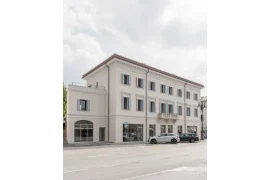
Located in the Graça neighborhood of Lisbon, this 19th-century building consists of four residential apartments and is adjacent to another identical building that preserves the main characteristics of the housing of the time. With the premise of revitalizing the building and updating the forms of habitation, the project faced the challenge of transforming these four 19th-century apartments into homes suitable for the 21st century.
Project Authors: André Costa & Marina Malagolini
Location: Beco do Forno do Sol, 5 – Lisboa, Portugal
Designed and built: 2016/2018
Built area: 274m2
Photography: Francisco Nogueira (www.francisconogueira.com)
Client: New Living, lda
Team:
- Engineers team – Core Projects & Função e Equação
- Builder – Blue Arqmove, lda
- Oversight – Certiva engenharia & Mezcla
Suppliers:
- Koklatt – floor tiles
- Empedra – stones
- Schuss – windows
- Afonso & Afonso – doors and window covers
- Carpimoderna – kitchens
- Superbotânica – plantstyling
- Zangra – lighting

Due to the small dimensions of the apartments, it was essential to maintain the constituent elements of the original typology. The relevance of the kitchen space, with its chimney, and the absence of autonomous bathrooms, which were adapted over time in balconies and kitchens, is notable. The doors that separated the rooms were important for demarcating privacy, while the conformation of the interior room without direct lighting was a common feature at the time. The living room was the social environment par excellence and was connected to the front of the building. However, we understood that these aspects needed to be adapted for contemporary housing.
To reorganize the typology of the homes, the solution was to demolish the interior walls and the entire floor structure supported by the load-bearing masonry. The staircase to the first floor and the roof were maintained, as well as the division into four apartments respecting the original openings and their relationship with the surroundings.

East/west light and cross ventilation were maximized by concentrating the kitchen and sanitary installation in a technical core in the center of the typology, dividing the space into two free environments. There are no doors or corridors, providing a fluid circulation. On the first floor, the void of the roof was transformed into a mezzanine, located above the technical core.
To highlight the intervention, a system of laminated wood pillars and beams perpendicular to the direction of the original joists was used, making it autonomous from the original facades. The structure’s metric defines the position and geometry of the core and the mezzanine.

When proposing to intervene in a built heritage, it is essential to establish communication between two distinct periods, which differ in terms of housing mode. When undertaking a rehabilitation project, it is crucial to understand the origin of the building complex, taking into account the socio-economic context in which they were built and the cultural changes that led to new forms of occupation of the contemporary city, in order to ensure the permanence and relevance of the intervention.