Together with Karmachina, the Milanese studio Migliore+Servetto has conceived the new permanent and multimedia design project for the European Museum in Schengen (Luxembourg) and the redevelopment of the Princess Marie Astrid II Boat, on which the Treaty of the same name was signed in 1985.
Project Name: The new exhibition and multimedia design of the European Museum in Schengen
Studio Name: Migliore+Servetto

It takes the form of a journey through the evolution of the concept of “borders” throughout the world, with a focus on the Schengen Treaty and how it has influenced relations between people and nations, going beyond the European level. The opening is scheduled for 2025, 40 years after the signing of the historic Agreement.
The project for the Museum by Migliore+Servetto and Karmachina, which follows the restoration of the existing structure by Forma Architects, starts from the theme “Borders” and reinterprets the Museum space as a “borderless” place, not only in spatial terms, with no architectural barriers, but also at the multimedia and narrative level. The goal is to create an inclusive museum that is capable of accommodating different types of audiences; one that is accessible, with different but complementary levels of reading and content sharing; one that is innovative, because it works on a multisensory level to activate cognitive memory. The new European Museum will guide visitors as they rediscover one of Europe’s foundational moments, involving them and accompanying them in an immersive experience that passes through the past and the present and looks towards the future.
“It has been an opportunity to have an unconventional and unique exhibition site. Working with the boat moored on the Moselle has allowed us to give physical form to the concept of a permeable cultural place capable of moving and shifting between different territories,” says Ico Migliore. “Our project presents a new concept of an open and itinerant museum that offers an additional experience, in which the 40-metre long boat is transformed into a memorable narrative moment.”

The museum develops as a route structured in stages, between the physical and the digital. It is an engaging journey to experience diversity, possible intersections and integration in an intuitive, interactive and playful manner, which also alternates moments of exploration and reflection. There are 19 installations in a linear progression of texts and objects related to the themes of the four main sections, each with different content, form and multimedia. A circular path flows, culminating in the central core, the “Cube”, the narrative heart that encloses an immersive and engaging installation at the end of the exhibition.
In this multimodal exhibition concept, the Cube constitutes the core of the set-up: it is a memorable and dynamic identity-forming sign, which represents the creative concept of “borderlessness” between countries and the multitude of people who are part of them, where the flag pattern that defines the skin of the cube symbolises the values of union and cooperation. The space expands and develops thanks to a system of mirrors and dynamic lights that produces the effect of a pulsating organism, transforming the Cube into an infinite tower that transcends physical and conceptual boundaries. Inside, an evocative installation recounts the personal adventures of people from inside and outside the Schengen area, testimonies that introduce an emotional catharsis as the final epilogue of the exhibition’s narrative experience.
“The museum has been designed from a dynamic perspective, as a summation of almost theatrical acts based around a central nucleus, the large “cube of flags”, which takes the visitor to another participatory dimension, engaging with time and space,” adds Mara Servetto.

To make the experience within the Museum even more personalised and participatory, the visitor will use a card, which they receive at the entrance, to move freely and activate the different digital stations, and also select their desired language (choosing between German, French and English). In addition, the pathway for children and young people will be guided with the help of a booklet, developed using a playful approach to make the space accessible and enjoyable by even the youngest visitors.
Finally, the new European Museum in Schengen will also house a completely renovated reception area that will serve both as a Tourist Information Centre and as an introduction to the exhibition space, with a check-in section.
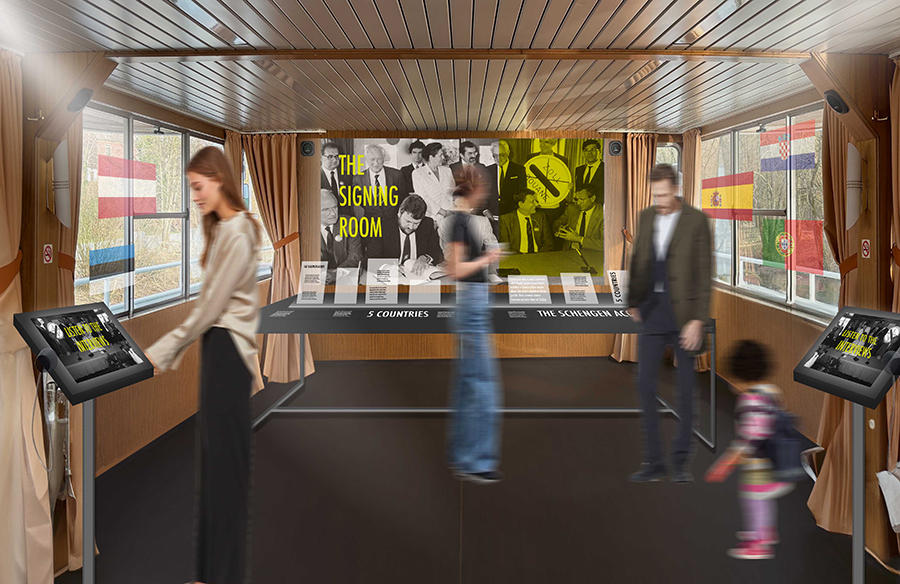
The design by Migliore+Servetto and Karmachina also includes the redevelopment and refitting of the Princess Marie Astrid II boat, the site of the signing of the Schengen Treaty. The boat and its historical structure, which were worn out by use and the passage of time, serve as the background for the story told, maintaining the original structure of the boat but at the same time creating a continuous dialogue with the new layout of the Museum. The finishes and materials in the upper deck room, as well as the curtains and lamps, recall the atmosphere and aesthetics of the time, integrated with contemporary installations and furnishings. For the lower deck of the boat, a flexible and multifunctional system has been designed that is capable of assuming different spatial configurations that can respond to different needs.

The Boat will then be completely renovated and will also host new functions, such as a conference space, a temporary exhibition area and a lounge, as well as a new dynamic installation that tells the story of the signing of the Schengen Agreement. The “Signature Room” will allow visitors to travel back in time, transporting them to the same space that welcomed the representatives of the first signatory countries of the Agreement in 1985. The boat will then become a large traveling stage machine for hosting flexible narrative scenarios, welcoming visitors to a surprising and dynamic environment.