The Migliore+Servetto design studio, which won the national competition to design the set up of the whole museum in 2018, has created the permanent design for Room IX of the Natural History Museum of Milan, dedicated to the “Natural history of humans”.
Project Name: The Natural History Museum of Milan
Studio Name: Migliore+Servetto

The intervention involves approximately 400 square metres and ranges from the overall conception of the room layout – also in terms of the planes and spaces of the environmental graphic communication and multimedia – to the design of the installations that will lead to the reopening of the room to the public, starting from the end of 2023, one year after its closure.
Thanks to the choral synergy between the exhibition elements, graphic communication and multimedia, the Studio’s contribution aims to restore the museum room’s status as a true “theatre of narration” that can dialogue with a variety of audiences in terms of age, level of knowledge, language and culture of belonging, while always keeping the visitor the protagonist of the whole experience. The exhibition concept, which was designed for the human evolution room (Room IX), is thus just the first step of the renovation process put into place by the museum and has been conceived so that it can be included in and adapted to all the other rooms.

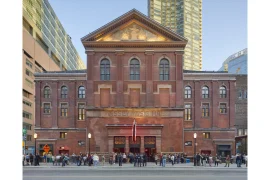
The Natural History Museum of Milan is a cultural and artistic centre for the city of Milan as the guardian of a collection of inestimable scientific value, which consists of more than 700 display cases divided into 23 rooms, housed in a Neo-Gothic style building within the Public Gardens of Porta Venezia.

The architects Ico Migliore and Mara Servetto have placed temporality at the core of the general concept and permanent exhibition design for the room, imagining spaces destined for long-term use. For this purpose, the exhibition system was conceived so that it could be integrated, and as such it is composed of freestanding, independent elements that fit into the space in a light manner and which have been designed to house different types of contents.
In keeping with the objectives of the scientific project by Anna Alessandrello, Curator of the Palaeontology Section of the Natural History Museum of Milan, the arrangement of the contents is able to develop a dense and stratified narration thanks to this new exhibition system. In this way, the visitor can approach the contents in a more engaging and spontaneous way through different levels of depth depending on their curiosity and
knowledge .

The design of the room’s new layout, which includes different exhibition typologies, reflects the curatorial subdivision of the space into four macro areas in ways that are immediately understandable, with every area distinguished by a specific colour and out of scale visual and numerical signage. “Who are we?”: the position of humans in nature and within the order of primates; “An African bush”: numerous species of bipedal hominids originated and coexisted in Africa between 6 and 2 million years ago, including the oldest Homo genus; “Out of Africa”: over roughly the last two million years, representatives of the Homo genus expanded their spatial range, spreading outside Africa on several occasions; “Homo Sapiens”: the appearance of the oldest members of our species.


A scenic tower stands out in the middle of each area as the core of the installation: a 4.5 metre-high parallelepiped made entirely of glass is conceived as the setting of a narration that spans the physical and the digital, both in the interior and exterior spaces. The first tower is completely closed and acts as a huge display case, within which skeletons of current primates are exhibited. The second one can be crossed through and invites visitors to enter and immerse themselves in the multimedia scenography. The third one features an entrance that opens up the view over the inner environment, which is arranged to build an immersive form of storytelling recounting how the ancient representatives of the Homo genus left Africa. The last one, which also can be crossed through like the second one, is dedicated to thought and creativity and is next to a special purpose-built display case that hosts the monumental remains of prehistoric animals.