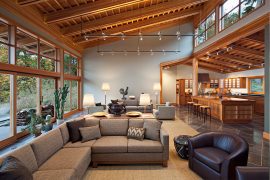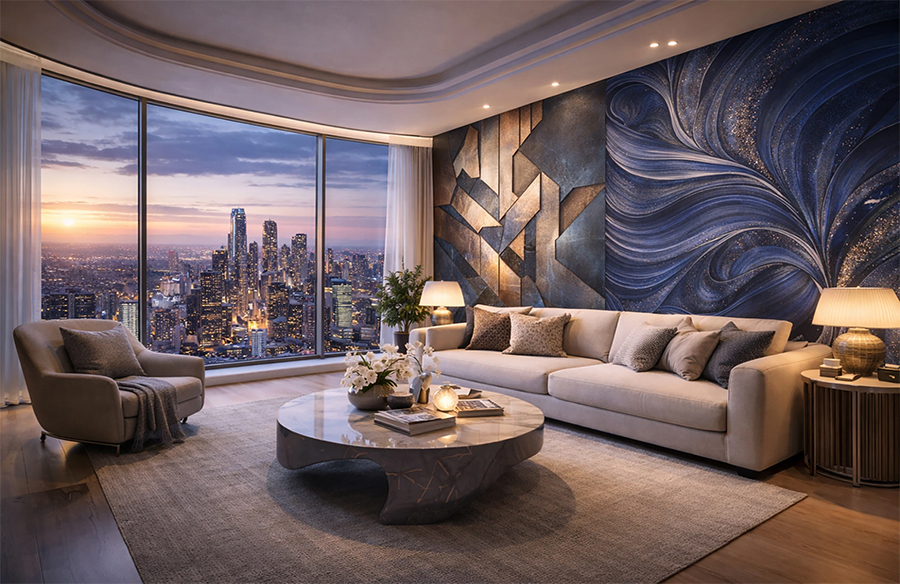
In residential design discourse, walls are often discussed as background infrastructure — planes to be painted, textured, concealed, or occasionally emphasized. Yet this view is incomplete. Walls do not merely enclose space; they regulate how space is read. They determine scale, absorb or reflect light, frame furnishings, control visual rhythm, and shape the tactile and emotional register of an interior. In that sense, the wall is not a passive boundary. It is one of the primary instruments through which architecture becomes perceptible.
This is particularly evident in homes where surface treatment has been considered as part of the design language rather than as a finishing afterthought. Wallpaper, wallcoverings, textile-backed materials, specialty vinyls, grasscloth, murals, and high-end textured surfaces all operate at the threshold between architecture and atmosphere. They bring pattern, grain, repetition, softness, contrast, and depth into direct relationship with proportion, light direction, and occupancy. When chosen well and installed with discipline, they do far more than decorate — they calibrate the interior experience.
For that reason, any serious discussion of residential interiors must include not only the specification of wall materials, but also the technical and perceptual consequences of how those materials are applied.
Surface Is Not Decoration — It Is Spatial Structure
The idea that surface is secondary to architecture has long been challenged in both theory and practice. In lived interiors, occupants rarely experience a room as abstract geometry. They experience it through surfaces: what light touches, what shadows articulate, what hands approach, what peripheral vision continuously reads. Texture and finish mediate this relationship.
A matte painted wall and a textile wallcovering may occupy the same physical plane, but they do not produce the same room. One may read as open, restrained, and optically quiet; the other may compress or enrich the envelope, soften reverberation, or establish a stronger perceptual edge. A repeating pattern can introduce cadence and hierarchy. A large-scale motif can stretch or destabilize scale. A subtly reflective finish can alter evening illumination more dramatically than furniture ever could.
This is why experienced designers often understand wall surfaces not as ornament but as environmental control. They affect more than appearance:
- how a room receives daylight
- how transitions between surfaces are perceived
- how ceilings feel in relation to walls
- how furnishings visually anchor within the room
- how intimate or expansive an interior becomes
In high-functioning interiors, walls are therefore not filled in at the end of the design process. They are part of the architectural argument of the space.
Why Wallpaper Remains Architecturally Relevant
Wallpaper is frequently misread as either nostalgic or trend-driven. In reality, its continued relevance lies in its precision as a design medium. Paint is broad and atmospheric; wallcovering can be exacting. It allows a designer to introduce controlled repetition, tactility, layered color, and material identity in a way that flat coatings cannot.
This becomes especially important in residential architecture, where the success of a room often depends on subtle distinctions rather than dramatic gestures. Wallpaper can modulate those distinctions with unusual sophistication:
- It controls visual grain.
The density of a pattern, weave, or texture affects how a room resolves at different distances. - It introduces material depth without increasing physical mass.
A wall can feel heavier, softer, warmer, darker, or more articulate without changing its structure. - It establishes rhythm.
Repetition across seams and panels creates cadence, which can either stabilize a room or intensify it. - It engages light differently throughout the day.
Morning, afternoon, and evening conditions can all read differently across textured or dimensional surfaces. - It allows a more deliberate relationship between wall and furnishing.
Instead of neutral backdrop logic, it enables compositional dialogue.
This is why wallpaper continues to matter in contemporary homes, particularly where the objective is not merely to finish a room, but to produce a specific spatial character.
The Technical Problem Hidden Behind the Aesthetic Result
What is often underappreciated outside professional practice is that wallcovering is among the most unforgiving interior finish systems in residential work. Unlike paint, which can visually absorb small imperfections, wallpaper records substrate quality, alignment accuracy, corner discipline, pattern continuity, and surface preparation with remarkable honesty.
Every wallcovering project therefore contains two parallel realities:
- the visible design intention
- the hidden technical infrastructure that makes that intention legible
A beautifully specified paper can fail visually for reasons that are not inherent to the material at all. Among the most common causes are:
- uneven or contaminated wall surfaces
- improper priming
- telegraphing seams
- insufficient smoothing of previous repairs
- pattern drift across corners
- poor cutting discipline around openings and trim
- failure to account for light direction
- incorrect sequencing of drops on dominant sight lines
These are not minor field issues. They are the difference between a composed interior and one that immediately reads as compromised.
For this reason, execution quality must be considered part of design authorship. The wallcovering installer is not simply applying a finish; they are translating geometry, pattern logic, and material behavior into a final visual field. In many projects, especially those involving feature walls, textured papers, dark grounds, metallics, or large-scale prints, the installer’s precision directly determines whether the intended architecture survives contact with construction reality.
Denver Homes as a Specific Context for Wallcovering Performance
Regional context matters more than many specifications acknowledge. Denver-area homes present a distinct combination of design ambitions and environmental conditions: strong daylight, relatively low humidity, seasonal shifts, contemporary-mountain influences, large windows, open-plan volumes, and growing demand for high-finish interiors that combine softness with architectural clarity.
These factors affect how wallcoverings are perceived and how they perform.
Light intensity and angle
Homes in the Denver metro area often receive strong directional light, especially in rooms with large glazing and elevated exposure. This means seams, substrate inconsistencies, and texture transitions may become far more visible than they would under flatter or dimmer light conditions.
Modern interior geometry
Many newer homes use open layouts, tall walls, simplified trim profiles, and cleaner transitions. Such spaces leave less visual clutter to hide minor errors. The wall surface is more exposed, more legible, and therefore more demanding.
Material contrast
Contemporary interiors in Denver frequently combine smooth drywall, natural wood, stone, metal, and large textile elements. In these settings, poorly installed wallcoverings can appear especially disconnected because the rest of the palette is often disciplined and crisp.
Climate and substrate behavior
Although wallcovering installation is not reducible to climate alone, dry conditions and seasonal movement can magnify the importance of proper prep, compatible primers, and controlled installation methods. What reads as “just a wallpaper job” is often, in reality, a substrate-management problem before it is ever a decorative one.
That is why homeowners and design teams searching for a reliable wallpaper contractor in Denver homes are often not merely seeking labor. They are seeking technical interpretation — someone able to understand how surface preparation, layout planning, pattern flow, edge treatment, and local light conditions combine into the final architectural reading of a room.
Pattern, Scale, and the Reading of Interior Space
One of the most intellectually interesting aspects of wallcovering is its effect on spatial perception. Pattern is not only stylistic; it is scalar. It tells the eye how large or small a surface feels, how fast it moves across a room, and where attention should settle.
Small, dense repeats can create a refined atmospheric field but may also produce visual chatter if overused in confined rooms. Large-scale botanical or mural compositions can make a room feel immersive and expressive, yet require careful relationship to furniture massing and sight lines. Vertical structures in pattern can strengthen height perception. Horizontal movement may calm or widen a room but can also flatten it if poorly coordinated.
The important point is that wallpaper does not sit neutrally on a wall. It redefines the wall’s legibility.
That is why architects and interior designers should think beyond the binary of “statement wall” versus “plain wall.” The more useful questions are:
- What grain of visual information should this room carry?
- At what distance is the wall expected to be read?
- Is the wall meant to stabilize the room or activate it?
- Will the pattern support the architecture or compete with it?
- How will furniture scale interact with pattern scale?
- What happens to the room when daylight shifts?
These are architectural questions disguised as finish questions.
Installation as a Design Discipline
It is common in residential construction to separate design intent from finish execution. Specifications are made, materials are ordered, and installation is treated as a downstream trade function. But with wallcoverings, this separation often fails.
The installer has to make decisions with compositional consequences:
- where the pattern starts
- where the eye first meets the seam
- how inside and outside corners are managed
- how termination points align with trim and casework
- how pattern continuity is maintained across focal views
- how texture is preserved without surface damage
- how material behavior changes during handling and adhesion
These decisions are not merely technical. They shape what the room becomes.
In that sense, wallcovering installation belongs closer to millwork fitting, stone templating, and finish carpentry than to generic surface application. It requires calibration, patience, substrate reading, and spatial judgment. The more ambitious the material, the more pronounced this becomes.
A luxury wallcovering on an unprepared wall is not a luxury outcome. An expensive pattern with poor layout logic is not high design. A well-designed room can lose authority very quickly when its wall surfaces reveal haste.
Why High-End Interiors Succeed Quietly
The most successful interiors rarely announce the amount of technical control behind them. Their effect is quiet. A room feels balanced. Light settles correctly. The wall has presence without aggression. Pattern supports the furnishings rather than overwhelming them. Corners feel resolved. Edges feel intentional. Nothing calls attention to itself, yet the whole space feels more exact, more coherent, more complete.
This quietness is often mistaken for simplicity. In truth, it is the product of layered decisions executed with care.
Wallpaper participates powerfully in that outcome because it occupies such a large percentage of the visual field. It can either unify a room with remarkable subtlety or expose every weakness in planning and execution. There are few finish materials with so much atmospheric influence and so little tolerance for error.
For architects, designers, builders, and homeowners alike, this should elevate how wall surfaces are discussed. They are not the after-image of design. They are part of the interior’s primary language.
Conclusion
In contemporary residential work, especially in design-conscious homes, wall surfaces deserve to be treated as more than decorative skins. They influence scale, light, rhythm, tactility, and emotional tone. Wallpaper, in particular, remains one of the most sophisticated tools for shaping those effects — not because it adds pattern alone, but because it gives designers a controllable medium through which space can be tuned.
Yet its success depends on more than taste. It depends on preparation, geometry, sequencing, and installation intelligence. The wallcovering does not merely need to be chosen well; it must be translated well.
And that is perhaps the enduring lesson of all serious finish work: the quality people experience most deeply is often the quality they notice least consciously. When walls are resolved with care, the room does not simply look better. It reads more clearly, feels more complete, and carries architecture more convincingly.