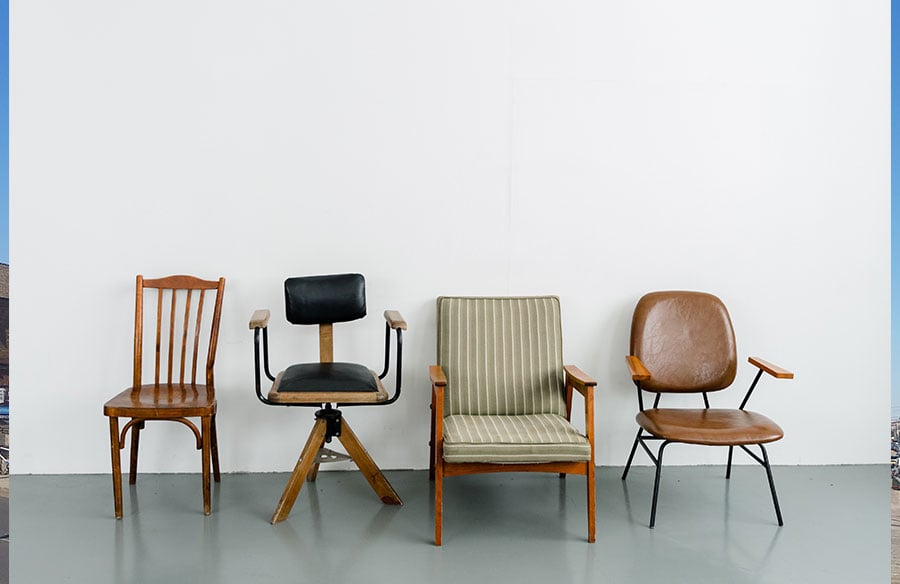
A handful of chairs designed between the 1920s and the 1950s still shape how modern interiors look today. They have lasted because their designers solved a problem rather than styled a shape: how to make a comfortable, mass-produced chair from new industrial materials. That same lineage explains why faithful reproductions of these pieces are made in such volume, and why so many of them turn up in the projects we admire.
What connects the Bauhaus and mid-century modern
The Bauhaus, the German design school founded by Walter Gropius in 1919, argued that good design should serve function and suit mass production. Its workshops treated a chair as an engineering problem as much as an aesthetic one. A chair had to be honest about its materials, cheap enough to make in quantity, and comfortable to sit in. Ornament was treated with suspicion.
When the school closed under political pressure in 1933, its teachers scattered. Several, including Marcel Breuer and Ludwig Mies van der Rohe, moved to the United States and carried on teaching. The principles travelled with them and fed directly into what we now call mid-century modern, the lighter and more organic language that flourished in America and Scandinavia after 1945.
So the two movements are not rivals. Mid-century modern is, in large part, the Bauhaus idea loosened up and given warmer materials.
Marcel Breuer and the tubular-steel breakthrough
Marcel Breuer designed the Wassily chair, originally the Model B3, at the Bauhaus in 1925, while still in his early twenties. The story goes that the bent tubular-steel frame was inspired by the handlebars of his bicycle. It was radical work: a club chair reduced to a steel frame and taut leather straps, with almost nothing solid about it.
Three years later his cantilever Cesca chair showed that a seat could stand on a single continuous frame with no back legs at all. Both designs still read as modern a century on, which is the surest sign the thinking was sound.
Mies van der Rohe and the Barcelona Chair
Ludwig Mies van der Rohe, the Bauhaus’s final director, designed the Barcelona chair with Lilly Reich in 1929 for the German Pavilion at that year’s international exposition in Barcelona. It was made for the Spanish king and queen to use at the opening, which is why it carries more ceremony than Breuer’s tubular pieces, with its hand-tufted leather and polished steel.
The Barcelona chair is also the design most often copied and most often misunderstood, because the quality gap between a careful reproduction and a cheap imitation is wide. If you are weighing one up for a scheme, our Barcelona chair replica guide sets out what separates a faithful version from a poor one.
The Eameses and the moulded shell
Charles and Ray Eames took the Bauhaus interest in industrial process somewhere new. Working in California through the 1940s and 1950s, they were as much film-makers and problem-solvers as furniture designers, and they approached a chair like a piece of equipment. They mastered moulded plywood, then fibreglass, shaping single-piece seats that follow the human body.
Their 1956 lounge chair and ottoman remains the piece most people picture when they hear the phrase “designer chair”. Charles Eames wanted it to feel like a well-used first baseman’s mitt, warm and receptive, and it still does. Because the originals command auction prices, faithful replica Eames furniture is how most people, and many projects, bring that form into a real room.
Scandinavia’s warmer answer
Scandinavian designers reached similar conclusions with wood and a softer hand.
- Arne Jacobsen designed the Egg and the Swan in 1958 for the SAS Royal Hotel in Copenhagen, sculpting foam and fabric into shapes that still feel futuristic.
- Hans Wegner’s Wishbone chair of 1949 pared a dining chair down to a steam-bent frame and a hand-woven paper-cord seat, and it has stayed in production ever since.
- Eero Saarinen, working in the United States, set out to clear away what he called the slum of legs, giving us the single-stem Tulip series and the enveloping Womb chair.
Different materials, same instinct: strip the object back to what it needs to be, then make it beautifully.
Why faithful reproductions matter now
Almost none of us will own an original. The pieces still in licensed production are expensive, and the vintage market is thin and unpredictable. That is why a large and legitimate reproduction industry exists, and why specifiers reach for it when a budget will not stretch to the licensed article.
The word to watch is faithful. A good reproduction follows the geometry, proportions and materials of the original as closely as it can, and is sold honestly as a reproduction rather than passed off as the real thing. A poor one cuts corners on both counts. At Mobelaris, the company I write for, that distinction is the entire business, and it is the same test any architect or specifier should apply when sourcing these designs: does the piece respect the original, and is it described honestly?
The chairs have lasted a hundred years because the ideas behind them were right. Owning one, in whatever form, is a way of living with a good idea. A faithful reproduction is simply the most practical version of that for most of the rooms we actually design and use.