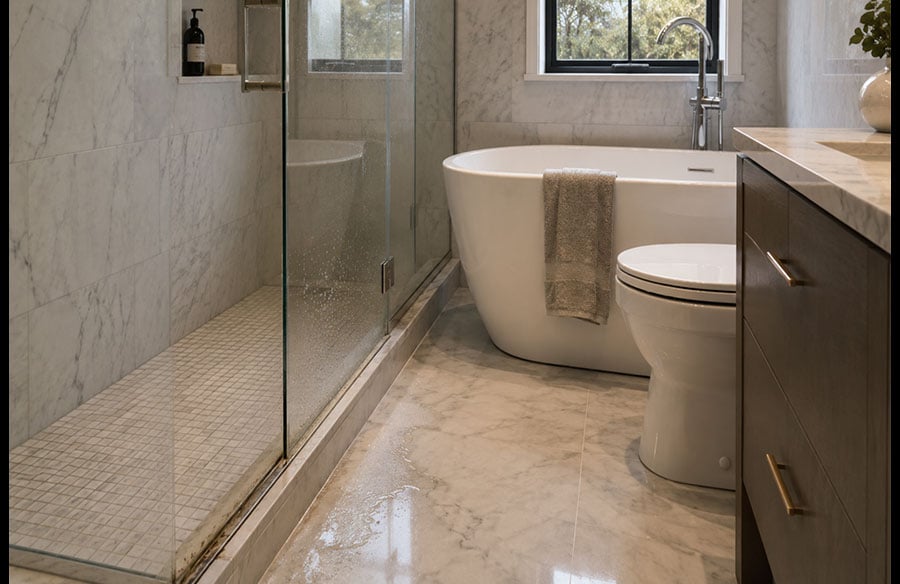
“The bathroom looked perfect in the render. The glass enclosure felt open, the tiles looked refined, and the whole space had the calm, minimal atmosphere we wanted. But after living with it for a few months, we are wiping the floor after every shower. Water collects near the door, grime sits inside the track, and the gap between the bathtub and toilet is too narrow for a mop to reach.”
Most designers have heard some version of this complaint.
It rarely appears during the final presentation or even on handover day. It comes later, when the space is no longer being admired as an image but used as part of daily life. What begins as an elegant composition of glass, stone, lighting, and proportion can gradually become a place of water marks, mould-prone corners, awkward cleaning routines, and maintenance frustration.
For designers, this kind of feedback is not simply about a client being difficult. It points to a familiar gap in bathroom design: the gap between how a space looks when completed and how it performs when lived in.
Bathrooms are particularly unforgiving in this respect. They are exposed to water, steam, soap residue, cleaning products, and repeated movement every day. Details that seem minor on a drawing can become highly visible once the space is used, cleaned, and maintained over time.
Why good-looking bathrooms become difficult to live with
Many bathrooms that fail in daily use do not look poorly designed.
The tile pattern may be carefully selected. The glass screen may feel light and almost invisible. The fittings may be restrained, and the lighting may create exactly the kind of atmosphere the client asked for. In a photograph, everything appears resolved.
But water does not behave like a photograph.
It travels along glass edges, gathers near thresholds, sits in narrow gaps, and leaves traces in places that hands, cloths, and mops cannot easily reach. Foam settles into tracks. Limescale forms along edges. Cleaning products repeatedly test surfaces that were chosen first for their appearance.
This is where the unseen parts of bathroom design begin to matter.
A bottom track on a glass shower door may collect hair, soap residue, and dirt. A narrow gap between a bathtub and a toilet may look acceptable on plan, but become almost impossible to clean. A deep joint between a glass panel and a wall can quietly collect limescale. A shower door that does not close tightly at the bottom may leave a small patch of water on the floor after every use.
Users rarely describe these issues in technical language. They do not say the node was not resolved, the material was poorly matched, or the drainage logic was incomplete. They simply say the bathroom is not practical.
That response matters. A bathroom’s sense of refinement is not sustained by its appearance at handover alone. It depends on whether the space remains orderly, usable, and easy to maintain after months and years of ordinary use.
Water control is the hidden logic of a functional bathroom
Many bathroom problems begin with a simple question: where does the water go?
When water escapes from the shower area and is not directed away quickly, it settles in corners, door gaps, tile joints, and floor edges. At first, this may only mean a damp floor. Over time, grout lines can darken, corners can develop mould, and timber cabinetry or skirting can begin to swell. If absorbent materials are placed near the bathroom, persistent dampness can even create a musty smell beyond the wet zone itself.
This is why wet and dry separation is not achieved by glass alone.
A frameless screen may make a room feel larger and visually lighter, but it cannot compensate for every other decision. If the screen is too short, if the shower head faces the opening, if the floor slope is weak, or if the door bottom does not create an effective barrier, water will still move beyond the shower area.
A successful shower zone depends on several decisions working together: the direction of the spray, the position of the user, the drain location, the floor fall, the size of the glass panel, the way the door opens, and the treatment of the glass edge.
These are rarely the most photogenic parts of a bathroom. Yet they often determine whether the space feels effortless or irritating in everyday life. When this logic is not considered early, designers and contractors are left to solve water problems on site. Such fixes may reduce symptoms, but they seldom replace a well-planned water-control strategy.
How shower screen sealing details shape wet-dry separation
Glass shower screens are often treated as visual devices. They bring transparency, reduce visual weight, and support the clean, minimal language common in contemporary bathrooms.
In use, however, the performance of a shower screen is rarely determined by the middle of the glass panel. It is determined at the edges.
The bottom of the door, the side return, the corner condition, and the junction between fixed glass and wall are all points where water can escape. These areas are exposed to daily water flow, movement, cleaning products, friction, and changes in temperature. If the edge is poorly resolved, water finds the gap. If the material ages, hardens, or deforms, a shower enclosure that once performed well can gradually lose its effectiveness.
For this reason, specifying a shower screen should involve more than selecting glass thickness, a hardware finish, or a frameless appearance. Designers also need to understand how the edge components behave as part of the bathroom system.
Seen in this context, a sealing strip for shower screen is not just a small accessory. It is one of the details through which the glass edge participates in water control, cleaning access, and long-term replacement. For designers, looking at the experience of specialist manufacturers can be useful. Simba, for example, has focused on shower door seals for nearly three decades, and that kind of product-specific experience can help clarify differences in sealing profiles, material hardness, transparency, and replacement logic in real bathroom conditions.
The point is not to make a sealing strip the centre of the design conversation. Rather, it is to recognise that bathroom performance is often shaped by modest, low-visibility details: edges, joints, thresholds, and door bottoms.
When these details work, users do not notice them. The floor simply stays drier. The door gap stays cleaner. The bathroom feels easier to maintain.
When they fail, they quickly become part of the client’s daily complaint.
Material choices should respond to context, not habit
The material used for bathroom edge components should not be selected only because it can block water. In practice, these materials must also respond to transparency, flexibility, weathering, ageing, cleanability, and the visual language of the room.
PVC is a familiar choice. It is cost-stable, easy to process, and suitable for many indoor bathrooms. In shaded, relatively stable environments with lower temperature variation, it can perform well and remain cost-effective. But strong light exposure, high expectations for transparency, or more visually sensitive conditions may call for another approach.
Acrylic can be more appropriate where transparency and visual lightness matter. It can sit more quietly alongside glass and reduce the visual interruption of the edge detail. In outdoor glass applications, semi-outdoor shower areas, or spaces with stronger sunlight exposure, acrylic may also be more suitable than standard PVC.
PP offers a light and unexpectedly clear appearance. It can work well where designers want an edge component that feels visually clean rather than bulky.
Rubber belongs to a different logic. Its value lies in durability, flexibility, and contact performance. Where a door is opened frequently, where cushioning is needed, or where a tighter fit is required, rubber may be more functionally stable over time, even if it is less visually discreet than transparent materials.
The useful question is not “which material is best?” but “which material belongs in this environment?”
A hotel bathroom used many times a day, a guest bathroom used occasionally, a semi-open bathroom exposed to daylight, and a compact shaded apartment bathroom should not all be treated with the same specification logic. Material decisions become more mature when they respond to actual use, exposure, and maintenance expectations.
Maintenance is part of the user experience
Designers often speak about clean lines, but cleanliness is not produced by minimal aesthetics alone. It is maintained through details that can be cleaned, reached, inspected, and replaced.
If a user must wipe glass, dry the floor, and clean the door gap after every shower simply to preserve the intended appearance, the design has shifted too much of its burden onto the occupant.
A successful minimal bathroom is not one with the fewest visible parts. It is one in which necessary parts are resolved intelligently.
Frames should not create unnecessary dirt traps. Door bottoms and side edges should not form unreachable wet zones. Drains, joints, and seals should be accessible. Components likely to age should ideally be replaceable without dismantling the entire system.
These choices may not appear dramatic in a render, but they determine how long the design remains convincing.
In hotels, serviced apartments, rental properties, and short-stay accommodation, this becomes even more important. Cleaning is not only a household routine; it is part of operations. A bathroom that is difficult to maintain can lead to higher cleaning costs, more frequent repairs, and a shorter renovation cycle.
Usability, in this sense, is not a compromise on design quality. It is part of design quality.
Small components influence the life of the whole bathroom
Some of the most important parts of a bathroom are also the least visible.
Seals, hinges, rollers, handles, drain covers, silicone joints, and thresholds rarely occupy much space in a presentation. Yet once they loosen, stain, grow mould, or fail, the experience of the entire room changes.
This suggests that a bathroom should not be understood as a fixed object completed once at handover. It should be understood as a system that will need to be maintained.
Many bathroom problems do not require a full renovation. The shower enclosure may not need to be removed. The tiles may not need to be replaced. Sometimes the issue is simply that a small, replaceable component has reached the end of its useful life.
Designing with this in mind has practical value. Homeowners can reduce repair costs. Rental properties can avoid unnecessary refurbishment. Hotels and short-stay accommodation can maintain quality without disrupting operations. Apartment developments can manage facilities more efficiently over time.
It also has environmental value.
Sustainability is not only about selecting materials with green credentials. It is also about keeping systems in use for longer and avoiding unnecessary demolition. If a small component can be replaced, the whole assembly should not be discarded because that component has aged.
A sustainable bathroom is not always the one that announces itself as sustainable. Often, it is the one that continues to perform well with fewer interventions and less waste.
Bathroom design is not finished in the render
Bathrooms are honest spaces. They reveal very quickly whether real use has been considered, whether materials suit wet conditions, whether junctions can be cleaned, and whether the maintenance logic is clear.
For designers, the edges of a shower area, its seals, drainage, material behaviour, and replaceable components may not be the easiest parts to show in a presentation. Yet they are among the details users experience most directly.
Design value is not found only in visible form, expensive finishes, or a carefully composed photograph. It also exists in the small decisions that reduce cleaning, repairs, and complaints.
When clients no longer return months later to say, “it looks good, but it does not work well”; when the bathroom remains intuitive, clean, and easy to maintain after repeated use; when the original visual quality is not slowly eroded by water marks, mould, and inaccessible corners, the design has moved beyond image-making.
The end point of bathroom design is not a beautiful handover photograph. It is a space that can withstand ordinary use, every day.