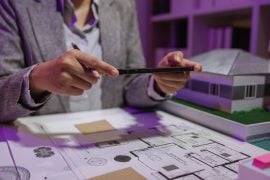
Imagine, for a moment, the year 2015. You are standing in a dusty, half-gutted loft in Tribeca with a client. You’ve spent forty hours on a hand-rendered watercolor and a meticulously crafted CAD floor plan. You present it. The client squints, tilts their head, and says those four words that every interior architect hears in their nightmares: “I just can’t visualize it.”
Fast forward to a Tuesday afternoon in 2026. You aren’t holding a roll of paper; you’re holding a thin glass tablet. You don’t explain the light; you show it. As the sun shifts in the sky outside, your software adjusts the digital shadows on your screen in real-time. Your client isn’t squinting; they are wearing a pair of lightweight AR glasses, walking through a kitchen that doesn’t exist yet, opening virtual drawers and feeling the “flow” of the room.
When they ask, “What if we moved the island six inches to the left?” you don’t reach for an eraser. You tap a prompt. The home planner software doesn’t just move the island; it recalculates the plumbing feasibility, updates the material cost, and checks if the new placement violates the building’s carbon-neutral certification.
This isn’t sci-fi. It’s Tuesday. And it’s the new baseline for a profession that has finally bridged the gap between the poetic and the digital.
Beyond the Grid: The Modern Software Wishlist
For decades, space planning software was essentially a digital version of a drafting table. You drew lines, and the computer made them straight. But as we move deeper into the mid-2020s, the needs of the interior architect have evolved from drafting to simulating.
The modern designer is no longer just a stylist; they are a data scientist with an eye for velvet. Today’s top-tier software—the likes of Revit, SketchUp 2026, and Vectorworks—must now satisfy three non-negotiable needs: Interoperability, Intelligence, and Impact.
1. The Death of the “Digital Silo”
Nothing kills a creative flow faster than a “File Format Not Supported” error. In 2026, designers demand software that talks to everything. Whether it’s importing a 3D scan from a phone’s LiDAR or exporting a BIM model to a contractor’s iPad, the workflow must be frictionless. Autodesk’s “Informed Design” (launched in 2024) set the stage for this, allowing architects to work with manufacturing-ready components from the start.
2. Generative Planning: AI as the Co-Pilot
“I don’t want the AI to design the room,” says Marcus Thorne, a senior interior architect based in London. “I want it to tell me why my design won’t work.” Modern software now includes “Generative Design” modules. You input the constraints—sunlight requirements, fire codes, and the client’s weird obsession with feng shui—and the software suggests ten optimal layouts in seconds. It handles the “math” so the designer can handle the “mood.”
Case Study: The Heritage Scan
In late 2025, a boutique firm in Milan was tasked with converting a 17th-century monastery into a luxury hotel. The walls were uneven, the ceilings were sagging, and traditional measurement would have taken weeks.
Using Vectorworks Nomad, the lead architect spent just two hours walking through the space with an iPhone. The LiDAR sensors captured every imperfection, creating a “Point Cloud” that the software automatically converted into a 3D model. By the next morning, the team was performing structural simulations. The software didn’t just plan the space; it respected the history of the stone.
The Green Algorithm: Designing for the Planet
Sustainability is no longer a “premium” add-on; it’s a legal and ethical requirement. Modern planning software now includes real-time carbon tracking. As you swap a marble countertop for a recycled composite, a small “Sustainability Score” in the corner of your screen updates.
Luc Lefebvre, a product marketing manager at Vectorworks, emphasizes that “Well-being” is the biggest trend of 2026. “Our tools now allow designers to simulate biophilic impact—how much natural light hits a desk at 3 PM in November, or how indoor plants affect air quality. We are designing for the nervous system, not just the eyes.”
The Final Render: A Human-Centric Future
With all this talk of algorithms and LiDAR, it’s easy to fear that the soul of interior architecture is being lost to the machine. But the opposite is true. The most sophisticated software of 2026 is designed to be invisible. It removes the “grunt work”—the tedious measurements, the repetitive Revit families, the endless rendering wait times.
What remains is the designer’s intuition. The software can tell you where a chair can go, but only a human knows where it should go to make a person feel at home.
In the end, modern space planning software is less like a calculator and more like a high-performance instrument. It requires a master to play it, but when it’s used correctly, it creates a harmony between the space we inhabit and the digital world that helps us build it.
Joachim Rodriguez y Romero, CEO and editor in chief of KUNSTPLAZA – an interior design focused online magazine – summarizes the latest evolution in interior design apps as follows:
“Modern room planning software has evolved into a sophisticated AI-driven ecosystem that bridges the gap between creative intuition and technical precision by integrating BIM, cloud rendering, and automated data analysis. Our expert evaluation of twelve leading apps reveals how these tools democratize professional-grade design, allowing both experts and enthusiasts to transform complex visions into photorealistic, sustainable realities with unprecedented speed. Ultimately, the right software has moved beyond being a simple drawing aid to become the essential engine for flawless architectural execution and emotional space-making.”
The Takeaway for Firms
If your firm is still debating whether to adopt AI or VR, you’re already behind. The “needs” have shifted from tools that draw to ecosystems that understand. In 2026, the best software is the one that lets you forget you’re using a computer at all.