Induction cooktops have moved from specialty item to mainstream choice in Toronto kitchen renovations. Many homeowners assume that dropping the gas burners also means they can downgrade the range hood. It is an understandable idea, and it is mostly wrong. The cooktop and the ventilation are two halves of the same decision, and both need to be settled before the cabinets are ordered.
What induction actually changes
Induction heats the pan directly through a magnetic field rather than heating a burner or element first. The efficiency gap is significant. In its 2021 Emerging Technology Award review of residential induction cooktops, ENERGY STAR estimated that induction transfers energy at roughly 85 per cent efficiency, compared with about 75 to 80 per cent for electric resistance and about 32 per cent for gas. That makes induction about three times as efficient as gas. The same review notes that the cooler cooktop surface releases less heat into the room and makes induction safer to work around.
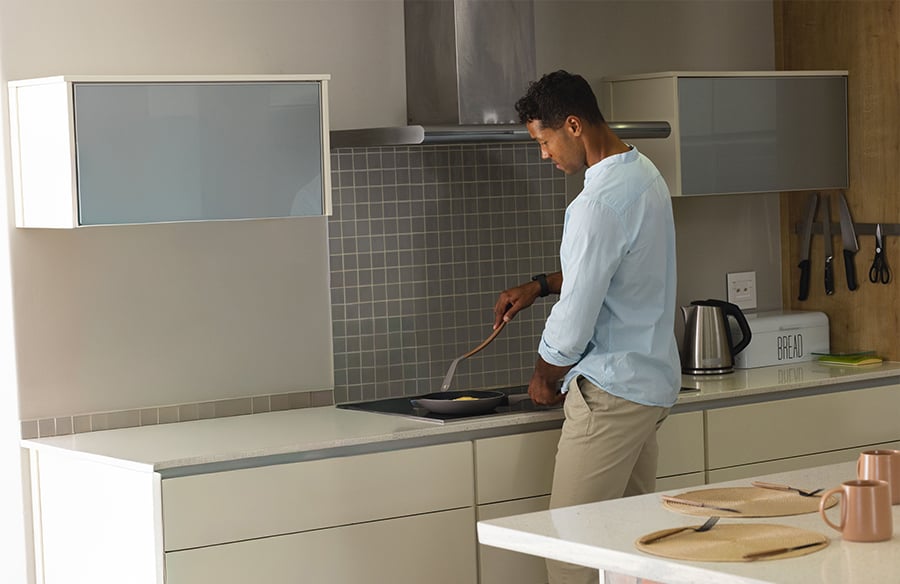
For a renovator, the cooler surface is the detail worth noticing. A gas range pours heat into the kitchen and up the wall behind it. Induction does not, which is part of why it is popular in condos and smaller open-plan kitchens where the cooking zone sits a few steps from the sofa.
Why you still need a good hood
Switching fuel removes combustion. It does not remove cooking. According to Health Canada’s factsheet on cooking and indoor air quality, cooking produces fine particulate matter whether you use a gas or an electric stove, and a Health Canada study found particle levels can be 65 times higher than background levels after cooking. Gas adds by-products such as nitrogen dioxide and carbon monoxide on top of that, which is one reason the switch to induction appeals to many families. But searing, frying and roasting generate smoke, grease and moisture no matter what heats the pan.
The same factsheet notes that running a range hood on its high setting, about 300 cubic feet per minute, can reduce exposure to cooking-related pollutants by more than 80 per cent compared with lower speeds. It also recommends a hood that fully extends over the burners. A slim hood that only covers the back half of a 36-inch cooktop will miss much of what comes off the front.
Sizing and ducting in real Toronto kitchens
Getting a hood to work well depends less on the brochure and more on the duct run. A few practical rules hold in most homes:
- Vent to the outdoors. Recirculating hoods filter grease and some odour, but they return moisture and fine particles to the room.
- Keep the duct short and straight, at the diameter the manufacturer specifies. Every elbow and reducer costs airflow, and a powerful fan choked by a long, narrow duct performs like a weak one.
- Match the hood to the cooktop width, and on an island, consider going wider. Island hoods have no wall behind them to help channel rising air.
- Ask about make-up air. A tight, renovated house can struggle to supply replacement air to a high-capacity hood, and your contractor or HVAC trade should check this before you buy one.
In older semis and bungalows, the route for the duct is often the hardest part of the design. Joists may run the wrong way, an exterior wall may be brick on one side and a neighbour on the other, and condo kitchens frequently have limited exterior penetrations at all. These constraints are why ventilation routing belongs in the pre-design check alongside load-bearing walls and electrical panel capacity, rather than being left to the week the hood arrives.
The electrical side of the switch
Induction cooktops and ranges draw substantial current and typically need a dedicated 240-volt circuit. In a house with an older 60- or 100-amp panel that already supports a heat pump, an EV charger or an electric dryer, there may simply not be room. An electrician should do a load calculation before you fall in love with a particular model, because a panel upgrade adds cost, scheduling and a permit to the project.
The gas line needs a decision too. Some homeowners cap it at the kitchen and keep gas for the furnace and water heater; others plan to remove gas altogether over time. Either is reasonable, but the work should be done by a licensed gas fitter, and the plan should be made before walls are closed.
Cookware, layout and the small stuff
Induction only works with magnetic cookware. Test your pots with a fridge magnet before budgeting for the switch, since replacing a full set of aluminum or copper pans is a real expense. On the layout side, induction’s flat glass top works well as part of an island or peninsula, where it doubles as extra counter space when cool. If the cooktop goes in an island, plan the hood or a downdraft system at the same time, because that choice affects the ceiling, the lighting plan and the sight lines across an open-concept room.
Homeowners comparing kitchen remodelling services should ask each contractor how they would route the hood duct, whether the panel can handle the new load, and who coordinates the gas fitter and electrician. The answers say a great deal about how much planning will happen before demolition.
Test the hood before the backsplash goes up
Once the hood is mounted and wired, run it on high with a pot of boiling water on the front burner and watch where the steam goes. If it rolls past the hood or the fan sounds strained, the duct may be undersized, kinked or poorly sealed. Fixing it is straightforward while the backsplash wall is still open, and considerably more disruptive after the tile is set.