Architecture is often associated with permanence: foundations, structural systems, façades and defined urban boundaries. By comparison, a tent is usually seen as simple outdoor gear, carried to a campsite, set up for a short stay and packed away again.
Yet from the perspective of human use, a tent is more than a temporary cover. It responds to basic spatial questions: how people enter, pause, store belongings, stay protected and remain connected to the surrounding environment.
As outdoor lifestyles become more flexible, the modern tent is taking on a broader role. It is no longer only a shell for sleeping, but a lightweight outdoor structure that can support rest, storage, conversation and short-term living in nature.
Lightweight Structures Can Also Be Spatial Solutions
Architecture does not always need to be heavy, permanent or complex. In many real-world situations, people need a lighter, more flexible spatial solution that makes an outdoor site usable without permanently altering it.
The tent is one of the clearest examples of this kind of lightweight space. It can be brought to a forest, lakeside, coast, field or campground, then opened when needed to create a place for shelter, rest and activity.
This is where the modern inflatable outdoor tent deserves reconsideration. It is not architecture in the conventional sense, but it still deals with shelter, support, ventilation, scale, boundary, and the organization of human activity outdoors.
In this sense, the tent is not a simplified version of architecture. It is a lighter, more temporary spatial form shaped around mobile ways of living.
Modern Tents Are No Longer Just Sleeping Spaces
Many people still choose tents by asking how many people they can sleep. Once used outdoors, however, it becomes clear that sleeping is only one part of what a tent must support.
A tent also holds bags, shoes, clothing, lighting, food and daily items. When several people travel together, it often becomes the central space of the camp: a place for arrival, changing, storage, short conversation and recovery.
This has similarities with spatial organization in architecture. A home needs entry, storage, resting areas and activity zones; a tent is smaller and lighter, but it still uses doors, windows, height and floor area to guide movement and comfort.
The design value of a modern tent is therefore not only about whether it can be set up. It is about whether the space works well once people are inside it.
Air Support Changes the Structural Logic of Tents
Traditional tents rely on poles to create their frame. This logic is direct, but setup often depends on multiple parts, steps and experience. Inflatable structures change that process by turning air into part of the support system.
Air-beam construction also changes the form of the tent. Compared with rigid poles, inflatable structures often feel more continuous, softer and more enclosed, allowing a compressed object to expand quickly into a usable space.
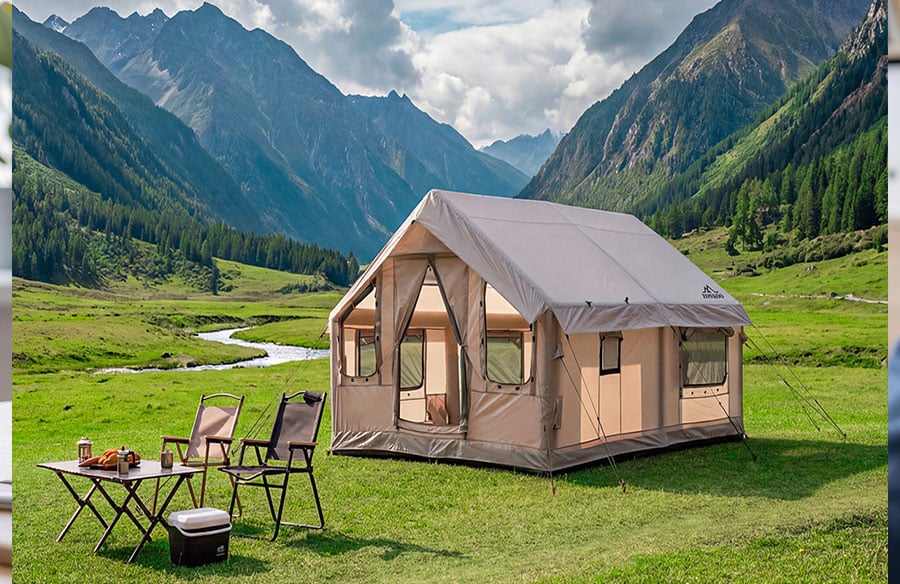
This approach is especially meaningful for larger outdoor settings. Zonkoo Draco fits this role within the category of large inflatable tents, offering families, friends or multi-person camps a shared space for rest, storage, communication and temporary gathering.
Once a tent moves from a single-purpose sleeping tool to a usable outdoor space, structure becomes more than support. It begins to shape how people behave inside.
Good Outdoor Space Needs a Clear Sense of Boundary
A tent creates a boundary without fully cutting people off from nature. It is not as permanent as a house, and it is more enclosed than a simple canopy. It sits between architecture and landscape.
That balance matters. If the boundary is too weak, people may lack comfort and security; if it is too strong, the connection to the outdoors is lost. Door placement, windows, ventilation routes, interior height and openings all influence how that balance feels.
This is the role a well-considered inflatable camping tent should play. It is not simply about enclosing people inside fabric, but about turning an outdoor setting into a more livable place.
Movable Spaces Are Adapting to New Ways of Living
Modern travel and outdoor life are becoming more flexible. Family trips are not limited to hotels, friend gatherings do not always stay indoors, and outdoor activities are no longer only for highly specialized users.
This gives movable structures such as tents renewed relevance. They can support a family camping trip, a friend gathering, an outdoor event, a long weekend away or a temporary stay at a campsite.
Just as importantly, their impact on the site can remain light. A tent does not need to permanently alter the land or turn nature into an interior environment. It simply allows people to stay outdoors longer, more comfortably and with more order.
That is the value of lightweight architecture: responding to immediate human needs without occupying the environment with heavier structures.
From Gear Design to Spatial Design
Modern tent design shows how outdoor products are moving from single-function equipment toward spatial experience. People no longer look only at rain protection, sleeping capacity or portability. They also consider movement, ventilation, storage, setup time and the feeling of place inside.
These questions go beyond product specifications. They are closer to spatial design: whether people feel comfortable, whether movement is natural, whether boundaries are appropriate and whether the structure supports real use.
Modern tents are therefore taking on a more complex role. They are outdoor gear, but also movable spaces; short-term shelters, but also transitional interfaces between people and nature.
Seen from this perspective, the modern tent is not outside architecture. It is a lighter, more flexible spatial answer to the needs of contemporary outdoor life.