Paperboard and Cardboard for Interior Design
Paperboard and cardboard offer lightweight, fiber-based alternatives for partitions, furniture, displays, and decorative interior components. Their low weight and adaptable structures make them especially suitable for temporary and semi-permanent spaces.
In this article, paperboard is used as the broader technical term for dense fiber-based board materials. Cardboard mainly refers to corrugated, honeycomb, and other structured boards commonly used in interior products and installations.
Common Paper-Based Board Structures
Solid paperboard, corrugated cardboard, honeycomb panels, and paper tubes serve different structural and visual purposes. In corrugated cardboard manufacturing, fluted medium is bonded between liner sheets to create a lightweight structure with good bending resistance. Honeycomb panels, by contrast, distribute loads through a cellular core.
Paper tubes provide compressive strength for columns, furniture legs, and shelving supports. The appropriate structure depends on the required stiffness, panel thickness, surface quality, and expected load direction.
Why Paperboard Supports Sustainable Design
Paperboard and cardboard can reduce material weight, transport demand, and processing requirements compared with denser interior substrates.
Renewable Fiber Materials
Paperboard is produced from wood pulp, recovered paper, or a combination of virgin and recycled fibers. These fiber sources are renewable compared with mined or petroleum-based materials, although sourcing practices and forest management still affect the overall environmental impact.
Recycled cardboard also keeps recovered fiber in circulation and reduces demand for newly processed raw materials.
Lightweight Transport
Paperboard and cardboard panels weigh less than particleboard, MDF, or gypsum panels of similar dimensions. Their reduced weight can lower fuel demand during transportation and simplify on-site handling.
Flat-packed cardboard furniture, partitions, and exhibition components also occupy less shipping space before assembly.
Efficient Honeycomb Structures
Honeycomb cardboard cores achieve high bending stiffness while using relatively little fiber between the facing sheets. This structure lowers panel density while maintaining resistance to distributed interior loads.
Cell size directly affects compressive strength. Smaller cells generally improve load resistance but increase fiber consumption, so designers must balance strength, weight, and production cost.
Low-Waste Modular Production
Digital cutting allows paperboard and cardboard panels to be produced in precise modular shapes. Standardized dimensions and optimized cutting layouts help reduce offcuts during fabrication.
Slotted joints and folded connections can eliminate some metal fasteners and simplify disassembly. Modular cardboard systems can therefore be reused in multiple retail, exhibition, or event installations.
How Paperboard Is Manufactured
During the paper production process, prepared fibers pass through forming, pressing, drying, and finishing stages.
Fiber and Pulp Preparation
Wood chips or recovered paper are pulped, cleaned, screened, and refined into a uniform fiber slurry. Fiber length, cleanliness, consistency, and refining intensity influence the final board strength, stiffness, and folding performance.
Recycled cardboard may pass through additional screening and cleaning stages to remove inks, adhesives, plastics, staples, and other contaminants.
Paperboard Machine Forming
In a paperboard making machine, the prepared pulp slurry is distributed onto a moving forming wire. Water drains through the wire while the fibers collect into a continuous wet mat.
Fiber orientation during forming establishes the primary strength direction of the sheet. Stable stock distribution and controlled drainage help maintain uniform thickness and basis weight across the board width.
Multi-Layer Board Forming
Thicker paperboard may contain multiple fiber layers bonded together during sheet formation. Manufacturers can combine virgin fibers, recycled fibers, and different pulp grades to balance strength, appearance, and production cost.
Outer layers may use cleaner or stronger fibers to improve surface quality, while inner layers contain lower-cost recycled material. Uneven moisture or layer thickness can cause curling and warping after drying.
Pressing and Drying
The wet fiber mat passes through press rolls that remove water and increase fiber bonding. Effective pressing improves sheet density and reduces the energy required in the drying section.
Heated drying cylinders then reduce the remaining moisture and stabilize the board dimensions. Controlled drying is essential because uneven moisture profiles can lead to deformation during converting or interior use.
Calendering and Coating
Calendering compresses and smooths the paperboard surface for printing, laminating, or decorative finishing. A more uniform surface improves graphic quality and allows facing materials to bond more consistently.
Coatings can add moisture resistance, abrasion resistance, or visual effects. However, plastic films and heavy barrier coatings may make the finished board more difficult to recycle.
How Production Affects Performance
Manufacturing choices directly affect the strength, weight, appearance, durability, and recyclability of finished paperboard and cardboard panels.
Fiber Strength and Bonding
Fiber length and refining intensity determine how effectively fibers bond during pressing. Stronger bonding improves tensile strength and resistance to delamination but may reduce folding flexibility.
Virgin fibers generally retain more strength than fibers that have passed through several recycling cycles. Recycled content must therefore be matched with the intended structural requirements.
Weight, Thickness, and Stiffness
Increasing panel thickness generally improves bending stiffness, but performance also depends on the internal structure. A lightweight honeycomb cardboard panel may be stiffer than a thinner solid board while using less fiber.
Grammage, measured in grams per square meter, indicates the material mass of the sheet. It should be considered together with thickness, density, core structure, and facing strength.
Moisture and Warping Control
Uneven drying, changing humidity, or direct moisture exposure can cause dimensional movement and panel warping. Balanced layer construction and controlled moisture content reduce these risks.
Protective facings and suitable coatings can improve stability, but they should be selected carefully when recyclability is an important project requirement.
Surface and Print Quality
Calendered paperboard accepts printed graphics, decorative films, and laminated finishes with fewer visible defects. This makes it suitable for branded retail displays and visually finished interior panels.
Corrugated cardboard normally has a less uniform surface. A smooth liner or printed facing sheet can be added when higher graphic quality is required.
Interior Applications of Paperboard and Cardboard
Paper-based panels are used for temporary and semi-permanent interior functions across retail, office, exhibition, residential, and event environments.
Partitions and Wall Panels
Honeycomb paperboard and corrugated cardboard panels can form lightweight interior partitions that are easy to transport, install, and reposition. They are often used where permanent structural walls are unnecessary.
Panel thickness, core density, joint design, and facing material determine resistance to impact and continuous pressure. Thin cardboard panels are unsuitable for load-bearing walls or areas exposed to repeated heavy contact.
Acoustic and Ceiling Panels
Perforated paperboard surfaces can absorb sound by allowing acoustic energy to enter internal cavities. Honeycomb and corrugated structures may also trap air and reduce sound reflection.
Panel depth, perforation size, backing material, and installation distance from the wall or ceiling influence acoustic performance. Fire classification must also be verified before overhead installation.
Retail and Pop-Up Interiors
Cardboard is widely suited to retail displays, pop-up shops, product stands, and temporary branded environments. Its low weight supports fast installation, while digital printing allows graphics to be applied directly to the surface.
Short retail cycles align well with the limited service life of many cardboard structures. Slotted components can also be disassembled and stored for later campaigns.
Furniture and Shelving
Cardboard furniture can include stools, chairs, tables, counters, and shelving systems. Honeycomb tabletops and folded structural sections distribute moderate loads while keeping the finished product lightweight.
Paper tubes may be used as table legs, columns, or internal supports. Continuous heavy loading can still cause creep, especially across long unsupported spans.
Event and Exhibition Structures
Temporary exhibition stands frequently use folded cardboard panels, honeycomb boards, and paper tubes for rapid assembly. These materials are suitable for backdrops, display walls, information counters, signage, and lightweight product platforms.
Reusable connections reduce damage during disassembly and allow structural components to support multiple events.
Decorative Interior Features
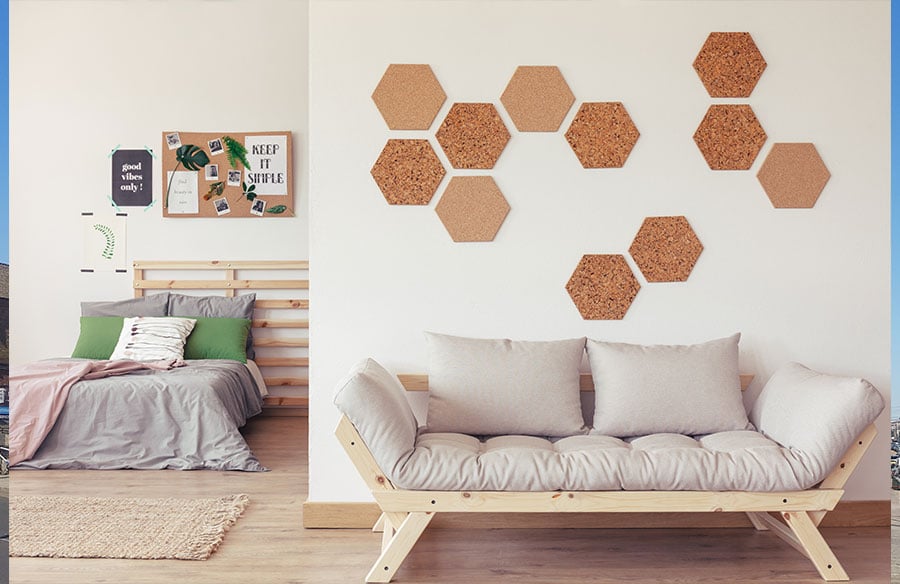
Paperboard can be cut, folded, layered, embossed, or printed to create decorative wall surfaces, lighting features, sculptures, and spatial installations.
Layered cardboard profiles can form complex three-dimensional shapes without requiring heavy framing materials. Their appearance can be left natural or finished with printed and laminated surfaces.
Selecting Paperboard and Cardboard for Interiors
Material selection should reflect the expected load, installation period, environmental conditions, surface requirements, and end-of-life plan.
Thickness, Grammage, and Fiber Composition
Thicker panels and higher grammage generally support greater loads but also increase material weight and cost. The relationship is not always direct because internal geometry strongly affects structural performance.
Fiber composition also influences strength and appearance. High recycled content may produce a less uniform surface but can improve the environmental profile of low-load applications.
Honeycomb Cores and Facing Materials
Facing sheets protect honeycomb cores from abrasion, localized impact, and moisture penetration. They also carry tensile and compressive stresses when the panel bends.
Thicker or stronger facings improve stiffness but increase weight. Kraft liners, coated paperboard, decorative paper, fabric, and thin wood veneers may be used depending on the required finish.
Fiber Direction, Folding, and Stiffness
Fiber direction changes how solid paperboard bends and folds. Sheets usually bend more easily across the grain, while folds made in an unsuitable direction may crack or form irregular creases.
Designers should align the stronger direction with expected load paths. Folding tests are recommended before producing large quantities of furniture or decorative components.
Solid Paperboard and Corrugated Cardboard
Solid paperboard offers a smooth and uniform surface suited to printing, fine detailing, folding, and decorative lamination. It is commonly selected where appearance and surface consistency are important.
Corrugated cardboard provides better cushioning, impact resistance, and thickness at a lower material weight. It is more suitable for displays, partitions, temporary furniture, and folded structural forms.
Single-Wall and Multi-Wall Cardboard
Single-wall corrugated cardboard suits lightweight displays, signs, and decorative structures. Double-wall and multi-wall boards offer greater compressive strength for furniture, counters, partitions, and exhibition components.
Additional flute layers improve rigidity but also increase thickness, weight, and cutting complexity.
Environmental Benefits and Trade-Offs
The environmental performance of paperboard and cardboard depends on fiber sourcing, manufacturing efficiency, service life, reuse, and end-of-life treatment.
Energy and Material Efficiency
Lightweight honeycomb and corrugated structures can achieve useful stiffness with less material than many solid interior panels. Reduced weight also lowers handling and transport requirements.
However, energy use varies according to pulp source, recycled fiber processing, drying demand, coatings, and production location.
Recycled and Virgin Fiber Use
Recycled fiber reduces demand for virgin pulp and gives recovered cardboard another useful life. However, fibers shorten and weaken each time they are repulped.
Manufacturers may combine recycled fibers with stronger virgin pulp to achieve the required performance. The appropriate balance depends on whether the product is decorative, temporary, or load-bearing.
Coatings, Adhesives, and Recycling
Coatings and adhesives can improve water resistance, surface durability, and structural bonding. At the same time, some plastic laminates, synthetic resins, and strong adhesives interfere with fiber separation during recycling.
Water-based adhesives, removable facings, and mono-material designs generally support easier recovery at the end of the product’s service life.
Lightweight Transport and Emissions
Lightweight cardboard components may require less fuel during transportation than heavier wood-based or mineral panels. Flat-pack systems further reduce shipping volume and warehouse space.
Actual transport benefits depend on distance, packaging efficiency, vehicle utilization, and how many times the components can be reused.
Reuse and End-of-Life Options
Slotted and modular connections allow cardboard components to be taken apart without severe damage. This can extend their service life across several exhibitions, retail campaigns, or temporary installations.
Clean and uncoated boards can often enter established paper recycling streams. Wet, contaminated, heavily laminated, or bonded boards may require disposal or specialized treatment.
Suitable Uses and Performance Limits
Paperboard and cardboard perform best when their load, moisture, fire, and service-life limitations are considered during design.
Temporary and Semi-Permanent Interiors
Cardboard is particularly suitable for short-term spaces where rapid installation, low weight, and easy removal are more important than long-term durability.
Semi-permanent installations require stronger cores, reinforced joints, protective edges, and controlled indoor conditions. Permanent structural applications generally require materials with higher load and moisture resistance.
Decorative and Low-Load Applications
Decorative panels, printed displays, acoustic features, signs, and light shelving fall within the practical performance range of paperboard.
Heavy equipment, long unsupported shelves, and continuously loaded structural elements require additional framing or reinforcement.
Extending Cardboard Service Life
Protective coatings, edge guards, replaceable facings, controlled humidity, and reduced direct handling can extend the life of cardboard interior products.
Regular inspection helps identify crushed edges, damaged joints, delamination, or moisture exposure before the structure loses stability.
Conditions That Reduce Performance
High humidity causes fibers to absorb moisture and swell, weakening internal bonds and encouraging warping. Direct water exposure can rapidly reduce the strength of untreated paperboard and corrugated cardboard.
Repeated abrasion, concentrated loads, impact damage, and poorly designed joints can also cause delamination, buckling, and structural failure.yv ghv