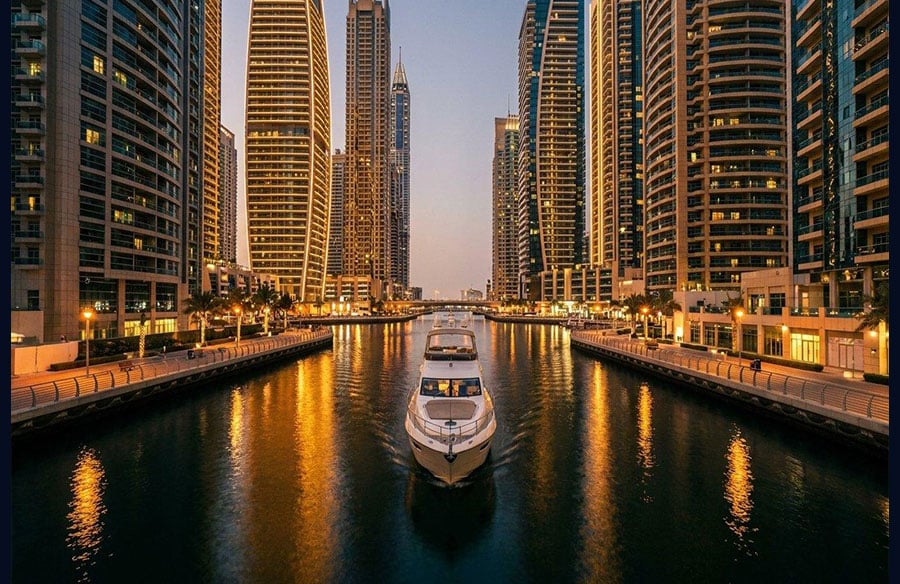
The Dubai yacht charter industry is shaped as much by the shoreside marina architecture as by the vessels themselves. Dubai Marina’s tower-canyon composition, Dubai Harbour’s open-water framing, and Mina Rashid’s heritage-modern hybrid each produce a distinct spatial experience for the guest. The regulatory infrastructure (DMCA licensing, Coast Guard coordination, marina zoning) is the invisible design layer that enables the industry to scale. Understanding both is essential to reading the sector as an architectural phenomenon, not just a hospitality one.
Key Points
- Dubai’s three primary yacht-charter marinas (Dubai Marina, Dubai Harbour, and Mina Rashid) each produce a distinct architectural experience through the composition of their surrounding built environment.
- Dubai Marina’s man-made canal (3.5 km) creates the tower-canyon experience that defines the industry’s most photographed vessel returns; the built environment does the visual work.
- Dubai Harbour, a newer 20 million square foot marina district, is designed for scale and open-water access; its architecture supports the larger vessel classes that Dubai Marina’s canal cannot accommodate.
- Mina Rashid combines heritage marina infrastructure (the historic Port Rashid) with modern cruise terminal facilities; the QE2 hotel remains anchored in-marina as a design landmark.
- Palm Jumeirah and Ain Dubai (250-metre observation wheel by Starneth) function as visual anchor infrastructure that yacht charter routes are consciously designed around.
- The regulatory infrastructure (DMCA licensing, Coast Guard coordination via emergency line 996, marina zoning through the Dubai Ports Authority) is the invisible architecture that enables the industry to operate at scale.
For architects and design professionals examining Dubai as a case study in waterfront urbanism, the yacht charter industry is a useful lens for reading the city’s marina infrastructure. A private Dubai yacht charter is not just a hospitality product; it is an experience shaped almost entirely by the surrounding built environment. The tower-canyon composition of Dubai Marina, the open-water framing of Dubai Harbour, and the heritage-modern hybrid of Mina Rashid each produce a distinct spatial experience for the guest, and none of them exist accidentally. Each is the product of deliberate architectural and regulatory decisions made across the last two decades. This piece examines the built infrastructure that enables the industry and the specific ways architecture shapes what the guest actually experiences on the water.
Why Marina Infrastructure Design Matters to the Yacht Charter Experience
The vessel itself is only one of several design objects in a yacht charter. The marina architecture, the surrounding urban composition, the visual anchor points along the cruise route, and the regulatory infrastructure that permits the whole system to function are all design decisions that shape the guest experience. In most yachting markets globally (Mediterranean, Caribbean), the natural coastline does most of the visual work; the architecture is secondary. In Dubai, the reverse is true: the natural coastline is a relatively straight Arabian Gulf shoreline, and it is the built infrastructure that produces every visual moment of the charter.
This is the difference that makes Dubai an interesting architecture case study rather than just a hospitality market. The industry’s growth over the last decade has followed the pace of infrastructure delivery, not the pace of consumer demand alone. The yacht charter market could not exist in its current form without the specific marina and shoreside architecture that has been constructed to enable it.
Dubai Marina: The Tower-Canyon Experience By Design
Dubai Marina is a man-made canal running 3.5 kilometres inland from the Arabian Gulf, developed by Emaar Properties beginning in 2003. The surrounding tower architecture, which includes the Marina Residential Tower by UNStudio among many other significant residential and mixed-use projects, was master-planned to create a dense vertical urban environment on both sides of the canal.
For the yacht charter experience, this produces a specific architectural moment: the return to the marina at dusk, when the boat is enclosed on both sides by illuminated tower facades. The vertical geometry, the reflectivity of the water, and the artificial-light density combine to create what most guests recognize as the definitive Dubai yacht photograph.
This composition is not accidental. The canal width (approximately 100 metres in the main channel), the tower setbacks from the water edge, the height distribution, and the marina walkway design were all decisions made during the master-planning process. The specific yacht-return experience is a by-product of those decisions, and it is the reason Dubai Marina remains the default marina for first-time visitor charters despite the operational advantages of the newer Dubai Harbour.
For architecture readers examining Dubai Marina critically, the tower density is often cited as a design excess. From the perspective of the yacht charter industry, that same density is the asset. The industry has developed around composition rather than in spite of it.
Dubai Harbour: The Open-Water Framing Infrastructure
Dubai Harbour, opened in 2021 and developed by Meraas, is a 20 million square foot marina district adjacent to Palm Jumeirah and JBR. Its architectural approach is deliberately different from Dubai Marina: instead of the canal-and-canyon composition, Dubai Harbour uses a coastal-embayment layout with direct access to open water.
The design consequence for the yacht charter industry is significant. Dubai Harbour can accommodate larger vessel classes (75 to 120+ feet) that struggle with Dubai Marina’s canal navigation. Departure clearance is faster, the run to open water is direct, and the framing on departure gives the guest an unobstructed view of Palm Jumeirah’s crescent and the Arabian Gulf beyond.
Dubai Harbour is also home to the region’s largest cruise terminal, which shares infrastructure with the yacht marina. The scale of the shoreside facilities (cruise terminal, retail, dining, adjacent hospitality) creates a different arrival experience for the guest: closer to a modern port precinct than to the residential-adjacent character of Dubai Marina.
For yacht charter operators handling larger vessels, this infrastructure difference determines what they can offer. A superyacht charter in Dubai almost always departs from Dubai Harbour rather than Dubai Marina because the canal navigation constraints at the older marina would compromise the vessel’s operation.
Mina Rashid: Heritage Marina Meets Modern Operation
Mina Rashid, historically Port Rashid, is Dubai’s oldest working port. Redeveloped by DP World over the last decade, it now combines heritage marina infrastructure with modern cruise and yacht facilities. The QE2 hotel, permanently berthed in Mina Rashid since 2018, functions as a heritage landmark within the marina.
The architectural character is distinct from both Dubai Marina and Dubai Harbour. The scale is smaller, the setbacks from the water are more generous, and the surrounding built environment references Downtown Dubai and the Meydan skyline rather than dense marina towers. For yacht charters departing Mina Rashid, the visual experience is more spacious, less enclosed, and more anchored in the older Dubai’s urban composition.
This complements Dubai’s wider heritage-marina redevelopment strategy, which is also reflected in the Al Seef Dubai Creek case study on the Bastakiya side. Both projects treat the older Dubai coastline as an asset to preserve and integrate rather than a legacy to overwrite. The yacht charter industry benefits from having Mina Rashid as an alternative to the more contemporary Dubai Marina and Dubai Harbour options, particularly for guests staying in Downtown or Business Bay who value the shorter transfer.
Ain Dubai and Palm Jumeirah as Visual Anchor Infrastructure
Yacht charter routes across Dubai are consciously designed around two specific visual anchor structures: Ain Dubai and Palm Jumeirah.
Ain Dubai, the 250-metre observation wheel on Bluewaters Island (designed by Starneth engineering with architectural collaboration), functions as the largest single visual object on the Dubai skyline when viewed from Dubai Harbour or the western marinas. Yacht routes leaving Dubai Harbour typically include an anchor position that places the boat with Ain Dubai in the photographic frame.
Palm Jumeirah, the 5.72 square kilometre artificial archipelago developed by Nakheel, functions as both a destination anchor and a photographic backdrop. Yacht routes from all three primary marinas include a Palm circuit or an anchor stop along the Palm crescent. The specific geometry of the Palm (16 fronds plus a crescent breakwater) creates recognisable anchor points along its perimeter that operators route around.
Both structures function as designed visual infrastructure for the charter industry. Neither was built for the yacht industry, but both have become central to how the industry composes its guest experience.
The Regulatory Infrastructure That Enables the Industry
The physical marina architecture is the visible design layer. The regulatory infrastructure is the invisible layer that permits the whole system to operate.
The Dubai Maritime City Authority (DMCA) is the primary regulator, responsible for vessel licensing, captain certification, marina zoning, and operational safety standards. The DMCA’s regulatory approach has generally favoured industry growth (through permissive licensing and clear operational rules) while maintaining safety standards (through mandatory captain licensing, hull inspections, and insurance requirements).
The UAE Coast Guard, coordinated via marine emergency number 996, provides the safety-and-response infrastructure that permits the industry to operate at scale. Operators integrate the Coast Guard emergency protocol into every guest safety briefing.
Dubai Ports Authority handles marina zoning, berth allocation, and cross-marina coordination. The specific allocation of berth types by marina (residential vs charter vs commercial cruise) is a zoning decision that shapes which vessel classes can operate from which marina.
For architecture readers, the regulatory infrastructure is worth understanding as a design system in itself. It is not visible in the built environment, but it constrains and enables every operator decision. Without the specific regulatory choices made over the last decade, the physical marina architecture would exist but the industry that operates within it would not have grown at the pace it has.
Adjacent regulatory context is illustrative: the Dubai Maritime Museum design proposal explicitly treats maritime infrastructure and regulation as culturally significant, which reflects the city’s own view of its marine sector as an integrated architectural and institutional system.
How Infrastructure Shapes Operator Offer
The relationship between infrastructure and operator offer is direct and observable. What an operator can offer at each marina is determined by what the marina architecture and regulation permit. Practical examples:
- Superyacht bookings (over 75 feet) are concentrated at Dubai Harbour because Dubai Marina’s canal navigation makes them impractical
- Family-friendly slow-cruise formats work best at Mina Rashid where the calmer near-shore water and shorter departure paths accommodate less-experienced guests
- Photography-focused sunset charters cluster around Dubai Marina because the tower-canyon backdrop is the desired composition
- Corporate hospitality events requiring larger guest counts typically use Dubai Harbour where the shoreside coordination infrastructure supports pre-boarding staging
Looking at the composition of the current Dubai yacht fleet reflects this infrastructure specialisation directly. Different vessels are deployed from different marinas based on what the built environment and the regulation permit. Operator success at any given marina depends on matching the vessel class to the infrastructure rather than trying to force a vessel type into an unsuitable marina.
What the Next Decade of Dubai Marina Architecture May Deliver
The Dubai waterfront continues to develop. Announced or in-progress projects that will affect the yacht charter industry over the next decade include additional marina developments in the Deira Islands area, further expansion of Dubai Harbour’s shoreside facilities, and heritage-marina redevelopment continuing along the older Dubai Creek waterfront.
For architects tracking Dubai’s urban development, the marina architecture is one of the more interesting design vectors because it must satisfy multiple constraints simultaneously: dense residential absorption, visual quality for the yacht industry, operational function for commercial vessels, safety standards for guest use, and integration with the wider city’s tourism and hospitality infrastructure. The projects that navigate all five constraints tend to succeed; the ones that optimise for a single constraint tend to underperform.
The next decade will likely see additional marina projects that explicitly target the yacht charter industry as a design driver rather than treating it as a secondary use of primarily-residential marina infrastructure. Dubai’s demonstrated ability to build for specific industry demand suggests this transition will happen quickly once the demand signal is clear.
For a working architectural understanding of Dubai as a case study in waterfront urbanism, the yacht charter industry is one of the most legible lenses. It reveals what the built environment can accomplish when infrastructure is designed to serve a specific industry rather than a general residential or commercial function. And it reveals the limits of what any architectural intervention can deliver without the corresponding regulatory infrastructure in place.