Desert architecture used to be a regional concern. It isn’t anymore. As arid zones expand and extreme heat events become baseline rather than exceptional, the design problems that practitioners in places like the Sonoran Desert or the Arabian Peninsula have been working through for decades are becoming everyone’s problem.
Thermal dynamics, material behavior under extreme conditions, mechanical systems that don’t collapse under load – these aren’t specialty knowledge. They’re the next frontier of mainstream building practice.The buildings that perform well in these conditions don’t fight their environment. They’re shaped by it.
Envelope Strategy: The Primary Defense
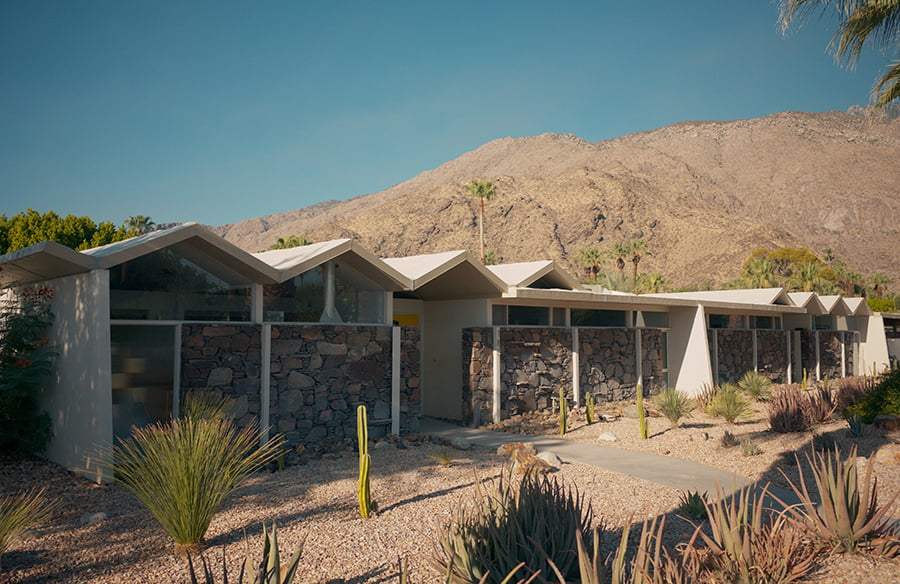
KC’s 23 ½ Cathedral City operates in one of the most demanding HVAC environments in North America – the Coachella Valley, where summer temperatures regularly exceed 110°F and cooling systems run continuously for months.
The integration of passive architectural strategies with active mechanical systems is what determines whether a building’s energy performance is merely adequate or genuinely efficient.
In hot, dry climates, the building envelope is the first and most important line of thermal defense. Every decision about orientation, massing, surface-to-volume ratio, glazing placement, and material selection either reduces or compounds the thermal load the mechanical system must manage.
Thermal mass is one of the most powerful tools available. Dense materials – concrete, rammed earth, adobe, stone – absorb heat during the day and release it slowly through the night. In climates with significant daily temperature swings, this time-lag effect can meaningfully moderate interior temperatures without active cooling.
Insulation strategy in desert climates differs from cold-climate logic. In cold climates, insulation is placed on the outside of thermal mass to keep stored heat inside.
In hot climates, the goal reverses: insulation between the exterior surface and the mass prevents daytime heat from penetrating, while the mass stabilizes interior temperatures. Reflective exterior surfaces reduce the solar energy the envelope absorbs before insulation and mass can do their work.
Glazing decisions are particularly consequential. North-facing glazing in the northern hemisphere captures diffuse daylight without direct solar gain. South-facing glazing can be shaded with fixed overhangs sized to the solar angle.
East and west glazing is the most problematic – low sun angles are difficult to shade with fixed geometry, making these orientations candidates for minimal glazing, deep reveals, or operable exterior shading.
Design decisions that meaningfully reduce solar heat gain in hot, dry climates:
- Building orientation – rotating the long axis east-west minimizes the building’s exposure to afternoon western sun, which is consistently the most intense thermal load in desert environments
- Massing and self-shading – courtyard configurations, deep overhangs, and recessed openings create shade on the building’s own surfaces, reducing surface temperatures and convective heat transfer
- High-albedo exterior finishes – light or reflective exterior surfaces can reduce absorbed solar radiation by 40-60% compared to dark finishes
Mechanical Systems in Extreme Heat
 The integration of passive architectural strategies with active mechanical systems is what determines whether a building’s energy performance is merely adequate or genuinely efficient.
In high-performance desert buildings, passive and active strategies are designed together from the schematic phase. A well-oriented, well-insulated building with effective shading arrives at the mechanical engineer with a reduced peak cooling load – smaller equipment, lower first cost, and better part-load efficiency.
Oversized equipment, endemic in hot climates because engineers size for worst-case conditions without accounting for passive load reduction, cycles inefficiently and provides poor humidity control.
Evaporative cooling is underutilized in dry desert climates where it performs best. Below 20-30% relative humidity, evaporative systems can reduce air temperature by 18–27°F with a fraction of the energy of refrigerant-based cooling.
Night ventilation – flushing the building with cooler outdoor air after sunset – is one of the most effective passive strategies in climates with significant temperature swings.
A building designed to capture and distribute night air can begin each day with substantially pre-cooled thermal mass, reducing peak cooling demand during the hottest afternoon hours.
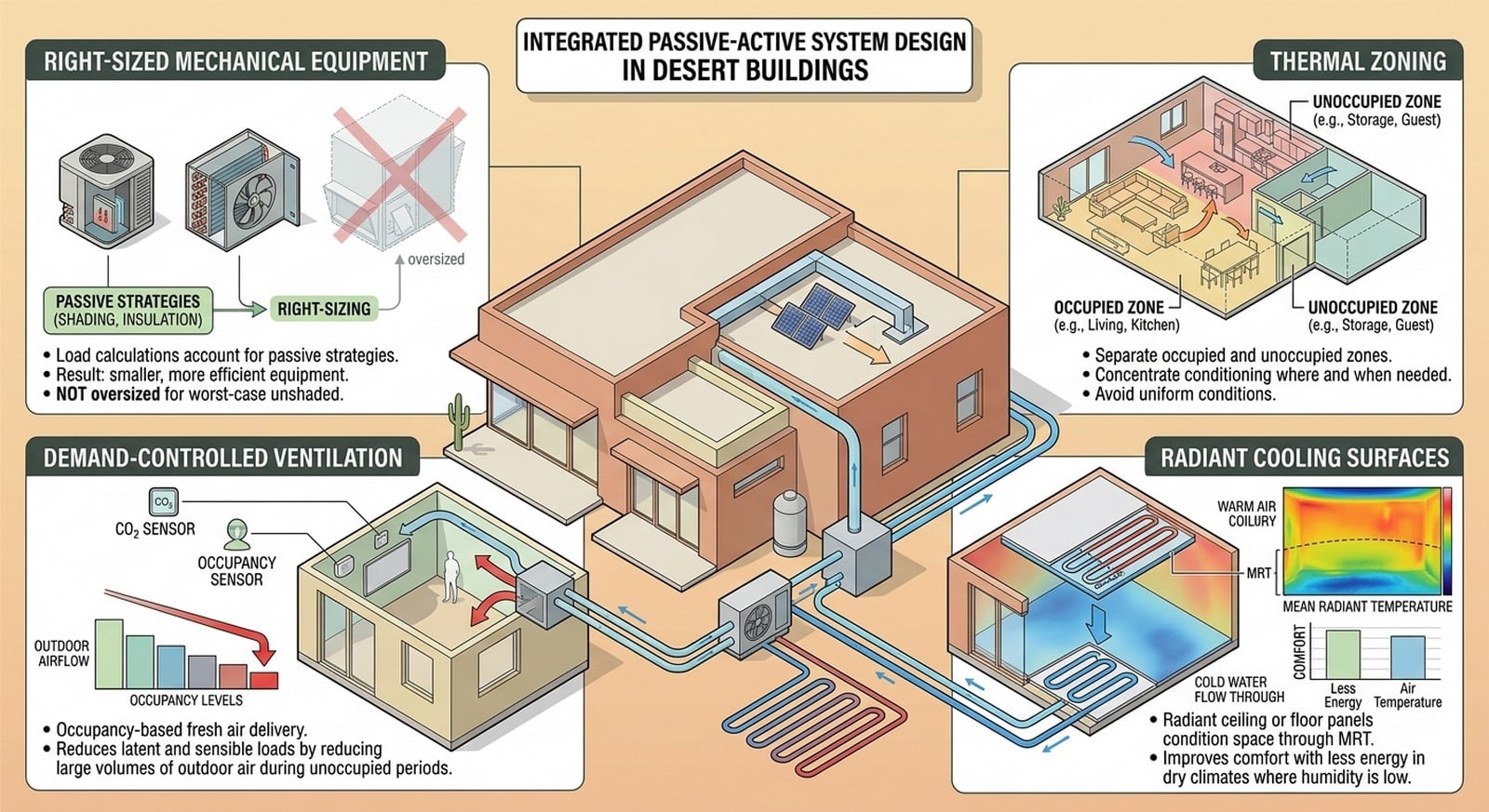
What integrated passive-active system design looks like in high-performance desert buildings:
- Right-sized mechanical equipment – load calculations that account for passive strategies produce smaller, more efficient equipment rather than oversized systems designed for worst-case unshaded conditions
- Thermal zoning – separating occupied and unoccupied zones allows conditioning to concentrate where and when it’s needed, rather than maintaining uniform conditions throughout
- Demand-controlled ventilation – occupancy-based fresh air delivery reduces the latent and sensible load associated with conditioning large volumes of outdoor air during unoccupied periods
- Radiant cooling surfaces – radiant ceiling or floor panels condition space through mean radiant temperature rather than air temperature, improving comfort with less energy in dry climates where humidity isn’t a limiting factor
Water and the Desert Building
Water scarcity is as defining a constraint as thermal load in desert architecture. Rainwater harvesting, greywater reuse, low-water landscaping integrated with building drainage, and cooling tower water management are architectural decisions as much as mechanical ones.
The architecture that will define desert communities over the coming decades will be measured against two standards: how well it keeps occupants comfortable and how responsibly it manages scarce resources. Buildings that address both are the ones worth studying.