Public spaces like parks, streets, plazas, and sidewalks symbolise urban life’s shared experiences, offering places for rest, connection, and movement. However, beneath their inviting appearance lies an uncomfortable truth: many urban spaces are designed not to welcome, but to exclude. Hostile architecture, a strategy that manipulates the built environment to control behaviour, enforces this exclusion through silent, often invisible, design tactics.

Understanding Hostile Architecture
Hostile architecture, also known as defensive urban design, involves specific design elements intended to discourage behaviours considered undesirable by city planners or property owners. Rooted in Crime Prevention Through Environmental Design (CPTED), this approach was first introduced by Professor C. Ray Jeffery in 1971 and later expanded by Architect Oscar Newman in his 1972 book Defensible Space. CPTED focuses on shaping the physical environment to influence human behaviour and reduce crime by altering the spaces people occupy.
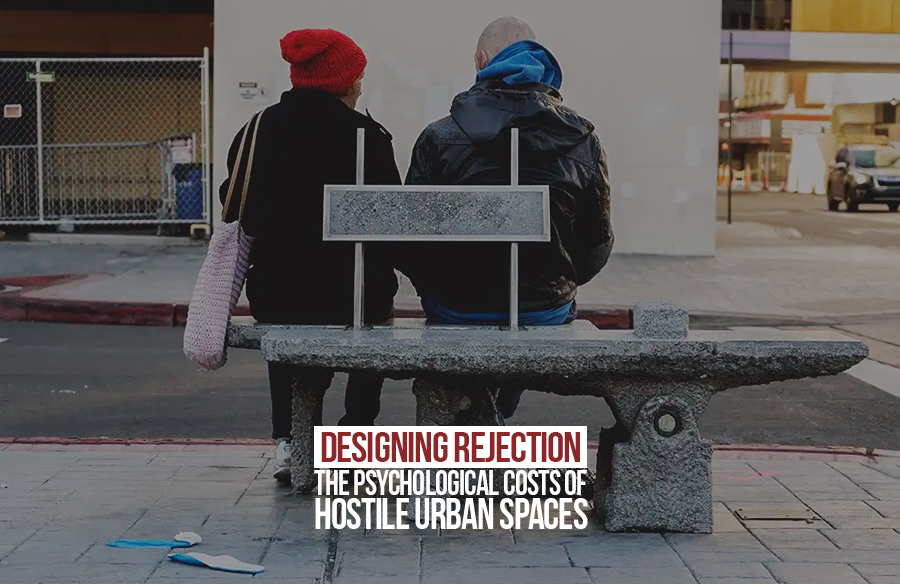
Hostile architecture targets actions such as sleeping on benches, loitering, or skateboarding by incorporating features like benches with metal armrests to prevent lying down, spikes installed on flat surfaces to deter sitting or sleeping, and rough-textured ledges designed to discourage skateboarding. Though these elements may seem practical, their purpose is intentional—excluding certain groups from public spaces. As architectural historian Ocean Howell points out, “When you’re designed against, you know it… The message is clear: you are not a member of the public that is welcome here.” These design choices quietly enforce exclusion, reinforcing social boundaries and leaving some individuals feeling unwelcome in the public realm.

The Psychological Toll of Being Unwelcome
Hostile architecture doesn’t just reshape urban spaces—it reshapes how people feel and behave within them. For those directly targeted, such as unhoused individuals, the psychological toll is profound. The environment itself becomes a constant reminder of exclusion, fostering feelings of shame, invisibility, and rejection.
Urban theorist William H. Whyte, in his book The Social Life of Small Urban Spaces, famously observed, “Spaces designed to keep out certain people tend to keep out others, too. But spaces that attract people tend to be free of problems.” Hostile design communicates societal contempt, making public spaces emotionally and psychologically oppressive for marginalized communities. By excluding certain groups, the built environment makes these individuals feel like they don’t belong—furthering isolation and perpetuating stigmatization.

The Rationale Behind Hostile Architecture
The logic behind hostile architecture often hinges on two flawed assumptions: discomfort with visible poverty and fear of crime. While concerns about safety are understandable, research consistently shows that unhoused individuals are more likely to be victims than perpetrators of violence.
Anti-homeless spikes, for instance, may prevent people from sleeping in certain areas but solve nothing. They simply shift the problem to another street or park, perpetuating a cycle of displacement. Planners and authorities may justify hostile design as a means of maintaining public order, but in reality, it creates cities where exclusion replaces empathy, and safety becomes a thinly veiled excuse for social segregation.

The Anxiety of Being Policed by Design
Hostile architecture doesn’t just affect its intended targets—it creates an environment of constant surveillance for everyone. Consider a park bench with a “No Loitering” sign. Actress Mia Wagner reflected on seeing one: “At what point am I loitering? Can I sit without buying something?” This statement, highlighted in Winnie Hu’s New York Times article Hostile Architecture: How Public Spaces Keep the Public Out, emphasizes how design elements can provoke anxiety and question public behavior. The design itself creates an atmosphere of surveillance, making everyone feel like they’re being policed, even in spaces that should offer relaxation and comfort.

Design elements that regulate behaviour force people to question their right to simply be in public spaces. What should be open and democratic becomes a conditional privilege, subject to unspoken rules of compliance. This constant policing induces anxiety, discouraging social interactions and reducing spontaneous urban life. Individuals become acutely aware of the “rules” governing their presence, often adjusting their behaviour or avoiding certain spaces altogether to comply.
Invisible Barriers, Visible Consequences
Hostile architecture builds invisible walls that divide people by class, privilege, and perceived worth. Its consequences extend beyond exclusion—it erodes social trust and weakens community bonds. Cities designed to deter “undesirables” often become hostile to everyone, transforming public life into a transactional experience devoid of warmth or connection.
Even well-intentioned designs can unintentionally alienate. In The Social Life of Small Urban Spaces, William H. Whyte observed that spaces designed to keep out certain people often end up being less inviting for others too. Parks without shaded seating, for example, may discourage unhoused individuals from resting, but they also limit access for seniors, parents, and others seeking respite. Hostile design punishes the vulnerable while diminishing the urban experience for all.

Reimagining Urban Design with Compassion
The solution to hostile architecture lies not in better exclusion but in reimagining inclusion. If benches aren’t meant for sleeping, cities must provide alternative spaces designed with empathy and dignity. Public spaces should offer shelter, rest, and acceptance—not rejection. Urban designers, landscape architects, and policymakers have a responsibility to create environments that reflect our shared humanity. Participatory design processes can help ensure spaces serve all people, regardless of socioeconomic status, fostering connection and care, and promoting equality instead of exclusion.
Public spaces are meant to be democratic, inclusive, and human-centered. Yet hostile architecture subverts these principles, creating cities built on division. To build a more compassionate urban future, designers must challenge hostile design and advocate for spaces that embrace everyone, not just a select few. Let us imagine cities where all people belong, and where compassion is embedded in the very design of our shared spaces.
References:
staff, A. (2019). Designing for Public Space Inclusive of Unhoused People. [online] The Field. Available at: https://thefield.asla.org/2019/03/07/designing-for-public-space-inclusive-of-unhoused-people/.
Hu, W. (2019). ‘Hostile Architecture’: How Public Spaces Keep the Public Out. The New York Times. [online] 8 Nov. Available at: https://www.nytimes.com/2019/11/08/nyregion/hostile-architecture-nyc.html.
Andreou, A. (2015). Defensive architecture: Keeping poverty unseen and deflecting our guilt. [online] The Guardian. Available at: https://www.theguardian.com/society/2015/feb/18/defensive-architecture-keeps-poverty-undeen-and-makes-us-more-hostile.
Whyte, W.H. (1980). The social life of small urban spaces. New York: Project For Public Spaces.
Hauptfleisch, W. (2022). A Hostile Architecture Tour Around London. [online] Medium. Available at: https://wolfhf.medium.com/a-hostile-architecture-tour-through-london-1f935574044b.
Lo, A. (2017). The debate: Is hostile architecture designing people — and nature — out of cities? [online] CNN. Available at: https://edition.cnn.com/style/article/new-dean-harvey-james-furzer-hostile-architecture-debate/index.html.
TEDx Talks (2019). Rethinking defensive urban design | Cara Chellew | TEDxTartu. YouTube. Available at: https://www.youtube.com/watch?v=3Gipo6TDzk8.
object Object (2019). Defending Suburbia: Exploring the Use of Defensive Urban Design Outside of the City Centre. Core.ac.uk. [online] doi:oai:ojs.cjur.uwinnipeg.ca:article/164.