Sambhal: History and Heritage
Sambhal, situated in northwestern Uttar Pradesh, India, rests on the alluvial plains of the Indo-Gangetic region. It is approximately 32 kilometres southwest of Moradabad, 158.6 kilometres from New Delhi, and 355 kilometres from the state capital, Lucknow. The city is renowned for its unique horn and bone craft items, primarily produced in Sarai Tarin, a locality located just 4 kilometres away. These handcrafted goods are widely exported, enhancing Sambhal’s reputation.
Historically, Sambhal boasts a rich legacy dating back to the 5th century BCE when it was part of the Panchal kingdom and later incorporated into Ashoka’s Mauryan Empire. The city came under Muslim rule in the early 14th century with Qutub-ud-din Aibak’s conquest, followed by Firoz Shah Tughlaq’s governance after conflicts with local rulers.
In the late 15th century, Sikandar Lodi elevated Sambhal to provincial capital status for four years. The city’s prominence continued under Mughal rule, with Babur constructing the historic Babri Masjid, also known as the Shahi Jama Masjid, and appointing his son, Humayun, as its governor. While Sambhal flourished during Akbar’s reign, it began to decline under Shah Jahan’s rule.
Throughout its history, Sambhal evolved into a thriving trade hub, particularly known for its agricultural products. Local industries include sugar refining, hand-loom weaving, and calico printing, further contributing to the city’s economy. The presence of various historic monuments, such as a fort, enriches its cultural heritage and highlights the city’s significance over the centuries.

Jama Masjid: A Historical Landmark in Sarai Tarin
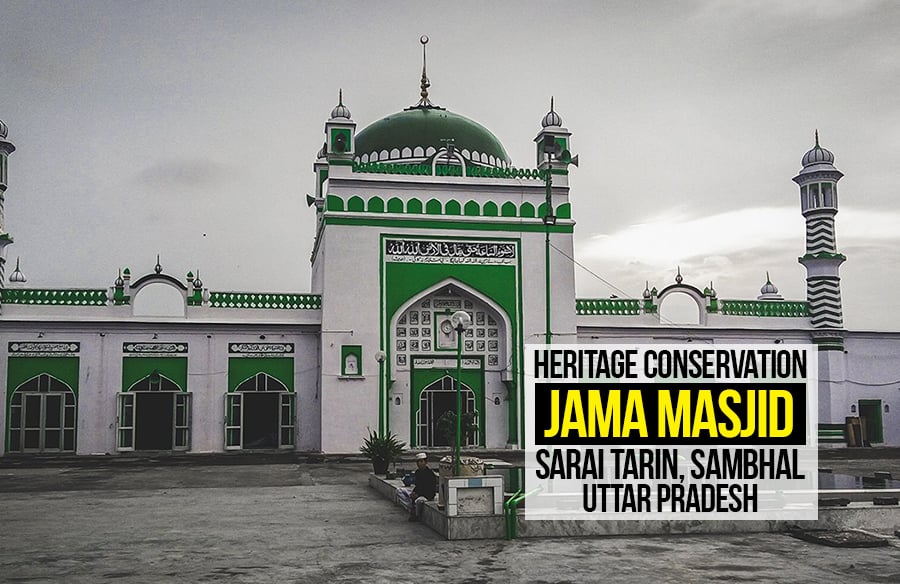
Jama Masjid is located in the locality of Mohalla Darbar in Sarai Tarin, a small town approximately 4 kilometres from Sambhal. This area is renowned for its unique handicraft business and is home to significant landmarks, including the Dargah of Hazrat Shah Fateh-Ullah Khan and Darbar ka Kuan. The surroundings of the mosque are marked by the ruins of older structures, broken arches, and other remnants that indicate its historical importance. Today, it is enveloped by congested houses, narrow streets, and old landmarks.
In the 15th century, Sambhal became part of the Lodi Dynasty’s territory and was strategically situated along the route from Delhi to Agra. This prompted the construction of several sarais (inns) for travellers. Sultan Sikandar Lodhi commissioned the Jama Masjid for the local residents in 1503 AD. The mosque took eight years to complete and is regarded as the oldest mosque in the city. During its construction, four wells were dug, with one becoming well-known as Darbar ka Kuan (the court’s well).

A few years after the mosque’s completion, a Sufi saint named Sheikh Fateh-Ullah Shah Tarin arrived and settled near the mosque. He was a companion of Khwaja Salimuddin Chishti from Fatehpur Sikri. Reflecting his roots in the Tarain tribe, a Pathan or Pashtoon group from Afghanistan near the border of Balochistan (Wadi Tarinia), he named the area around the mosque Sarai Tarin. As he gained followers who sought his guidance, many established their homes nearby. Darbar ka Kuan also became a vital source of water for the community. Consequently, Jama Masjid became a pivotal factor in the settlement of Sarai Tarin, evolving into a central hub for the local community and ultimately establishing Sarai Tarin as the largest sarai in Sambhal.

Jama Masjid: Architectural Overview
Originally surrounded by few structures, Jama Masjid is now flanked by residential houses, with notable landmarks nearby, such as Darbar Ka Kuan and the Dargah of Sheikh Fateh-Ullah Shah Tarin. The total plot area of Jama Masjid is 3,737.1 sq. m, comprising a built-up area of 2,256.5 sq. m (60%) and an unbuilt area of 1,480.5 sq. m (40%). Initially, over 60% of the site was unbuilt before the construction of the verandah and other spaces. The verandah was originally a raised platform, while the courtyard was adorned with beautiful plants and trees.
Layout and Access:
The masjid features three main gates on the east side and an additional gate on the south. The main gate opens to the courtyard and verandah, connecting to the old masjid at the centre. Access is provided to the wudhu-khana (ablution area) and toilets, which were added later.

Major Areas:
- Main Prayer Hall: The oldest part of the masjid, featuring a Mehrab and Minber. The rectangular plan is divided into four squares, with three corbelled domes supported by piers. The thick brick walls ensure stability and accommodate approximately 250 worshippers.

- Verandah: Added in 1984, the verandah obscured the main façade but can accommodate approximately 600 people. It features wide openings for ventilation.

- Courtyard: The largest open space, measuring 28.5 m by 30 m, can accommodate around 1,500 people. Previously landscaped, it is now paved with bricks.

- Wudhu-khana: Located to the left upon entering, separated from the prayer space for cleanliness, with racks for shoes and seating for ablution.
- Hujrah: Attached to the verandah, used by the Muazzin for calling the Adhan, equipped with sound equipment.
- Jama’at Room: Designed for visitors of the Tableeghi Jama’at, including a small ablution area, kitchen, and dining space.
Architectural Elements:
- Domes: Three corbelled domes, with the central dome being hemispherical and the side domes being saucer domes, decorated with floral motifs.

- Arches: Four pointed arches in the main hall transfer the roof’s weight to the piers. Multi-foliated arches adorn the main entrance.

- Pendentives: Triangular segments filling corners to support the dome, decorated with floral patterns.
- Minarets: Four small minarets at the main entrance, with two larger ones on octagonal bases, covered with clay tiles.
- Mihrab: Niche in the Qibla wall indicating the direction of Mecca, decorated with floral motifs.
- Minber: Multi-step structure used by the Imam, with niches for Hadith and a microphone.
- Floral Motifs: Decorative features in plaster, painted in gold against whitewashed walls.

- Doors: Three wooden doors in the inner hall, adorned with floral patterns, that can be partially opened.
- Calligraphy: Inscriptions of the Quran, including Persian calligraphy detailing the mosque’s foundation.
- Merlons: Decorative elements on parapets, shaped like arches, enhancing stability and ornamentation.
- Eastern Wall and Main Entrance Gate: A massive wall with three gates, decorated with floral patterns and calligraphy.
Building Materials and Techniques
Brick is the primary material used in the construction of the Jama Masjid. The domes and arches are created using corbelling techniques, while the walls of the inner hall are approximately 10 to 12 feet wide. Surkhi (brick powder) is incorporated into the plaster of the inner hall and walls. After 1984, construction utilised cement concrete and modular bricks. The inner hall and verandah feature marble flooring, whereas the courtyard is paved with modular bricks.

Social Impact
- Community Worship Hub: Jama Masjid serves as a primary prayer space for thousands of Muslims, functioning as a centre for communal worship and social interaction, thereby fostering a strong sense of community.
- Economic Activity: The mosque’s location promotes a bustling market every Friday, attracting vendors and shoppers from surrounding areas, enhancing local economic activity and supporting small businesses.
- Spiritual Significance: The proximity of the mosque to the Dargah of Hazrat Shah Fateh-Ullah Khan emphasises its spiritual importance, drawing pilgrims and reinforcing the cultural identity of the community through shared religious practices.
Heritage Value
- Historical Significance: Built in 1503 AD under Sultan Sikandar Lodi, Jama Masjid represents the architectural and cultural heritage of the Lodi Dynasty and Mughal era, marking its importance as a historical landmark.
- Architectural Heritage: The mosque features corbelled domes, pointed arches, and intricate floral motifs, showcasing the craftsmanship and aesthetic sensibilities of its time, thereby enhancing its heritage value.
- Symbol of Resilience: Jama Masjid embodies the community’s resilience, having witnessed significant historical changes. Its ongoing use and maintenance reflect the local population’s commitment to preserving their heritage.
Threats to Jama Masjid
- Urbanisation Impact: Rapid development around the mosque has led to congestion, compromising its structural integrity and diminishing visibility.
- Alteration of Character: The mosque’s architectural character has been altered by extensions, including the added verandah, whose beams intersect with the façade, and the expansion of the wudhu area, which encroaches on the minaret.
- Proportional Disruption: As the surrounding road level increased, the mosque’s floor was raised to maintain accessibility, disrupting its original proportions and affecting the visual harmony of its arches and domes.

Conservation Measures
- Community Involvement: Engaging local artisans and residents in conservation efforts fosters ownership and preserves traditional craftsmanship.
- Government Support: Collaborating with government heritage bodies can provide funding and expertise for restoration projects, facilitating effective conservation strategies.
- Awareness Programs: Educational outreach regarding Jama Masjid’s historical
The Jama Masjid has played a significant role in the development of the city, benefiting the community for over 500 years. The construction techniques employed in this mosque are unique and rarely found in other structures in the region. Notably, the Jama Masjid of Sambhal was built after this one, and the same three-dome concept can be seen in the Shahi Jama Masjid of Delhi.
Unfortunately, the importance of Jama Masjid is diminishing with time, highlighting the urgent need to recognize it as a heritage site. It is essential to educate people about its historical significance and ensure that this architectural gem retains its originality and cultural value for future generations.
References List
- Sambhal | Mughal City, Cultural Hub, Trade Center | Britannica. (2024). In: Encyclopædia Britannica. [online] Available at: https://www.britannica.com/place/Sambhal [Accessed 13 Oct. 2024].
- Sambhal.nic.in. (2018). History Sambhal | District Sambhal, Government of Uttar Pradesh | India. [online] Available at: https://sambhal.nic.in/history/ [Accessed 13 Oct. 2024].
- Qasmi, M. A.-M. (2002). Tareekh-e-Sambhal. Sambhal: Deoband Computer, Deoband.
Images / Visuals
- Wikipedia Contributors (2024). Sambhal. [online] Wikipedia. Available at: https://en.wikipedia.org/wiki/Sambhal [Accessed 13 Oct. 2024].
- Qureshi, A. (2017) Entrance Gate Dargah Shah Fatehullah Khan and Darbar Ka Kuan, Sarai Tarin, Sambhal [Photograph].
- Qureshi, A. (2017) Jama Masjid, Sarai Tarin, Sambhal [Photograph].
- Qureshi, A. (2017) Main Entrance, Jama Masjid, Sarai Tarin, Sambhal [Photograph].
- Qureshi, A. (2017) Prayer Hall, Jama Masjid, Sarai Tarin, Sambhal l [Photograph].
- Qureshi, A. (2017) Verandah, Jama Masjid, Sarai Tarin, Sambhal [Photograph].
- Qureshi, A. (2017) Courtyard, Jama Masjid, Sarai Tarin, Sambhal [Photograph].
- Qureshi, A. (2017) Domes, Jama Masjid, Sarai Tarin, Sambhal [Photograph].
- Qureshi, A. (2017) Arches, Jama Masjid, Sarai Tarin, Sambhal [Photograph].
- Qureshi, A. (2017) Picture showing Mehrab, Minbar, Pendentive and Motifs, Jama Masjid, Sarai Tarin, Sambhal [Photograph].
- Qureshi, A. (2017) Surkhi (Brick Powder) used in Plaster, Jama Masjid, Sarai Tarin, Sambhal [Photograph].
- Qureshi, A. (2017) Extensions made to the Masjid, Jama Masjid, Sarai Tarin, Sambhal [Photograph].