Architecture, as a profession, holds a profound responsibility in shaping the environments where people live, work, and interact. Architects have the responsibility to not only focus on the appearance and practicality of their designs but also to consider the broader impact on society. “Balancing the Scales: Navigating Justice and Fairness in Architecture” emphasises the importance of creating a fair and inclusive society through architectural practices. This piece delves into how justice and fairness can be woven into architectural work, touching on accessibility, inclusivity, ethics, community involvement, and fair resource allocation.

Designing for All
Justice and fairness in architecture are deeply intertwined with ensuring accessibility for all individuals, including those with disabilities. This involves incorporating features like ramps, elevators, wide doorways, and accessible restrooms in buildings and public spaces. However, true accessibility extends beyond mere compliance with regulations; it requires a mindset that places the needs of all users at the forefront.

For instance, when designing a public library, architects must ensure that individuals using wheelchairs can freely navigate through reading rooms, restrooms, and computer stations. This may entail the inclusion of ramps next to staircases, the installation of elevators, and the provision of accessible parking spots. Moreover, the use of tactile signage and Braille can assist visually impaired individuals in moving around the library. By emphasising accessibility in their designs, architects play a crucial role in fostering a more inclusive environment where everyone can fully utilise and appreciate public amenities.
Designing for Diversity
Inclusivity in architecture means designing spaces that cater to the diverse needs of different populations, considering factors like culture, age, gender, and socioeconomic status. This approach ensures that architectural designs do not inadvertently exclude or marginalise certain groups.

For instance, consider the layout of a community centre in a diverse neighbourhood. A welcoming design would require interacting with the community to grasp their requirements and desires. This could lead to a facility that encompasses a range of amenities like a versatile hall for cultural gatherings, a play area for kids, a serene space for meditation or prayer, and accessible features for people with disabilities. By integrating various needs into the design, architects establish environments that promote inclusivity and serve the entire community.
Building with Integrity
Architecture professionals must uphold ethical standards by prioritising fair labour practices, sustainable design, and ethical sourcing of materials. Architects must avoid exploiting workers, causing harm to the environment, or perpetuating social inequalities in their projects. Ethical behaviour in architecture involves sustainable materials and eco-friendly construction methods. Architects can reduce their ecological footprint by choosing energy-efficient designs and using suppliers who treat workers respectfully and provide fair wages.


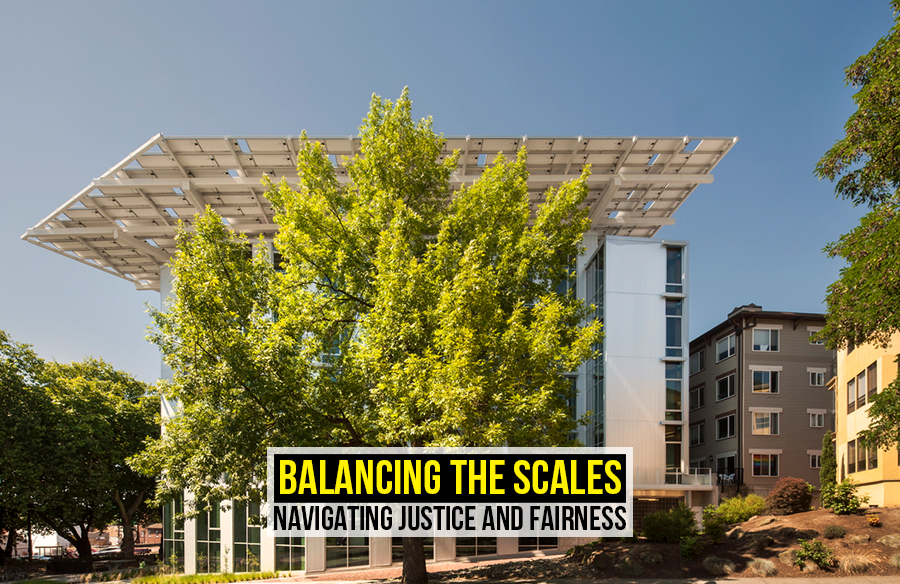
The Bullitt Center in Seattle is frequently referred to as the most environmentally friendly commercial building globally. It serves as a great model of ethical and sustainable architecture. The building integrates solar panels, rainwater harvesting, and composting toilets, which greatly lessen its impact on the environment. Furthermore, it was built using materials that were responsibly and sustainably sourced. These practices showcase how architects can uphold environmental stewardship and ethical integrity, thus promoting a balance of justice.
Community Engagement
Community engagement plays a crucial role in architecture, promoting equity and impartiality through active community participation in the design process. This inclusive approach enables architects to comprehend the needs, preferences, and concerns of the community, leading to designs that mirror their aspirations and necessities. To illustrate, when developing a public park in an urban area, an architect may conduct workshops, surveys, and meetings to gather feedback from residents. Through this collaborative effort, the community’s desire for a playground, community garden, seating areas and outdoor event spaces may be unveiled. By integrating these features into the design, the architect establishes a valuable asset for the community. A prime example of successful community engagement is the transformation of the High Line in New York City into a vibrant public park, achieved through extensive community participation.

Equitable Distribution
Ensuring a fair distribution of resources, opportunities, and benefits across communities is crucial in architecture. One key area where this is evident is in affordable housing projects. Architects can create living spaces that are not only safe and comfortable but also affordable for low-income families. By incorporating energy-efficient features and using durable materials, architects can help reduce long-term costs for residents, ultimately making housing more accessible.
An excellent example of equitable distribution in architecture is the Via Verde housing development in the Bronx, New York. This development includes affordable housing units, green spaces, community gardens, and health facilities, catering to residents of different income levels. By combining affordable housing with sustainable design and community amenities, Via Verde promotes both social and environmental justice, offering a healthy and supportive living environment for its residents.


Achieving a balance between justice and fairness in architecture is not just a lofty ambition, but a core duty of the profession. By emphasising accessibility, inclusivity, ethical standards, community involvement, and fair distribution, architects can help shape environments that are equitable, just, and welcoming. These values ensure that architectural creations benefit society at large, not just a privileged few. As the architectural landscape progresses, upholding these principles will result in stronger, fairer, and more prosperous communities. By adhering to these values, architects can effectively navigate the intricate realm of justice and fairness, leaving a meaningful and enduring mark on the world.
File References:
Dattner Architects. (n.d.). Via Verde. [online] Available at: https://www.dattner.com/projects/view/via-verde-the-green-way/.
The, B. and Center (2014). Living Proof High Performance Building Case Study. [online] Available at: https://bullittcenter.org/wp-content/uploads/2015/08/living-proof-bullitt-center-case-study.pdf.
CCA. (n.d.). How architectural design can improve social equity. [online] Available at: https://www.cca.edu/newsroom/architectural-design-improves-social-equity/.
network.aia.org. (n.d.). Equity in Architecture: It’s Part of Sustainability. [online] Available at: https://network.aia.org/blogs/elizabeth-rupp-del-monte-faia/2019/08/21/equity-in-architecture-its-part-of-sustainability.