In the heart of amidst city of Ghent in medieval Europe, a masterpiece of religious art was born. From the skilled hands of the Van Eyck brothers, Hubert and Jan. The Ghent Altarpiece, this masterpiece became a symbol of devotion, and artistic excellence and the borderline of the Northern Renaissance. In the late 15th century the leaders of Ghent commissioned for grand masterpiece for St. Bavo’s Cathedral. The art was made not only to adorn the sacred space but also to inspire reverence among the faithful.

The Birth of the Altarpiece
Hubert Van Eyck was Chosen for his marvellous religious artwork to execute this project but even before he could vision his fully completed project he passed away, leaving his younger brother Jan Van Eyck to carry on, being a skilled artist for himself, took up the challenge with utmost determination.

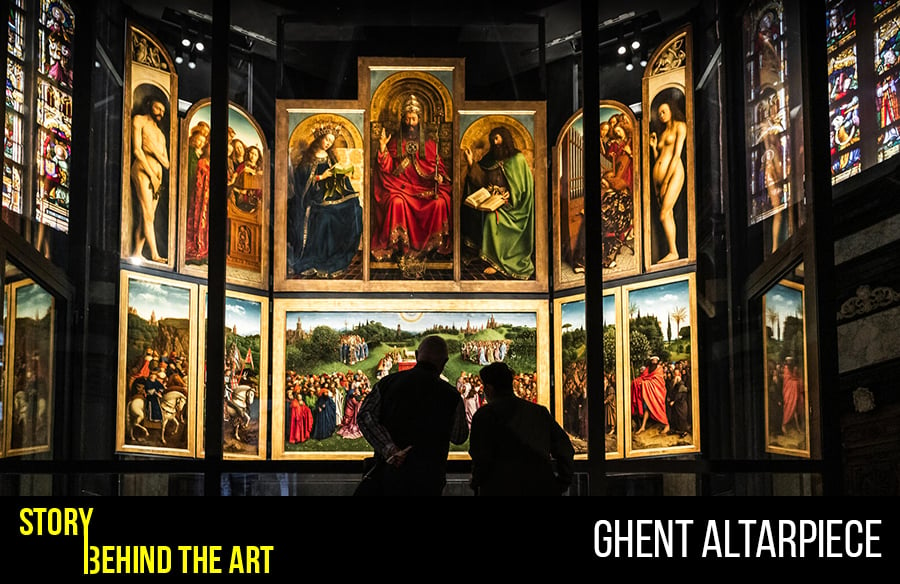
The Ghent Altarpiece was also known as” Adoration of the Mystic Lamb”. It consisted of multiple panels of intricately painted scenes from the Bible, the Annunciation, and the Just Judges, each picture itself has a part of the story to tell.
Every detail of the altarpiece was meticulously crafted from the facial expressions of the people, from the delicate folds of the garments worn by several figures showcasing the importance of each
element in the frame. Jan Van Eyck the renowned oil painter appointed several artists to bring the various details to showcase the craftsmanship in material, color effect, and texture to make it more real.
When the altarpiece was finally done it became a testament to the Van Eyck brothers, bringing out their best artistic vision.
Over several years the Ghent Altarpiece survived many wars, thefts, and natural disasters enduring as a symbol of faith, beauty, and human creativity. Today the altarpiece stands out as a most celebrated masterpiece of Western art as a window to the soul-stirring power of religious devotion and artistic realism.
The central panel which showcases the adoration of the Mystic Lamb symbolizes the sacrificial Lamb of god Jesus Christ whose death and resurrection are central to Christian theology.
Surrounding this central motif are the depictions of angels, saints, and figures from the Old and New Testaments, alluding to Christian ideology across faith and time.

The altarpiece also contains symbolic references to the sacraments of the catholic church such as Baptism and Eucharist as well as the representation of virtues and vices reminding viewers of the struggle between the helpless people and their sorrows, the difficulties, and the cruelty of evil people.
The Great Ghent Altarpiece Explained
The Ghent Altarpiece, painted in 1432 by the Van Eyck brothers is a very large and complex painted piece with wing panels allowing it to be closed and opened. This would only be opened on Holy days. The rest of the leaving is closed allowing only the Annunciation to be visible. This masterpiece is a feast of colour-tone material texture showcasing many moral values. It reveals colour, festive energy vibrant colour, brighter than those of the closed shutter.

The Inner Glow of the Altarpiece
The monumental Ghent Altarpiece was painted on oak panels covered in thin layers of a mixture of chalk and animal glue. The figures have been painted using oil with several layers. This combination of painstaking work and transparent work creates an extra dimension. As you can envision yourself a divine light of faith is in front of it.
To explain its richness in art let’s examine every panel:


Adam & Eve: The biblical ancestors of the whole of humanity occupying the uppermost panels. The only panels without the sky as a background to distinguish them from heavenly figures. They symbolise both sinners and savers as the definition of the whole of humanity. That serene gaze explains the grief bringing death to the world. Also, the fruit that Eve is holding is a citrus fruit which may be an allusion to the bitterness of the downfall.

Also, the two sandstones showcasing the first credulity even happened Cain’s murder of his younger brother Abel, also the other one showing all the difficulties humankind had to deal with.
There are many saints and angels singing choirs. On the opposite panel to the right Angels are playing instruments.

The Virgin Mary: The Mother of God is right-hand side of the mysterious figure in the center. Her serene, dressed up in blue rob, decorated with jewels absorbed in a prayer book.
John The Baptist: The last Old Testament prophet, in a stately green costume sitting, pointing to the Messiah with their right index finger.
Christ: This figure has been widely identified as the god the father, overseeing the story of salvation.
A father, the son the Holy Spirit all in one.
The Just Judges: The people presented on this panel are administrators and politicians. This panel was stolen in 1934 and now what exists is a copy by Jan Van der Veken.
The Adoration of Mystic Lamb: The large central panel in which a divine liturgy is being performed around the lamb of god in a green landscape with a high horizon.

The platform represents Mount Zion; the lamb stands erect bleeding into a glass representing wine as Jesus describes wine as his blood to earn the forgiveness of his sins.
The Hermits and the Pilgrims: Those who turned their back to worldly pleasure to save Christ.

So this is the story behind the Ghent Altarpiece which is after 4 years of renovation now brought to the restoration studio at the Ghent Museum of Fine Arts (MSK).
Citations:
The image descriptions and reference sources are mentioned below -:
Websites referred for data and information
- https://artsandculture.google.com/story/inside-the-ghent-altarpiece-lukas-art-in-flanders/igVxmZszGRczIA?hl=en
- https://smarthistory.org/van-eyck-the-ghent-altarpiece/
- https://visit.gent.be/en/see-do/ghent-altarpiece-supreme-divine-art