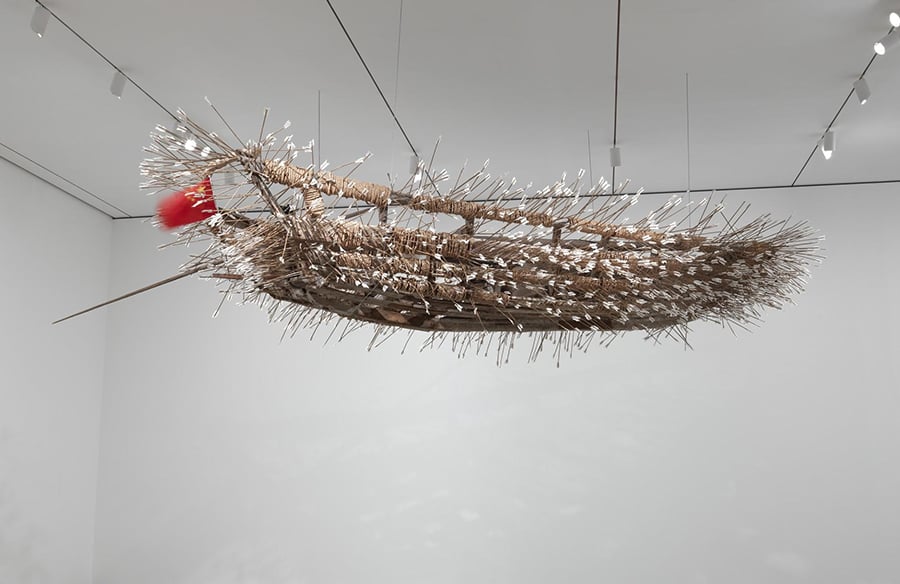
Cai Guo-Qiang, born in 1957 in Quanzhou, China, is a well-known contemporary artist whose works have been splendid and exciting to the lives of many people around the world. Having forged his artistic personality within the four walls of a family that is very ingrained in traditions, Cai’s urban background greatly influenced his artistic sensibilities. He could clearly understand Chinese painting, calligraphy, and philosophy when he was still small. They provided him with a springboard to capture the essence of art and the spirit of social expression in the future.
Cai’s artistic journey started from canon where the classic Chinese arts provided a solid basis. He found his fancy in stage design while learning at the Shanghai Theater Academy. This burgeoning passion was driven by the skills he developed in emphasizing visual storytelling and an appreciation of how artistic ventures can elicit feelings and stir people’s thoughts. Such initial experience of mixing old Chinese art with contemporary, concept-driven techniques set the pattern of his later work.
Launched into the early 1980s, Cai reached Japan, where he never stopped improving his skills and investigating new destinations for his exchange of thoughts. Just at the time when he started using gunpowder as a canvas in the true spirit of artistic freedom, his career reached an unforeseen peak. Upon incorporating his stage designing prowess, Cai set out gunpowder and created giant-scale shots of explosion and beauty that momentarily captured the very essence and the transient nature of both transformation and creation.
To demonstrate his passion for art Cai blew away people’s minds, stirring up debates and triggering various emotions. His paintings have been aired in museums and galleries all over the world, and he has been recognized with multiple prizes and recognitions for his part in contemporary art. Cai’s art is yet more than just its ability to awaken and provoke, but also that of crossing frontiers, and connecting us to our shared human nature and culture.


Career – Philosophy, Style of Work
The artistic philosophy of Cai Guo-Qiang is deeply influenced by his Chinese heritage and his career path as a foreign artist who immigrated from China to America. His art reveals an unconceivable admiration of nature, an enticing curiosity for the heavenly bodies, and the ability to change the viewer’s consciousness.
Gunpowder is not the only tool that Cai uses to create artwork. The artist, Cai taking into account his past as a scene designer, searches out invisible dimensions of nature using his unrefined but vivid expression that features explosive bursts of nature. Besides the mere technical aspect of gunpowder, it is also a philosophical matter as it signifies the cyclic nature of life. It is like a constantly turning wheel which is short and fast.
Cai is known precisely for his “Sky Ladder” work, which shows how he approaches art practice. Respecting his work a documentary about him was made in the name called “Sky Ladder”. The artwork, which represents a human vainglorious endeavor to cross Earth’s limitations and never-ending, takes the form of the ladder of fire. Through the use of fire as the key element, not only Cai builds a colorful play but also sends a message with the themes of transformations and rebirth.
Nevertheless, Cai never leaves aside the important aspect of his work he has a taste for Chinese culture and history. Many of his sculptures derive from the base of traditional Chinese drawing and writing, but he reenacts the concepts in a modern style. Take for instance, in his “Ink Games” series, large-scale drawings use gunpowder and ink, which reflect traditional Chinese brushstrokes yet with modern techniques applied.
Finally, the artwork of the Cai Guo-Qiang shows how capable art is to trespass the boundaries of cultures and link people together around the globe. The novelty of his creation of traditional Chinese aesthetics, modern techniques, and philosophical level has ranked him among the top innovators in the contemporary art sphere.


Recognition after Death
Despite that he died in 2023, Cai Guo-Qiang managed to triumph in his art traditions all over the world. According to him, all nature might exist in harmony, each part of it supporting and reinforcing the other. The work of Emil Nolde was a source of inspiration for artists and art lovers around the world, his heritage is carefully preserved.
The exhibition of Cai’s works in museums and galleries has continued to be a major attraction globally and this is expressed through the increasing demand they pull every time they are in town. One of the major exhibitions that he has had is a retrospective in major museums as well as galleries globally. These presentations are not only dedicated to illustrating her artistic masterpieces but also a remembrance of his lasting influence on the practitioners of now times arts.
Various publications which focus on Cai’s life and his body writing have been issued after his death so that scholars and art historians may bettering explore his artistic philosophies and practices. Besides them being a heritable record of Cai’s artistic merit, they similarly serve as informational and inspirational From US$8.00/Page
Recently, Cai Guo-Qiang’s art has gained timely recognition with him being awarded various awards and honors. He has been recognized all over the world for his contribution to contemporary art. They cover such lines as the Praemium Imperiale prize for sculpture by the Japan Arts Association, assessing him for outstanding contributions to the arts.
Most pragmatically, Assumptions about Cai continue to spur the artists to challenge their horizon of imagination. It is his unusual application of materials and his exceptionally creative talent that produce artworks that go beyond cultural restrictions. Such artworks are sure to last throughout various generations, ensuring that his legacy remains afresh.


Only individual creativity can bring about real social development.
- Cai Guo-Qiang
Credits:
- Cai Guo-Qiang Burns up the art scene this fall (2017) Galerie. Available at: https://galeriemagazine.com/snapshot-cai-guo-qiang/ (Accessed: 30 March 2024).
- Cai Guo-Qiang: Gunpowder art exhibition – press release (no date) Ashmolean Museum. Available at: https://www.ashmolean.org/press/cai-guo-qiang-gunpowder-art-exhibition-press-release (Accessed: 30 March 2024).
- https://www.wsj.com/articles/BL-SEB-97292
- Phaidon (no date) Astonishing animals – Cai Guo-Qiang’s heritage installation, PHAIDON. Available at: https://www.phaidon.com/agenda/art/articles/2018/august/20/astonishing-animals-cai-guo-qiangs-heritage-installation/ (Accessed: 30 March 2024).
- https://en.wikipedia.org/wiki/Emil_Nolde
- (No date a) Embassy of Japan in the UK. Available at: https://www.uk.emb-japan.go.jp/en/webmagazine/2013/09/praemium.html (Accessed: 30 March 2024).