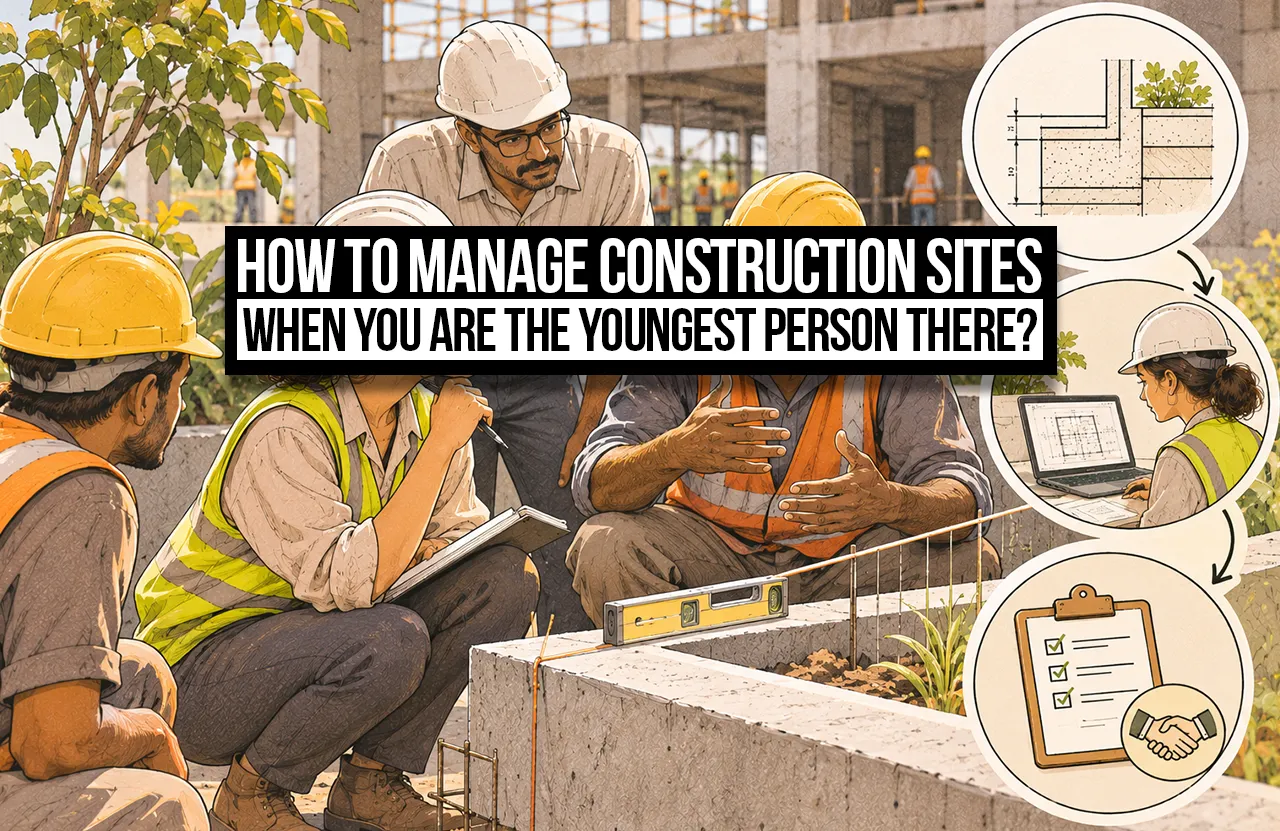
Being the youngest person on site can be quite intimidating. You’re going to be working with contractors, engineers, supervisors and all sorts of skilled folk who have years of experience behind them. You’re expected to know the drawings, you’re expected to be able to give instructions, you’re expected to be able to spot the errors, and at times you’re expected to make decisions about the work you’re still learning. How do you find your place without just pretending you know everything?
Many young architects and designers find it difficult to transition from the classroom to the actual construction environment. In school, you learn to design, draw, learn about materials, and learn how things are constructed. On site, it’s very different. A drawing that is perfectly straightforward on paper can be absolutely complicated in the actual construction environment, and decisions that are trivial in the design phase can have massive implications for cost, time, and quality.
The real problem isn’t so much about managing a site. It’s about learning to take responsibility in an environment where many people share experience, knowledge, and authority. The next stage is learning how to work in that shared environment.
-
Know Your Site Before You Step Onto It
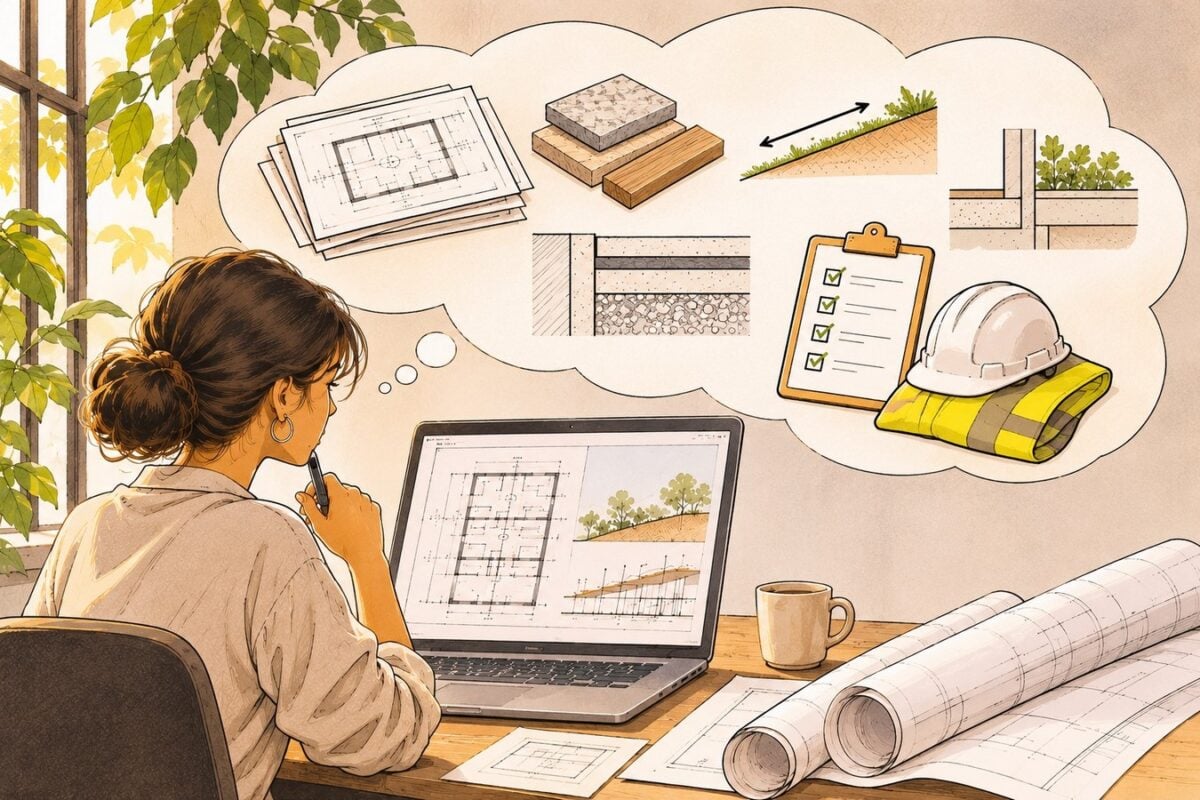
Good site management starts before you even get there. If you turn up without any idea where the project is at, what work is being done, or what you’re meant to be doing, a simple inspection can be a real pain. So you need to be properly prepared prior to your visit.
Start by going through the latest approved drawings, specs, sections, and any consultant drawings. You need to know what you’re building, be aware of any details that need attention, and be up to speed on any issues that have arisen previously. Looking at the layout isn’t enough. You also need to know the finished levels, the drainage slopes, the material specs, and how the various elements interface.
It’s also vital to know your role. Are you there to check that the design is being followed, monitor progress, work with the contractors, or supervise a particular task? Knowing your role and what decisions you can make will go a long way toward avoiding confusion on site.
-
Understand Who You Are Working With
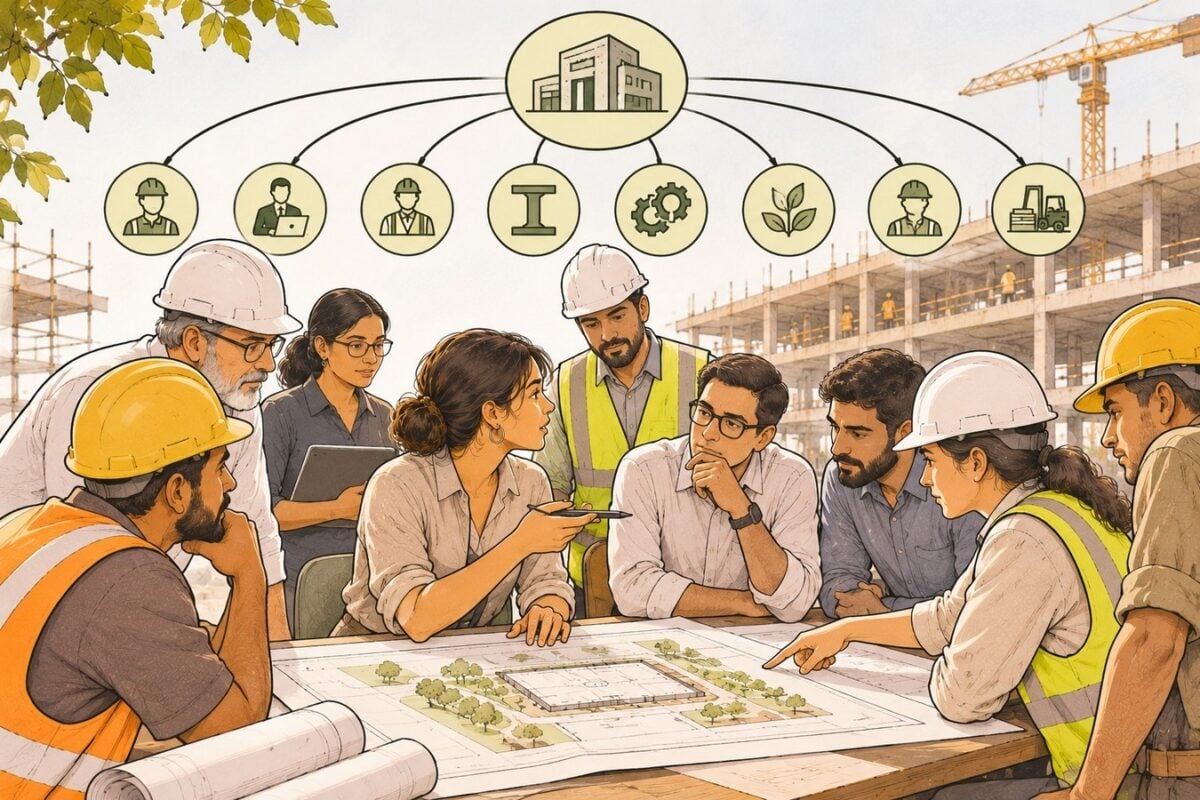
A site brings together all sorts of people, each with their own skill set. You’ve got the architects, project managers, site engineers, structural and MEP consultants, contractors, sub-contractors, supervisors, suppliers, and skilled tradespeople.
As an architect early in your career, it’s vital that you understand how that hierarchy works. You may be asked to pass on a design requirement, but that doesn’t mean you can approve every construction decision. That’s the sort of thing you need to be aware of if you’re to get on.
For example, you’d refer any discrepancy in a structural detail to the relevant structural professional rather than mucking about with it yourself. A proposed change to landscape levels would probably require a conversation with the drainage and civil engineers as well.
Knowing who to talk to, when to raise an issue and who can actually approve the changes makes site co-ordination a lot easier. Once you’ve got that flow, then the next step is learning to listen before you instruct.
-
Listen Before You Instruct
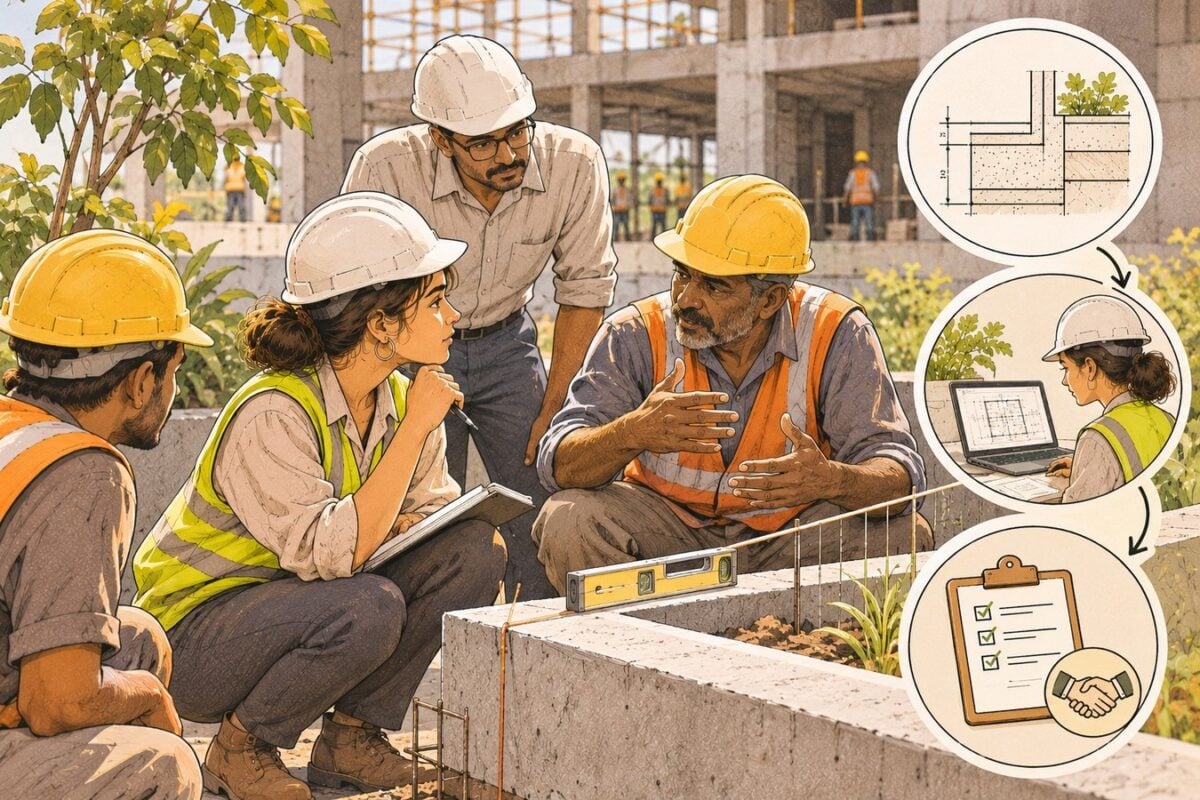
One of the most fascinating things about working on a site is getting the chance to meet people with far more hands-on experience than you. A mason will know how a material actually behaves when you’re installing it; a site supervisor will spot a sequencing issue that’s not obvious in the drawings. Rather than just giving instructions, take the time to see how people actually do the work. Ask questions, watch how they do it, and pick up their practical advice.
But listening doesn’t mean you have to follow every suggestion. Some shortcuts might hurt the design, durability, or safety of the project. Always check any suggestion against the approved drawings, the specs, and the technical requirements.
The aim is to bring practical experience and design knowledge together rather than view them as two separate and potentially opposing things. Once that balance is established, the next issue is knowing when to speak and when to be silent.
One of the hardest things for the young lad is worrying about appearing inexperienced. If a senior contractor or experienced person asks you a question, you’ll often feel the need to answer straight away even if you’re not absolutely sure.
But on a construction site, you can’t just guess instead of having real knowledge. The wrong instruction can waste materials, cause rework and delays, and in the worst case create a safety hazard.
If you’re not 100% certain about a construction detail, then say so. Go check the drawings, get the view of a more experienced architect or specialist, and then provide the solution.
There’s a difference between not knowing the answer and not knowing how to find the answer. Knowing how to research, verify, and share accurate information is a key professional skill, and it’s even more important when you’re asked to question work on site.
It can be difficult to challenge someone older or more experienced, especially if the work you see doesn’t match the approved drawings.
But if you avoid difficult conversations, little mistakes can turn into big problems.
The key is to focus on the work, not the person. Don’t jump to conclusions and start blaming. Look at the drawing, point out what’s wrong, and then talk about how you’re going to fix it.
For instance, if you’re building a planter at the wrong level, check the measurements, figure out why it’s wrong, and involve the team responsible before you carry on.
Being respectful doesn’t mean you have to be passive, and being assertive doesn’t mean you have to be confrontational. Good communication means everyone can put forward their concerns and work together to find a solution. That same principle applies to good documentation.
-
Document Everything That Matters

Docs aren’t always sufficient when you’ve got a number of people working on different bits of the job. Instructions get muddled, decisions get lost, and issues get lost. It’s therefore vital to maintain site observations, take photos, record the discrepancies, and produce clear site visit reports. A good report identifies the issue, states where it is, describes what you saw, references the correct drawing/spec, and states what needs to be done and who will follow up.
Docs aren’t just paperwork. They keep people accountable, make coordination easier, and stop the same mistakes from happening over and over again. They should be part of every site visit.
-
Understand That Construction Is About Coordination, Not Just Execution
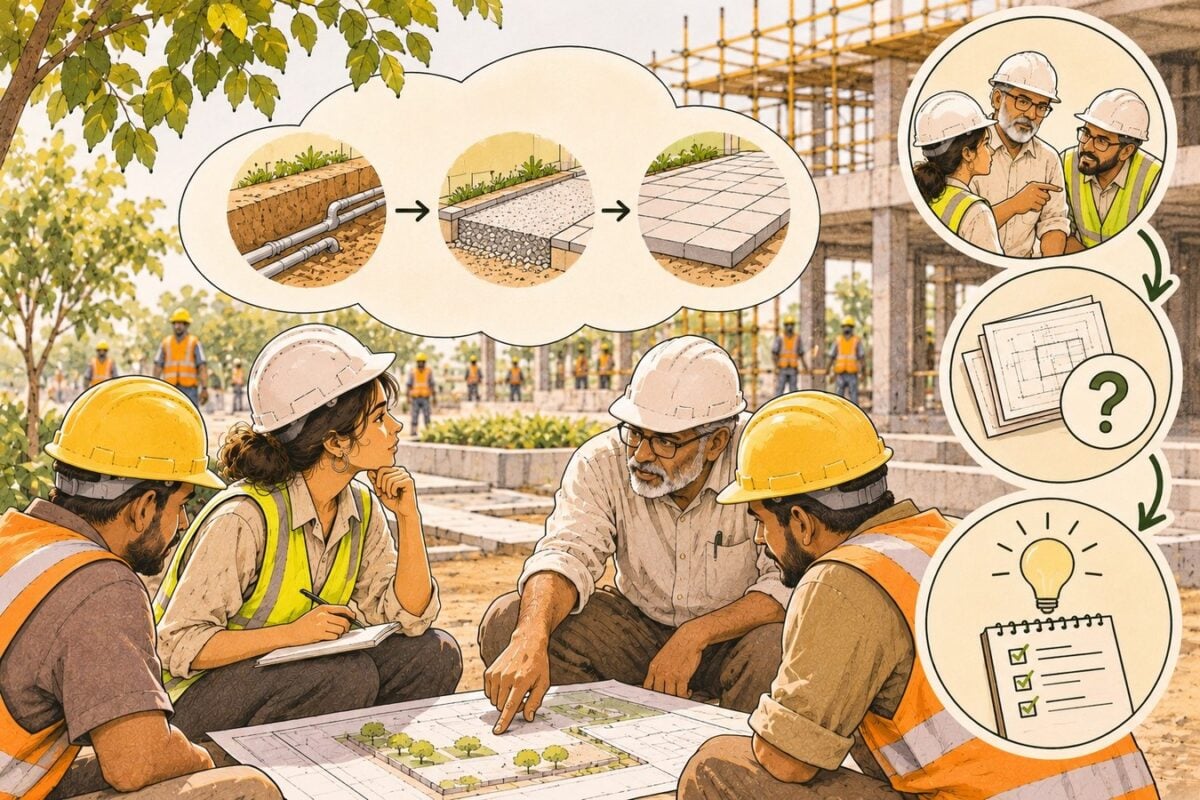
On site, all the trades are linked. One trade’s progress can directly affect another. If paving installation begins before the underground irrigation lines are complete, the finished paving will likely need to be removed later to allow the irrigation system to be installed. This will lead to additional cost, delay and waste of material.
That’s why it’s just as important to know the order of construction as it is to know the detail of each task. You have to look beyond the task at hand and consider what needs to happen prior to, during, and after it. Coordinating architectural, structural, electrical, plumbing, and landscape work can prevent problems. That’s why every site visit should be an opportunity to learn.
Not every site visit will go smoothly. You may come across incomplete drawings, unforeseen site conditions, disagreements, errors, and questions you simply can’t answer at the moment.
Don’t view these as failures. See them as opportunities to learn. What went wrong? Could you have picked it up during the design phase? How do you avoid it next time? Apply those lessons on the next visit.
Just as important is to look for mentors. An experienced architect, an experienced engineer, a skilled contractor, a skilled tradesman, etc., can impart a lot of knowledge you simply won’t get from textbooks or software. The learning process and your ability to take constructive criticism will slowly develop the technical judgment you need to manage more complex projects. That then brings us back to the original points of preparation, patience and growth.
The Youngest Person Doesn’t Have to Know Everything
You’re the youngest on site, so obviously you’re not the least capable. You’ll probably find yourself in situations where the others have far more hands-on experience.
You don’t need to be in the same position as that experience or be in a position to pretend you’ve learned everything. Just prepare properly, listen carefully, communicate clearly, know your limitations, and stick to your decision.
In the end, site management isn’t about being the loudest, having all the answers or having the title. It’s about bringing people together and bringing different skills and perspectives to bear on a common objective. You might be the youngest person in the room, but if you’ve got the right attitude, the right preparation, and the willingness to learn, you can absolutely become someone people trust to get the job done.
Source/Credits:
- (2026). Sloped Screed – Construction Drainage Guide. Darda GmbH. https://www.darda.de/en/knowledge/sloped-screed
- (2023). Complexity and Construction Management: An Integrated Analysis of Logistics, Organizational Processes, and Productivity. Buildings 13(17). https://doi.org/10.3390/buildings16173406
- Aziz, N. A., Rahim, F. A. & Aziz, N. M. (2022). SYSTEMATIC LITERATURE REVIEW ON COMMUNICATION IN CONSTRUCTION PROJECT MANAGEMENT: ISSUES AMONG PROJECT PARTICIPANTS. Journal of Surveying 13, pp. 52-70. https://doi.org/10.22452/jscp.sp2022no1.5
- Thomas, H. R., Riley, D. R. & Messner, J. I. (2005). Fundamental Principles of Site Material Management. Journal of Construction Engineering and Management 131(7), pp. 808-815. https://doi.org/10.1061/(ASCE)0733-9364(2005)131:7(808)
- Kavanagh, D., Tell, J. & Frisa, K. (2026). Construction Rework: Causes, Costs, and Solutions. Procore. https://www.procore.com/library/construction-rework
- (2020). Evaluate and confirm work methods. CITB. https://www.ukstandards.org.uk/en/nos-finder/COSVR728/evaluate-and-confirm-work-methods
- Smith, J. (2022). Construction Site Management: A Practical Guide for the Site Manager. Publisher: XYZ Press. https://www.xyzpress.com/construction-site-management
- Inc, H. O. (2026). Construction Coordination Workflow That Prevents Rework. House Of Engineers. https://houseoe.com/construction-coordination-workflow/
- (2026). Mentorship at AIA. American Institute of Architects. https://www.aia.org/career-growth/mentoring