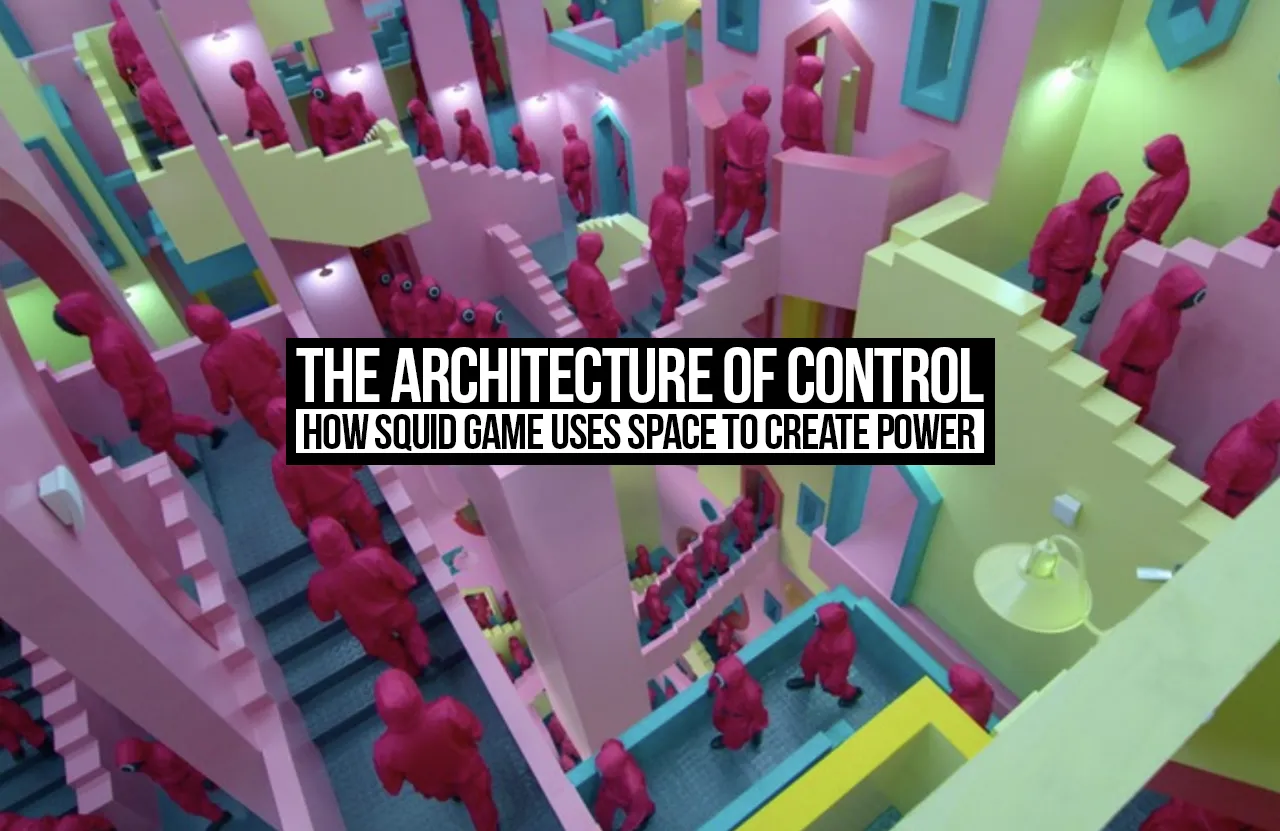
Squid Game uses architecture as a means of control. From the dormitories, stairs, arenas, to the VIP areas, the production designer has stated that they created a specific aesthetic ‘using colours, scale, and spatial hierarchy’.
Spatial Hierarchy
One of the most obvious messages in the architecture is that there is a lack of equal space. We are shown that there is a lot of divide between the players and organisers. The players live in a huge, cold dormitory whilst the organisers have their own private rooms, high vantage points and luxurious VIP areas. This shows us how privileged the organisers are and how the players are just numbers.
The bunk beds in the dormitory are really significant. Chae stated that she designed the bunk beds to look like items in a warehouse. She did this by making them tall to make the occupants feel objectified. These bunk beds also represent social hierarchy. The higher you are up the bunk beds, the better view you get; however, no one is truly free from this overcrowded hierarchy. The bunk beds in the dormitory help put the players into controlled storage. This helps create a feeling of scarcity. There is little floor space, meaning there is no privacy for the players. Everything they do can be seen by their competitors. This helps to create a feeling of distrust, forming alliances and betrayal. The social hierarchy is embedded throughout the show. From the ceilings, beds, corridors, and sight lines, everything makes the players feel socially stratified.
Staircase
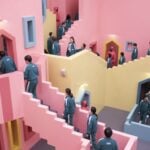
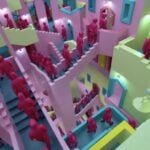
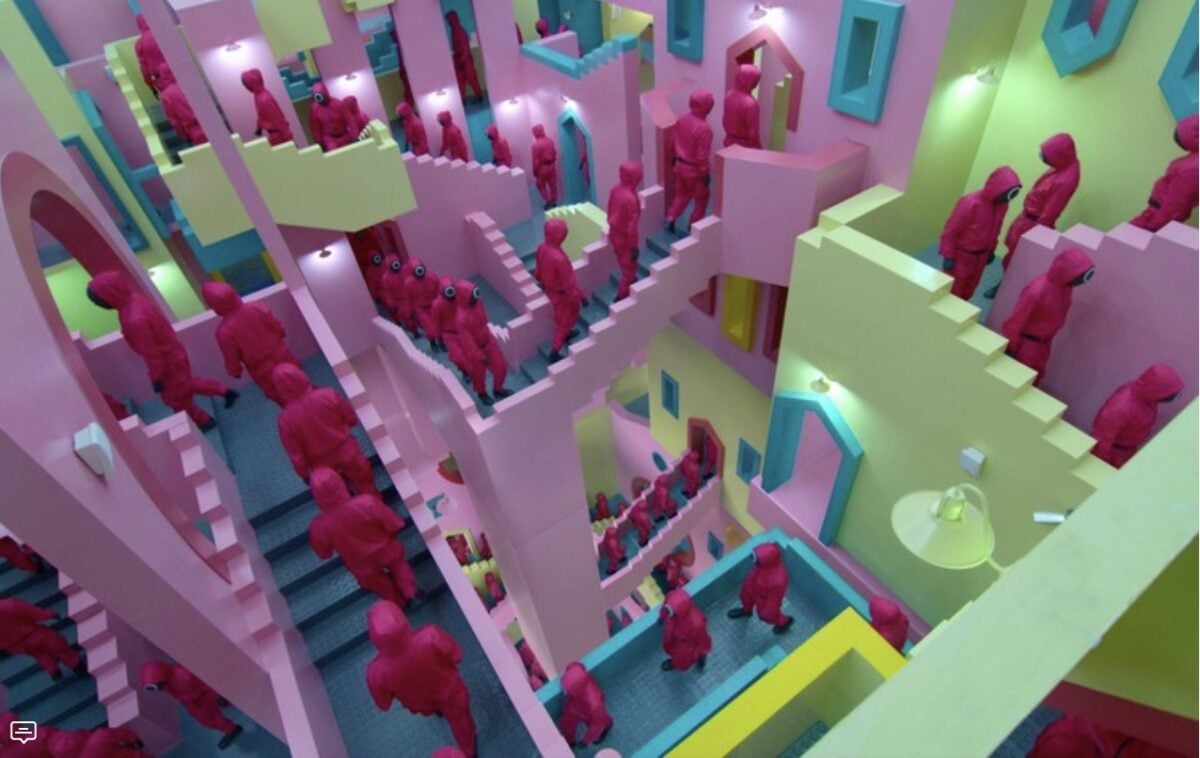
The pink and green staircase is probably the most recognisable part of the space in Squid Game. The staircase is never-ending and has many crossing parts to create a maze. This was inspired by M. C. Escher’s Relativity. Chae Kyoung-sun stated that they wanted to make the players feel lost. The staircase acts as a maze due to the impossible geometry inspired by Escher.
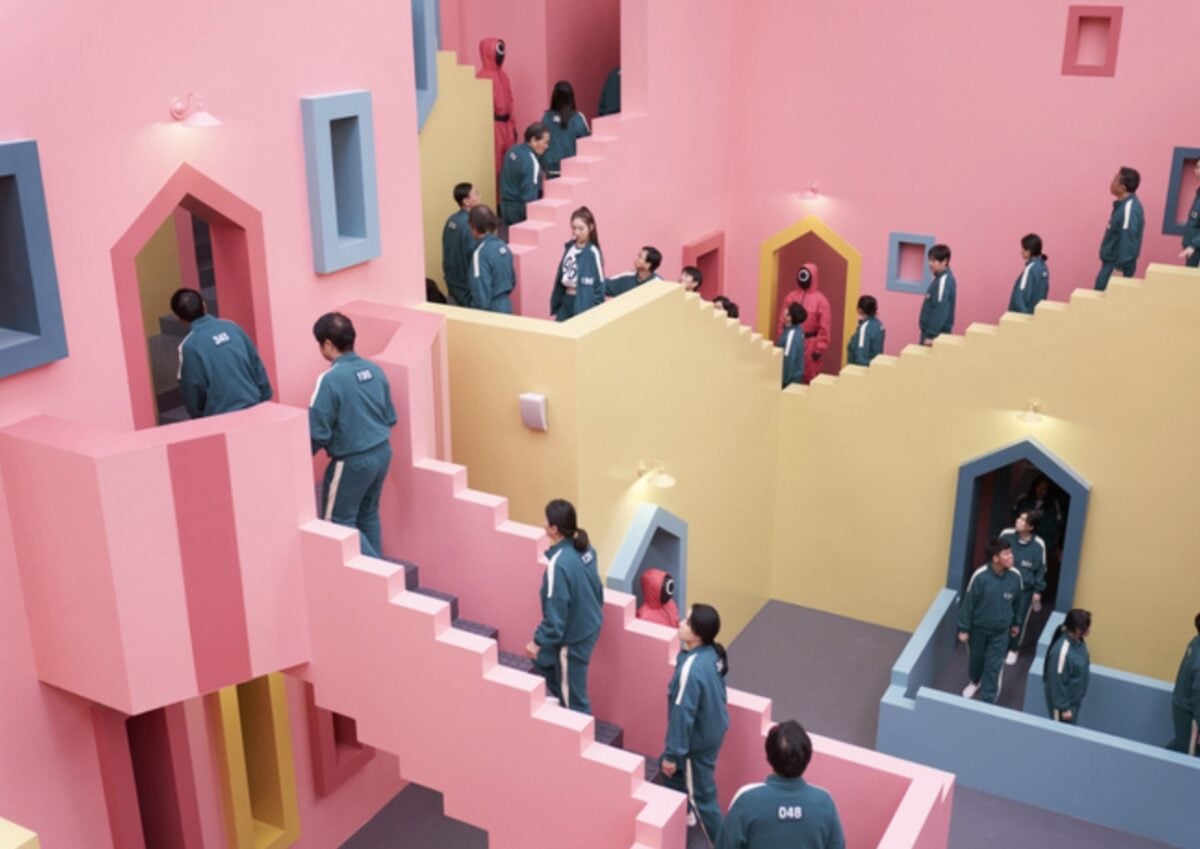
The staircase is a metaphor for the social status of the players. They are constantly moving, trying and climbing; however, there is no obvious way out of the system. The bright colours help to make this feeling of anxiety less obvious; however, the repetitive geometry makes it more obvious. The architecture also acts as a trap. The staircase also helps to control the speed of the players. They must walk along open routes that can be seen by others. They can be separated and redirected by the guards. The size of this staircase means more than a hundred people can fit on it. This makes the players feel like they are all moving as one. There is no individuality.
Controlled Movement
Every element of Squid Game has been created to create a feeling of being watched. The dormitory is spacious and has a central layout. There is controlled access to the entrance and exit. The guards are in a high or hidden position. The game arenas are framed. Although the players may feel like they are playing freely, the architecture ensures they are being watched.
The dormitory has a central high area and white-tiled walls, making it feel like a tunnel or travel area. Chae stated that the concept was to make it feel like “people abandoned on the street.” This makes the players feel like they have been taken away from their normal social protection. Instead, they are in an area where they are being treated as humans. There is very little privacy due to the open space. The entrance and exit are small, making it feel like there is no way out. This makes the players feel like they are controlled by the architecture. They start policing each other due to the lack of privacy, trust, and individuality.
Pastel Colours
One of the creepiest things about Squid Game is the pastel colours. The soft pinks, mint greens, pale blues, and candy-like game sets give off a childlike vibe; however, they are playing deadly games. This makes the violence seem more surreal and creepy. The areas look innocent; however, the rules are extremely harsh.
Chae Kyoung-sun stated that they used light pink and light green in the set alongside the bright pink and green tracksuits to create a visual hierarchy. This means the players are all the same visually. However, the guards, staff and VIPs have their own visual identity.
Architectural Narrative
Every major area in Squid Game affects how the characters act. The dormitory makes them feel tense due to being close together. This causes them to negotiate and form fragile alliances. The game arenas make them feel exposed due to the open space. Working together can save their lives; however, they can also be eliminated. The VIP areas make them feel luxurious and distant. The wealthy can view human suffering as a game.
The alleyway sets were inspired by Korean alleys from the 1970s and 1990s; however, they have doors instead of real houses. Chae stated that this creates a realistic urban feel. However, there is no security in the houses. This creates a feeling of the uncanny. The areas also reflect how the characters are feeling emotionally. As trust breaks down, the dormitory feels like a prison. The game areas have fun shapes; however, they create feelings of fear. Squid Game has made the architecture react to the narrative. This ensures that the location is a character in the story.
Power Through Design
Overall, Squid Game makes the argument that power is often shown through design. The organisers don’t have to explain their power over the players as the spaces already show this. The players are in a stacked, watched, coloured, and confusingly arranged area. The elites are watching from a safe place. The architecture is a silent language of inequality.
This is why the visuals are so memorable. The pastel colours and fun shapes make the critique sharper. Squid Game has made the dormitories look like warehouses, the staircases look like mazes, and the leisure areas look like they are for surveillance. This shows how architecture can affect behaviour, enforce hierarchy, and make the feeling of control feel natural.
Reference List:
Grobar, M. (2022). ‘Squid game’ creator Hwang Dong-Hyuk & production designer Chae Kyoung-sun delve deep into creation of “an unprecedented universe” – the process. [online] Deadline. Available at: https://deadline.com/video/squid-game-hwang-dong-hyuk-chae-kyoung-sun-on-shows-production-design/ [Accessed 8 Nov. 2026].
Kemp2022-06-22T11:27:00+01:00, S. (n.d.). Emmys spotlight: ‘Squid game’ production team on creating the show’s unforgettable visuals. [online] Screen. Available at: https://www.screendaily.com/features/emmys-spotlight-squid-game-production-team-on-creating-the-shows-unforgettable-visuals/5171528.article [Accessed 8 Nov. 2026].
Kyoung-Sun, C. (2014). Interiors. [online] Interiors. Available at: https://www.intjournal.com/chae-kyoung-sun [Accessed 8 Nov. 2026].
Licuria, R. (2022). Chae Kyoung-sun (‘squid game’ production designer) video interview. [online] Gold Derby. Available at: https://www.goldderby.com/feature/chae-kyoung-sun-squid-game-production-designer-video-interview-1204961713/ [Accessed 8 Nov. 2026].
Netflix.com. (2026). Welcome to zscaler directory authentication. [online] Available at: https://www.netflix.com/tudum/articles/squid-game-season-2-production-design [Accessed 8 Nov. 2026].
Reinstein, M. (2021). Game, set, watch. [online] Television Academy. Available at: https://www.televisionacademy.com/features/news/online-originals/game-set-watch [Accessed 8 Nov. 2026].
www.domusweb.it. (n.d.). Squid game’s disturbing architectures. [online] Available at: https://www.domusweb.it/en/architecture/gallery/2021/10/22/the-disturbing-architecture-of-squid-game.html [Accessed 8 Nov. 2026].