“Business and real estate literacy is not a distraction from design. It is what protects it.”
What design school doesn’t cover?
Architecture school taught me to design buildings. It never taught me how to run the business that builds one. I learned this in my first week at the firm, a few months after graduating, when the real job looked very different from what I had studied for in the studio.
I expected drawings and 3D models. Instead, on Monday I sat in on a client’s call about the budget per square foot, not the facade. On Wednesday, my senior declined a dream project because the fee would not cover the team’s time. Next week, a contractor, a dealer and a client’s relative argued over one bathroom layout.
My seniors settled it in ten minutes, using numbers, tact and one phone call to a supplier. That evening I wrote in my notebook that drawing is perhaps forty per cent of the job. I now think that was about right, and it changed how I see my own career.
A drawing becomes a building only when someone pays for it, approves it, supplies the materials, and builds it on schedule. Each has money, pressure and priorities of their own. Architects who understand those pressures get their designs built close to the drawings. Those who don’t watch their best ideas get value-engineered into the average.
This article is my attempt to help you learn the other sixty per cent of why learning business is crucial in the construction market.
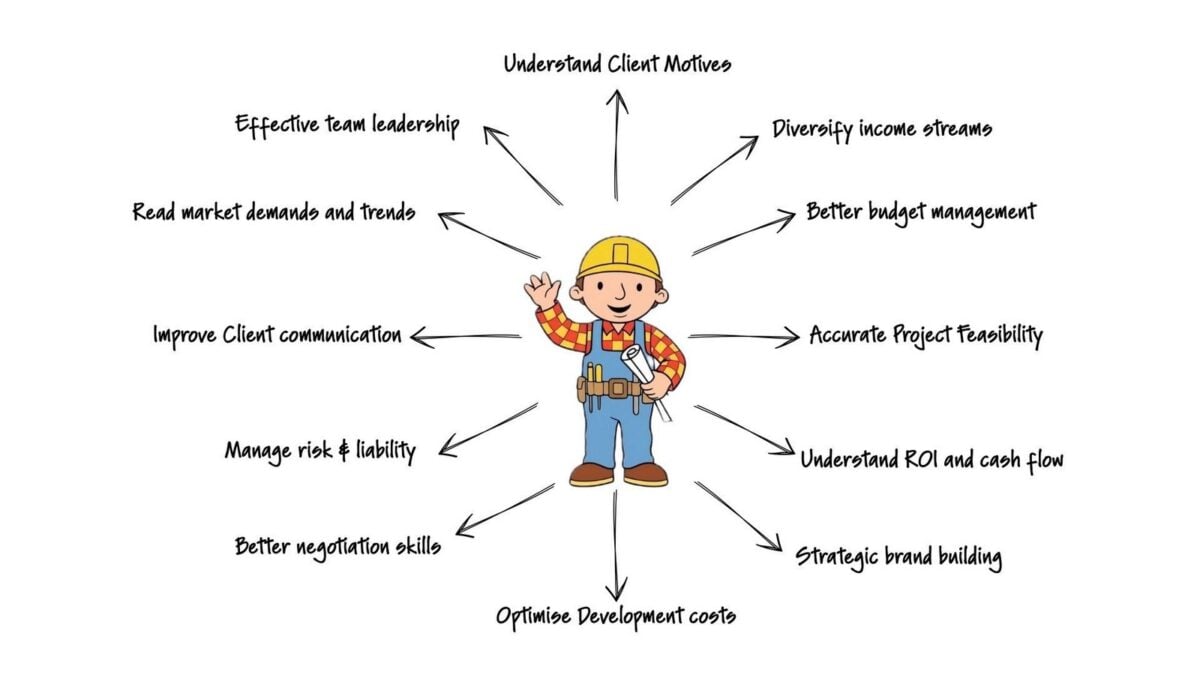 Design alone does not pay the bills:
A studio survives on margin and cash flow, not talent alone. Every firm must answer three questions: what does an hour of our time cost, what do we charge for it, and when does the money actually arrive? No one ever asked me about any of them in college or in a studio.
Here is an illustrative example. A firm quotes ₹6 lakh to design and supervise a house. The team spends 800 hours at an internal cost of ₹500 per hour, which is ₹4 lakh. Rent, software and the architect’s time must come from the remaining ₹2 lakh, and one round of unplanned revisions can erase it.
I watched this go wrong on a project that ran half over its drawing hours. Nobody wrote down the scope, so every request for a small change was absorbed for free. The architect’s fix was simple: a defined scope, fees tied to stages, and a written note whenever the client asked for something extra.
The basics I am learning first:
- Fee structures: percentage of construction cost, lump sum or hourly, and when each protects the firm.
- Scope control: what is included, what counts as extra, and who approves it in writing.
- Payment milestones: cash at each stage, not one large payment at the end.
- Overheads: how much of the team’s time is billable and what the office costs monthly.
Reading the Client’s real question:
Most clients are not buying a design; they are making a property decision. A homeowner thinks about resale value, a developer about margins, a shopkeeper about footfall and rent. If I cannot speak that language, my design gets judged on the wrong terms. I am learning it in two layers.
The first layer is land and its rules. Floor space index (also called floor area ratio), setbacks, height limits and permitted use decide how much can be built before I draw a line.
They fluctuate through town and state, so I examine the nearby construction bylaws as opposed to trusting memory.
The 2nd layer is the developer’s arithmetic: land, construction, approvals, finance and marketing, as compared towards what the completed vicinity will promote or hire for. Efficiency, the share of built area that can be sold or rented, matters enormously. Trimming a foyer or moving a staircase can upload sellable vicinity to each floor.
In a feasibility meeting, I observed the developer requesting 3 questions in a row: what are we able to build, what’s going to cost, and who will purchase it? My early conceptual sketches spoke back none of them, and I now begin each idea with the ones 3 questions.
This lets me say, “This courtyard costs you a little area but lifts the price of every unit around it.” That sentence wins arguments.
Everyone around the drawing:
A building is made by a chain of people, and the architect sits in the middle. Each connection desires something different.
Clients need reality: approximate price, time and outcome. They do not often examine drawings as I do, so they choose me based on how sincerely I explain. Written approvals at every level and sincere early warnings approximately price count number greater than a stunning presentation. A patron amazed by the means of an invoice forgets the design.
Contractor paintings on skinny margins and tight coins flow. I want to examine an invoice of quantities, examine rates on an equal basis, and certify paintings and bills on time. A contractor who trusts the architect to certify pretty commonly is going the extra mile with the info that counts.
Dealers and suppliers control lead times, stock, samples and after-sales service. A dealer who likes working with me will warn me early that a finish is being discontinued. One who doesn’t lets me find out when the site is waiting.
The common thread is negotiation: know my priorities, understand theirs, put agreements in writing and keep the relationship intact afterwards. An architect’s authority on site comes from being fair, prepared and right about the numbers.
Connections are framework:
Referrals bring most small and mid-sized practices to their next client, and reliable trades decide whether that project finishes well. Relationships are built from habits, not charm. Start with a contacts sheet: name, trade, strengths, preferred contact method and how the last job went. It will grow every week.
Habits that work:
- Show up: visit showrooms, workshops and sites.
- Pay and respond on time: reputation beats introductions.
- Give credit: name the carpenter and supplier when a project is published.
- Follow up without selling: a short note after a project closes keeps the relationship warm.
One may have no clients yet, but can offer attention, reliability and a willingness to learn. Over the course of a decade, those compound into people who are glad to take my call.
Learn to pitch your product, not just the plan:
Architects pitch constantly, and not only the building. Every faucet, light, sofa and curtain must be proposed to a client, defended against a cheaper option and sourced from a supplier. A pitch works when I know the product well enough to explain why it belongs in this room for this person.
My first pitch was a matte black faucet. The client loved it in the showroom and baulked at the price. I had not checked that the finish needs care in hard water, or that the concealed valve body had to be ordered with the tiles. I should have known its ten-year cost and installation needs first.
I now use a five-element pitch: the client’s problem, why this product fits, proof (sample, reference site, warranty), the entire fee inclusive of set up and upkeep, and the chance if it’s miles not on time or unavailable.
Two habits build trust. First, disclose any supplier commission and recommend what serves the client. Second, pitch the other way too: dealers respond to an architect who knows their range, brings clear volumes and timelines, and negotiates trade pricing and samples openly.
A Real Example: Brinda Somaya

Brinda Somaya shows what business sense can build. She began her Mumbai practice in 1978, with her first office at the back of her garden. By her own account, she had worked in no large firm and had no mentors to look up to (MGS Architecture).
Her first project was pro bono and never took off, but people on that committee gave her her first paying job (ThinkMatter). Later, an industrial family, the Chauhans, trusted a young woman with part of a factory. She says they are still her clients forty years on (Outlook Business).
Her firm, Somaya and Kalappa Consultants, went on to rehabilitate an earthquake-torn village, restore an 18th-century cathedral and, in 2019, win the competition to restore Louis Kahn’s buildings at IIM Ahmedabad (Bangalore Literature Festival, Wikipedia).
She is also firm on business. She says she is uncompromising on remuneration, and she once lost a project by being frank with a client about integrity, which she does not regret (Outlook Business).
My takeaway: a practice lasts when design quality and business discipline grow together.
- Treat money as a design constraint like any other.
- Treat every person on a project as a collaborator whose problems you should understand.
- And treat curiosity about how things are sold, priced and built as part of the craft.
None of this requires an MBA. It requires attention, a notebook and the willingness to ask what things cost and why.
The architects whose work gets built, and whose practices last, are rarely the ones with the most dramatic drawings. They are the ones who understand money, land, people and products well enough to carry a design all the way to the finished building.
Design gives an architect a voice; business and real estate literacy gives that voice a room in which it is heard. The earlier a young architect learns both, the more of their work will stand as they imagined.
References:
Bangalore Literature Festival (n.d.) Brinda Somaya. Available at: https://bangaloreliteraturefestival.org/participant/brinda-somaya/
MGS Architecture (n.d.) Ar Brinda Somaya. https://www.mgsarchitecture.in/architecture-design/architects-interior-designers/1144-ar-brinda-somaya-snk.html
Outlook Business (2018) ‘Bold builder’, Outlook Business, Women of Worth 2018. Available at: https://www.outlookbusiness.com/specials/women-of-worth-2018/bold-builder-4864
ThinkMatter (2015) ‘Architects on Architecture: Dr Brinda Somaya’, ThinkMatter, 12 September. Available at: https://thinkmatter.in/2015/09/12/architects-on-architecture-dr-brinda-somaya/
Wikipedia (n.d.) Brinda Somaya. Available at: https://en.wikipedia.org/wiki/Brinda_Somaya