Every agency knows the feeling. The client approves the concept, the launch date is fixed, and then the product samples arrive late, or the studio is booked, or the packaging changes two weeks before the shoot. Traditional product video depends on a long chain of physical things going right, and one weak link can sink the whole timeline.
That is why more agencies are asking a different question: does this campaign need a camera at all?
3D product animation is no longer a niche option reserved for technical demos. It has become a mainstream production method for ads, launches, and pitch decks. Here is how to decide when it beats live action, and how to get the most from it.
What 3D Product Animation Actually Is
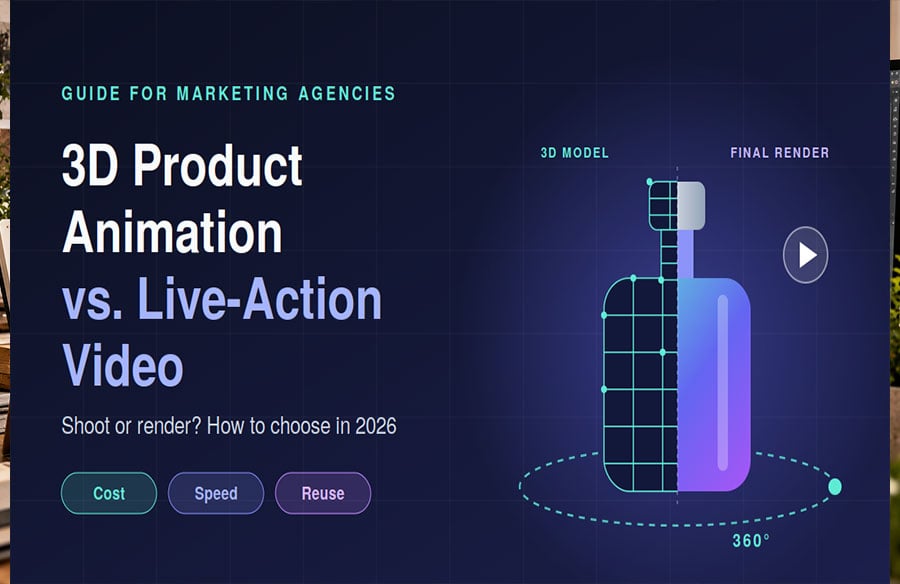
3D product animation is a video built from a digital model of the product rather than from filmed footage. Every material, light, and camera move is created in software. The result can be photorealistic enough that viewers cannot tell it apart from a real shoot, or deliberately stylized to match a brand’s look.
The key difference is control. With live action, you work with what physically exists on set. With 3D, you can show the product from any angle, slice it open to reveal its internal parts, or place it in a setting that would be expensive or impossible to build.
Where 3D Animation Beats Live Action
1. Products that don’t exist yet
Pre-launch campaigns are where 3D shines. If the product is still in development, you cannot film it, but you can animate it from CAD files, sketches, or reference images. Teams can start teasers, landing pages, and investor materials while manufacturing is still underway. It also removes much of the guesswork and expense of building multiple physical prototypes just to get marketing visuals.
2. Products that are hard to film
Tiny components, reflective surfaces, liquids, glass, jewelry, and complex machinery are notoriously difficult to light and shoot well. In 3D, lighting is fully controlled, and reflections are predictable. Detail and close-up shots can focus on textures, finishes, and craftsmanship without macro-lens headaches.
3. Explaining how something works
Exploded views, assembly sequences, cutaways, and step-by-step how-to animations are where 3D has a clear edge. Showing the internals of a device or the logic of a mechanism is simply not possible with a standard camera. This is also where explainer content can cut down customer support questions after launch.
4. Changing briefs
Clients change colors, finishes, and packaging constantly. With a reshoot, that means new samples, new studio time, and a new budget. With a 3D asset, a color variation is an update to the model and a re-render, not a restart.
Where Live Action Still Wins
Honesty matters here. Live action is usually the better choice when the campaign depends on real human emotion, such as testimonials, lifestyle storytelling led by actors, or authentic behind-the-scenes content. Many strong campaigns combine both: real people for the emotional hook and 3D for the product detail.
The goal is not to replace filming everywhere. It is to stop defaulting to a shoot when another method would be faster, cheaper, or simply better for the message.
The Real Advantage for Agencies: One Asset, Many Deliverables
Agencies rarely need a single video. They need a campaign: a hero film, cut-downs for social, vertical versions for Stories and Reels, short loops for display ads, stills for banners, and visuals for the pitch deck.
This is where building the product digitally pays off. A detailed 3D model is a reusable foundation. From one asset, you can generate:
- A full product launch film
- Short looping clips for paid social
- 360° product spins for landing pages
- Hero stills for print and web banners
- Variations by color, angle, or market
Specialist studios such as PIXREADY structure their 3D product animation services around exactly this idea. A single project can be repurposed into social clips, website banners, trade show loops, and sales presentations, so the budget stretches further and the visuals stay consistent across every touchpoint.
How 3D Fits into Agency Workflows
The practical question for agency leaders is not whether 3D looks good, because it clearly can. The question is whether it fits into how an agency actually works: tight deadlines, multiple stakeholders, and frequent feedback rounds.
A few things to look for in a production partner:
Clear scope and pricing. Agencies need to quote clients confidently. Upfront pricing tied to the number of deliverables, complexity, and usage scope prevents surprise costs.
Flexible inputs. You should not need a finished 3D model to start. A good studio can build the model from CAD files, photos, or sketches, and can optimize existing assets for marketing use.
Platform-ready delivery. Different channels need different aspect ratios, lengths, and formats. Assets should arrive ready for web, social, presentations, and where relevant, AR or interactive use.
A defined creative process. Look for a pipeline that moves from brief and creative direction to modeling, storyboarding, animation, rendering, and post-production, with client review built in at each stage.
Agencies that want a broader view of how this works beyond animation, including product CGI, lifestyle scenes, interactive visuals, and AR/VR assets, can look at 3D rendering services for marketing agencies. It is useful reading if your team is deciding how much of its visual production to move into 3D.
3D Animation vs. AI-Generated Video
It is fair to ask why not just use an AI video generator. The honest answer is that it depends on how much accuracy the project demands.
AI video can be fast and useful for concepting. But it synthesizes footage rather than building from a real model, so exact dimensions, mechanisms, logos, and brand-critical details can drift or change between frames. When the product must look exactly as designed, a model-based 3D workflow gives you control over every camera angle, light, material, and movement, and it can be edited precisely when the client asks for changes.
A sensible approach is to use AI for early ideation and mood boards, then use 3D where precision and brand consistency matter.
A Simple Decision Checklist
Before you book the next shoot, ask:
- Does the product physically exist and is it ready to film?
- Is the product difficult to light, shoot, or ship?
- Do we need to show internal parts, assembly, or how it works?
- Will we need many versions, formats, or color variants?
- Is the timeline tight, or likely to shift?
If you answered “no” to the first question or “yes” to two or more of the others, 3D animation deserves serious consideration.
Final Thoughts
Marketing is moving toward more content, in more formats, on shorter timelines. Production methods that depend entirely on physical logistics struggle to keep up. 3D product animation gives agencies a way to start earlier, change faster, and reuse more without sacrificing visual quality.
It will not replace every shoot, and it does not need to. Used in the right places, it can turn product visuals from a bottleneck into one of the most flexible assets in your campaign toolkit.