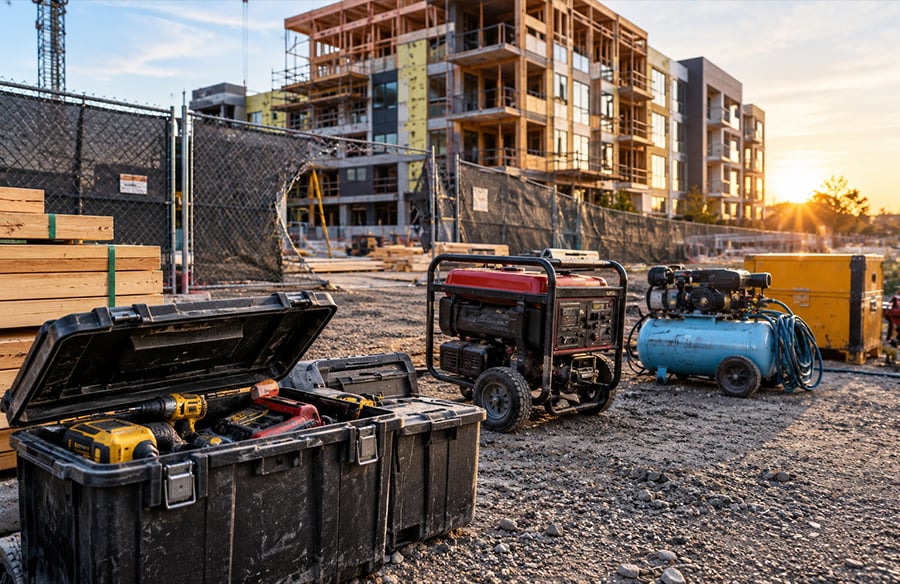
It’s Monday morning on a mixed-use job. Over the weekend, someone cut the fence, loaded up a pallet of framing lumber from the laydown yard, and rolled your generator, compressor, and gang box out with it.
By Wednesday, the developer’s builder’s risk claim is moving. The lumber will be replaced. Your gear is not on that claim, and nobody is calling you about it.
This is one of the most common surprises contractors run into on large developments. The policy protecting the project and the coverage protecting your tools are two different things, and the gap between them only shows up after a loss.
Why Mixed-Use Developments Are Easy Targets for Tool Theft
There are long periods of time, many trades, street presence, and staging areas that go into mixed-use projects. It is therefore harder to secure the contractors’ tools and equipment than in single-family homes.
A mixed-use project is really two buildings stacked together. Retail or office space sits on a concrete podium, and residential units rise above it. That means you’re working under the rules of both residential and commercial construction at once, often for a year or more.
That setup creates openings for thieves:
- Long schedules. Gear sits on site for months, so thieves have time to learn the routine.
- Many trades. Dozens of subs come and go, which makes unfamiliar faces and trucks easy to miss.
- Shared laydown areas. Materials and equipment belonging to different contractors can be found in one common yard.
- Street frontage. Urban sites often border sidewalks and parking, giving easy access after hours.
- Empty nights and weekends. Once crews leave, a partially built podium is quiet and dark.
What a Builder’s Risk Policy Actually Covers
A builder’s risk policy typically covers the structure under construction and the materials that will become part of it, not the tools and equipment contractors use to build it.
On most mixed-use projects, the developer or the general contractor buys builder’s risk coverage. It protects their investment in the building while it goes up.
Builder’s risk is designed to cover the building, not the people building it. According to the standard Insurance Services Office (ISO) Builders Risk Coverage Form, CP 00 20, covered property centers on the building under construction and the materials, fixtures, and equipment intended to become a permanent part of it. That typically includes:
- The structure itself while it’s under construction
- Lumber, rebar, drywall and other materials stored on site
- Fixtures and building equipment, such as HVAC units, waiting to be installed
Your saws, generators, compressors, and lifts will never become a permanent part of the building. That’s why they generally fall outside the policy, no matter how much the developer’s coverage is worth.
Developers know this. Experienced investors expect the contractors they hire to carry their own coverage, and many contracts require proof of it before work starts.
Why Your General Liability and Commercial Auto Won’t Pay Either
General liability insurance will cover damages caused to another person’s property, while commercial auto insurance covers the automobile. In other words, neither of the two will replace the tools and equipment of a contractor that have been stolen.
After a theft, most contractors call their agent expecting one of their existing policies to step in. Usually, none of them do.
Here’s why:
- General liability. According to the standard ISO Commercial General Liability form, CG 00 01, the policy excludes damage to “property you own, rent, or occupy” and to personal property in your care, custody, or control. Your own generator sits squarely inside that exclusion.
- Commercial auto. The ISO Business Auto Coverage Form, CA 00 01, covers physical damage to the vehicle and its equipment. Loose tools in the bed or a toolbox generally aren’t part of that, so the smashed window may be paid while the tools inside are not.
- Builder’s risk belongs to the project, and as covered above, it’s built around the structure and materials.
That leaves a gap right where your most valuable working assets sit. Most contractors only learn about it after the first loss.
What a Weekend Theft Actually Costs a Contractor
The real cost of jobsite theft goes beyond the price of the stolen gear and includes emergency rentals, lost production days, and delayed progress payments.
The replacement price of stolen tools is only part of the hit. A weekend break-in on a mixed-use job typically sets off a chain of costs:
- The stolen gear itself: a towable generator, an air compressor, a gang box of cordless tools, batteries, and lasers
- Emergency rentals: rental of replacement equipment by Monday to allow work to continue
- Lost production: workers standing around for half a day or longer to await replacement of equipment
- Schedule ripple: delayed inspections or trades that result in delaying your next pay application
- Admin time: police reports, inventory lists, and claim paperwork
When there is no coverage, each and every cost becomes part of the margin on the job. The important issue is not only whether you have insurance for your tools but rather what your coverage does after the theft.
How Tools and Equipment Insurance Fills the Gap
Tools and equipment insurance, a form of inland marine coverage, protects a contractor’s gear against theft, vandalism, and damage on the jobsite, in the truck, in storage, and in transit.
Equipment theft isn’t random. According to the National Insurance Crime Bureau, investigators in Florida broke up a construction equipment theft ring tied to roughly $2 million in stolen gear. Organized crews know what jobsite equipment is worth and how quickly it can be resold.
This is the risk inland marine coverage is built for. According to the Insurance Information Institute, inland marine insurance was developed for property that moves or doesn’t stay at one fixed location, and contractors’ equipment is among the property it commonly protects. Regulators recognize the line as well. According to the NAIC Nationwide Marine Definition, inland marine can include mobile equipment such as contractors’ equipment. Because the coverage follows your gear, it can respond whether the loss happens in a laydown yard, a truck bed, or a storage unit.
Contractors who carry dedicated tools and equipment insurance can file one claim and get back to work, instead of buying a full replacement kit out of pocket while the schedule slips.
One detail to check on any policy is how losses are paid:
- Replacement cost pays what it takes to buy new gear today.
- Actual cash value pays what the gear was worth after depreciation, which often falls well short of a new tool’s price.
Scheduled vs. Blanket Coverage on a Mixed-Use Job
Scheduled coverage lists high-value equipment individually with a set value, while blanket coverage protects a group of smaller hand and power tools up to a total limit.
Most contractors on a mixed-use job need both. The trick is putting each piece of gear in the right bucket.
Schedule your big-ticket equipment, such as:
- Generators and light towers
- Air compressors
- Mini excavators and skid steers
- Laser levels and survey equipment with high replacement costs
Use blanket coverage for your everyday kit, such as:
- Drills, impact drivers and saws
- Nail guns and hand tools
- Extension cords, ladders and small gear
Blanket policies often cap how much they’ll pay for any single item. For example, a $50,000 blanket limit with a $2,500 per-item cap pays only $2,500 toward a stolen $9,000 robotic total station, even though the overall limit has plenty of room. Anything worth more than the per-item cap belongs on the schedule.
Keep a running list of serial numbers, purchase receipts, and photos for everything. It speeds up claims and helps police match recovered gear to its owner. According to California Penal Code Section 537e, it’s a crime to knowingly buy, sell, or possess property whose manufacturer’s serial number has been removed or altered, so recorded serial numbers give investigators something concrete to work with when stolen gear turns up.
Also ask whether your policy covers tools your employees own. Many tradespeople bring their own hand tools to the job, and those aren’t automatically included. Some insurers offer an employee tools endorsement to cover them.
The Policy Fine Print That Decides Whether a Theft Claim Gets Paid
Inland marine insurance policies sometimes come with terms that limit vehicle theft claims, or that exclude unexplained loss or coinsurance for scheduled equipment.
It’s possible for two contractors using the same policy to receive vastly different treatment when there is a theft. It lies in the conditions rather than in the name of the policy. Be sure to review them beforehand:
- Vehicle theft conditions. Some policies only pay for tools stolen from a vehicle if it was locked and shows visible signs of forced entry.
- Mysterious disappearance. Many policies exclude gear that simply goes missing with no evidence of theft, which is why inventory records and prompt police reports matter.
- Coinsurance on scheduled items. If you insure equipment for less than its actual value, a coinsurance clause can shrink your payout, even on a partial loss.
- Per-item limits and deductibles. Blanket coverage often caps what it pays for any single tool, and deductibles may apply per item or per occurrence.
- Reporting deadlines. Most policies expect prompt notice and a police report, so a theft discovered Monday should be reported Monday.
This is how coinsurance actually works with figures. Suppose your generator and compressor system is valued at $40,000 now but has been insured for $28,000 under a policy with 100 percent coinsurance. If $20,000 worth of property gets stolen because you have not insured 100 percent of the asset value, your insurer covers 70 percent of the amount, which is $14,000.
The fix is straightforward. Update scheduled values at every renewal so they match current replacement costs, and go through these terms with your agent while you still have time to close a gap.
Rented and Borrowed Equipment on Mid-Rise Builds
When rented equipment is stolen or damaged on a jobsite, the rental agreement usually makes the contractor who rented it responsible for the loss, not the developer.
Mid-rise mixed-use work leans heavily on rented gear. Telehandlers set materials on upper floors, scissor lifts handle ceiling work, and rented generators fill in before permanent power is live.
If one of those machines disappears, the rental company sends the bill to you. Most rental agreements make the renter responsible for the equipment from the time it’s delivered until it’s picked up.
Before you sign a rental contract, check:
- Whether your policy covers rented and borrowed equipment, and up to what limit
- Whether the rental company’s damage waiver actually covers theft
- Who is responsible during weekends and holidays when the site is closed
A single stolen telehandler can cost more than a small contractor’s entire tool inventory, so this isn’t a detail to leave until after a loss.
It’s also worth asking about rental reimbursement coverage. If your own generator or compressor is stolen, it helps pay for a substitute rental while the claim is settled, so your crew isn’t sitting idle.
Practical Ways to Reduce Theft on Mixed-Use Sites
Locked storage, GPS tracking, good lighting, and an up-to-date equipment inventory reduce jobsite theft and make insurance claims faster to settle.
Insurance pays for the loss, but it doesn’t give you back the lost days. A few habits cut down on how often you need to file:
- Lock it up. Store small tools in heavy-duty gang boxes chained to something solid, not loose in a shared laydown yard.
- Track the big pieces. GPS trackers on generators, compressors, and compact equipment improve the odds of recovery.
- Coordinate with the GC. Ask about fencing, cameras, lighting, and after-hours patrols before you move gear on site.
- Empty the truck bed. Don’t leave tools in an open bed or an unlocked toolbox overnight.
- Mark your gear. Engrave or label tools with your company name and keep serial numbers on file.
- Do a weekly count. A quick inventory check helps you spot missing items early and report them while they can still be traced.
Frequently Asked Questions
Does the developer’s builder’s risk policy cover my tools?
Usually not. Builder’s risk is generally written to cover the structure under construction and the materials that go into it. A contractor’s own tools and equipment typically fall outside that coverage and need a separate policy.
Is my generator covered if it’s stolen from the jobsite?
Only if you carry tools and equipment insurance, also called inland marine coverage, that includes it. General liability and commercial auto policies do not cover theft of your own equipment.
Should I schedule my heavy equipment or cover it under blanket?
Schedule high-value items such as generators, compressors, and compact excavators. Use blanket coverage for everyday hand and power tools. Blanket policies often limit what they pay per item, so expensive gear is safer on the schedule.
Who pays if rented equipment is stolen from the site?
In most cases, the contractor who rented it. Rental agreements usually hold the renter responsible from delivery to pickup, so confirm your policy covers rented and borrowed equipment before the machine arrives.
What’s the difference between replacement cost and actual cash value?
Replacement cost pays what it takes to buy new equipment today. Actual cash value subtracts depreciation, so the payout is often much lower than the price of a new tool.
Are tools stolen from my work truck covered?
They can be, if your tools and equipment policy includes theft from vehicles. Many policies require the vehicle to be locked and show signs of forced entry, so confirm those conditions before relying on the coverage.
Does my policy cover tools my employees bring to the job?
Not automatically. Employee-owned tools often need an employee tools endorsement. Without it, a worker’s stolen tools may not be covered under your policy.
Conclusion
On mixed-use developments, the builder’s risk policy protects the project, but only a contractor’s own tools and equipment coverage protects the gear the contractor depends on to keep working.
Mixed-use work pays well, but it also puts your equipment in some of the most exposed spots in construction. Long schedules, shared yards, and open street frontage give thieves plenty of chances.
When something goes missing, the developer’s policy will take care of the building. Your generator, compressor, and tool kit are your responsibility.