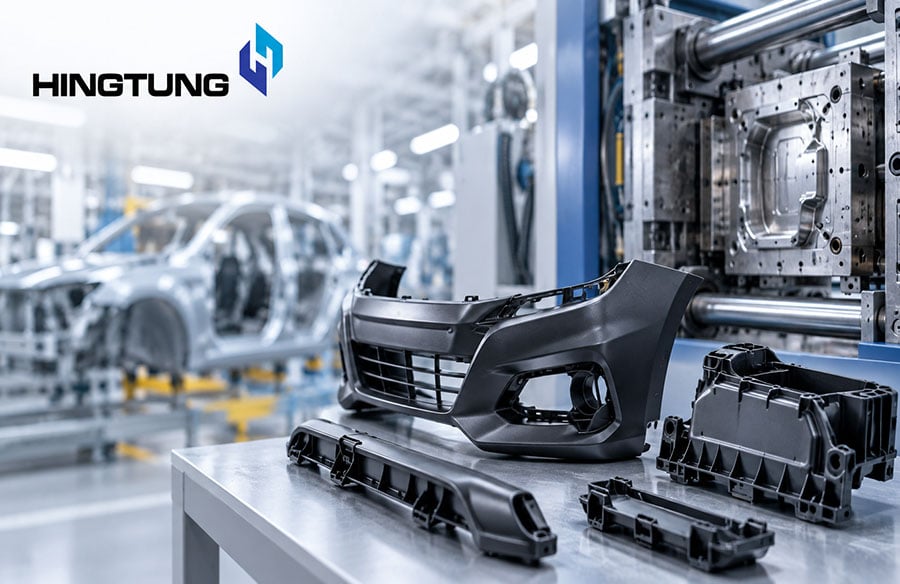
Choosing among automotive injection molding companies requires more than comparing production capacity. Automotive components demand consistent material processing, precise tooling, and reliable quality control.
This guide compares eight manufacturers with different strengths, including automotive specialists and integrated manufacturing providers such as HingTung.
Top 8 Automotive Injection Molding Companies at a Glance
The following automotive plastic injection molding companies offer different capabilities in precision molding, large-part production, multi-material processing, and OEM manufacturing. The list is organized as a practical supplier shortlist rather than an independently scored ranking.
| Company | Location | Main Strength |
| HingTung | China | Integrated tooling, molding, and assembly |
| Kaysun Corporation | USA | Complex precision molding and engineering resins |
| Century Mold | USA / Mexico | High-volume automotive injection molding |
| Cumberland Plastic Solutions | USA | Automotive trim and 2K molding |
| Manar Inc. | USA | Scientific molding and process control |
| Thogus | USA | Custom engineered automotive components |
| Wabash Plastics | USA | Multi-shot molding and automotive lighting |
| EVCO Plastics | USA / Mexico / China | Large-tonnage molding and automation |
8 Best Automotive Injection Molding Companies
1. HingTung — Integrated Tooling and OEM Manufacturing
 Location: Guangdong, China
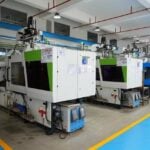
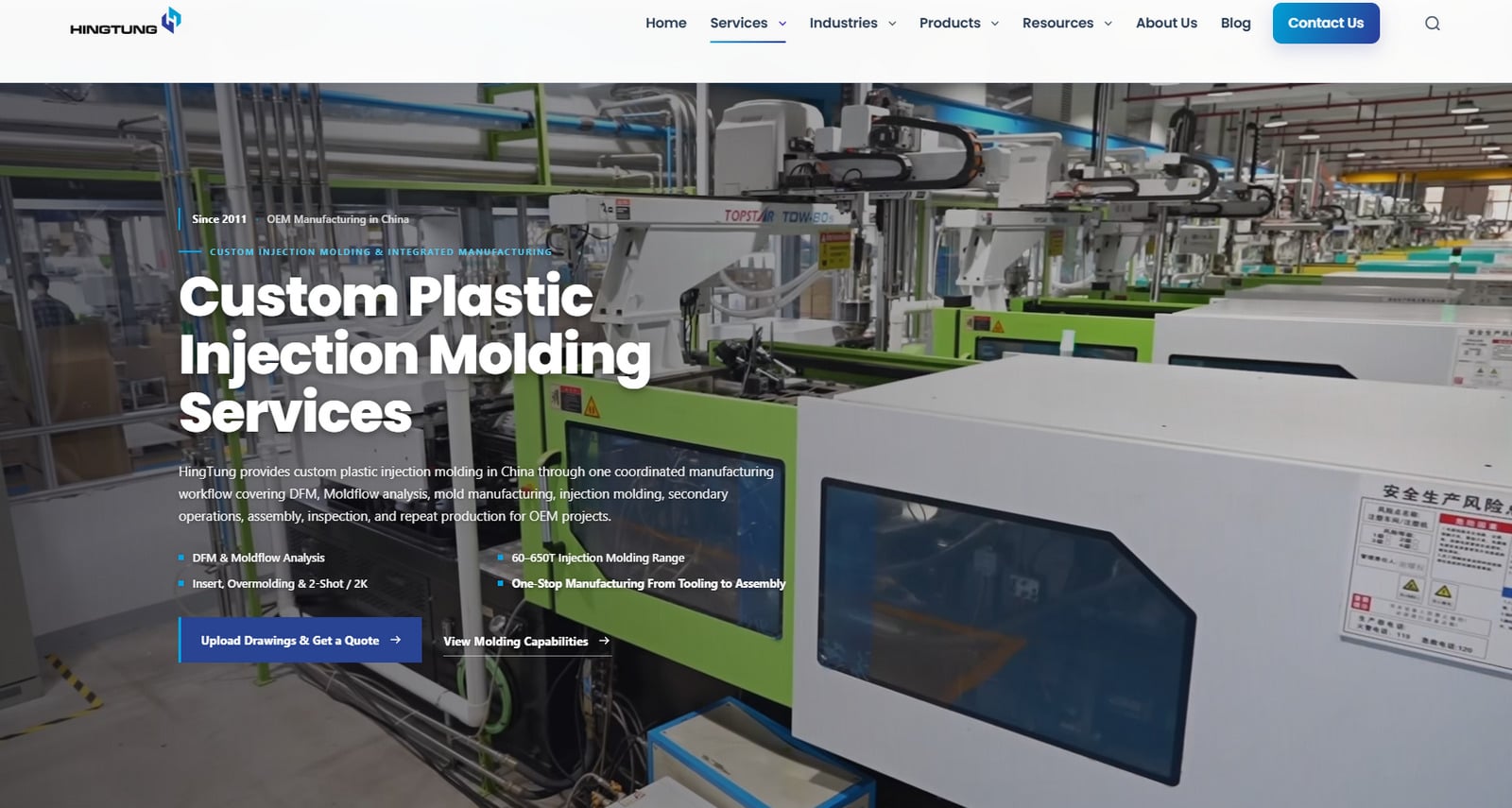
Established in 2011, HingTung is a plastic injection molding manufacturer offering DFM, in-house mold manufacturing, injection molding, secondary processing, and assembly. Its 50,000 m² manufacturing facility houses more than 350 pieces of equipment, including over 80 injection molding machines with capacities up to 650 tons.
Key advantages:
- Integrated production: DFM, mold making, trials, injection molding, and assembly within one manufacturing workflow.
- Engineering capability: Moldflow analysis, CNC/EDM machining, and tooling modifications.
- Quality certifications: ISO 9001, ISO 14001, and IATF 16949.
- Manufacturing flexibility: CNC machining, sheet metal fabrication, and secondary operations.
- Fewer supplier handoffs: Engineering changes and production issues can be coordinated across manufacturing stages.
HingTung’s automotive injection molding solutions support custom plastic components requiring coordinated tooling, production, and dimensional control.
2. Kaysun Corporation — Complex Precision Molding
Location: Wisconsin, USA
Kaysun specializes in complex automotive plastic injection molding using engineering thermoplastics. Its automotive applications include powertrain, thermal management, braking, and electrical components.
Key advantages:
- DFM, mold-flow analysis, and engineering support.
- Processing experience with high-performance thermoplastics.
- Scientific molding and process validation.
- IATF 16949 quality management and PPAP/APQP support.
Kaysun’s technical focus makes it relevant for demanding automotive components where dimensional accuracy and material performance are critical.
3. Century Mold — High-Volume Automotive Production
Location: USA and Mexico
Century Mold focuses on automotive injection molding, with equipment capabilities reaching 2,200 tons. Its manufacturing experience includes engine cooling, fuel systems, electrical components, and electric vehicle applications.
Key advantages:
- High-tonnage injection molding for larger parts.
- Moldflow analysis and tooling engineering.
- Insert molding, gas-assisted molding, and secondary assembly.
- IATF 16969 quality management systems.
Its manufacturing footprint supports established automotive programs requiring production capacity across North America.
4. Cumberland Plastic Solutions — Automotive Trim and 2K Molding
Location: Opelika, Alabama, USA
Cumberland Plastic Solutions provides custom molding, tooling support, and automated assembly. Its injection molding equipment ranges from approximately 90 to 1,500 tons, supporting both functional and appearance-sensitive automotive components.
Key advantages:
- Single-shot and two-shot injection molding.
- Class A interior and exterior trim manufacturing.
- Color, gloss, and surface-finish measurement.
- Vibration welding, heat staking, and automated assembly.
Cumberland’s capabilities are particularly relevant to automotive trim and plastic assemblies with strict cosmetic requirements.
The meticulous attention to surface finish and aesthetic detail in automotive trim mirrors the demands of high-end interior design, where material selection and seamless integration are paramount. Designers often specify particular textures, colors, and tactile qualities for components that shape the user experience within a space, whether a vehicle cabin or a residential room.
5. Manar Inc. — Scientific Molding and Process Control
Location: USA
Manar supplies custom injection molded parts for automotive and industrial applications. Its manufacturing approach emphasizes controlled processing, repeatability, and engineering support.
Key advantages:
- Scientific molding and process monitoring.
- Production tooling and engineering development.
- Automated molding and secondary manufacturing.
- IATF 16949-certified facilities and PPAP support.
Manar is worth evaluating when dimensional consistency and documented production processes are central to the project.
6. Thogus — Custom Engineered Automotive Components
Location: Ohio, USA
Thogus produces custom plastic components for automotive OEMs and suppliers, including connectors, brackets, switches, and functional assemblies.
Key advantages:
- Engineering support and material selection.
- Custom molding for functional plastic components.
- Experience with automotive assemblies and mechanical parts.
- Design collaboration for manufacturability.
Its strengths lie in matching part design and material properties to practical manufacturing requirements.
7. Wabash Plastics — Multi-Shot Molding and Automotive Lighting
Location: Evansville, Indiana, USA
Wabash Plastics supports automotive lighting, trim, and assembly applications. Its molding capabilities include two-shot processing and equipment ranging from approximately 90 to 1,300 tons.
Key advantages:
- Multi-shot molding, overmolding, and insert molding.
- Automotive lighting housings and trim components.
- Decorative finishing, welding, and assembly.
- Tooling engineering and scientific molding support.
These processes make Wabash relevant to parts combining multiple materials, surfaces, or manufacturing steps.
The integration of multi-material components, especially in lighting, presents unique challenges and opportunities for industrial and architectural design. Crafting light fixtures that blend seamlessly with their environment, or stand out as focal points, requires careful consideration of material properties, light diffusion, and structural integrity, much like the design of a building’s facade or a bespoke furniture piece.
8. EVCO Plastics — Large-Tonnage Molding and Automation
Location: USA, Mexico, and China
EVCO Plastics provides custom injection molding across a broad equipment range, from approximately 28 to 4,400 tons. Its capabilities extend from smaller precision parts to large molded components.
Key advantages:
- Large-tonnage and precision injection molding.
- Multi-shot, overmolding, and gas-assisted processes.
- Robotics, automation, and assembly.
- Mold engineering and production support across multiple locations.
EVCO’s range of molding technologies gives OEM teams flexibility when component size or processing requirements are unusually demanding.
How to Choose an Automotive Injection Molding Company
 Different automotive injection molders serve different production needs. A company experienced in large interior panels may not be the right supplier for small electrical connectors or precision sensor housings.
When comparing automotive injection molding suppliers, check:
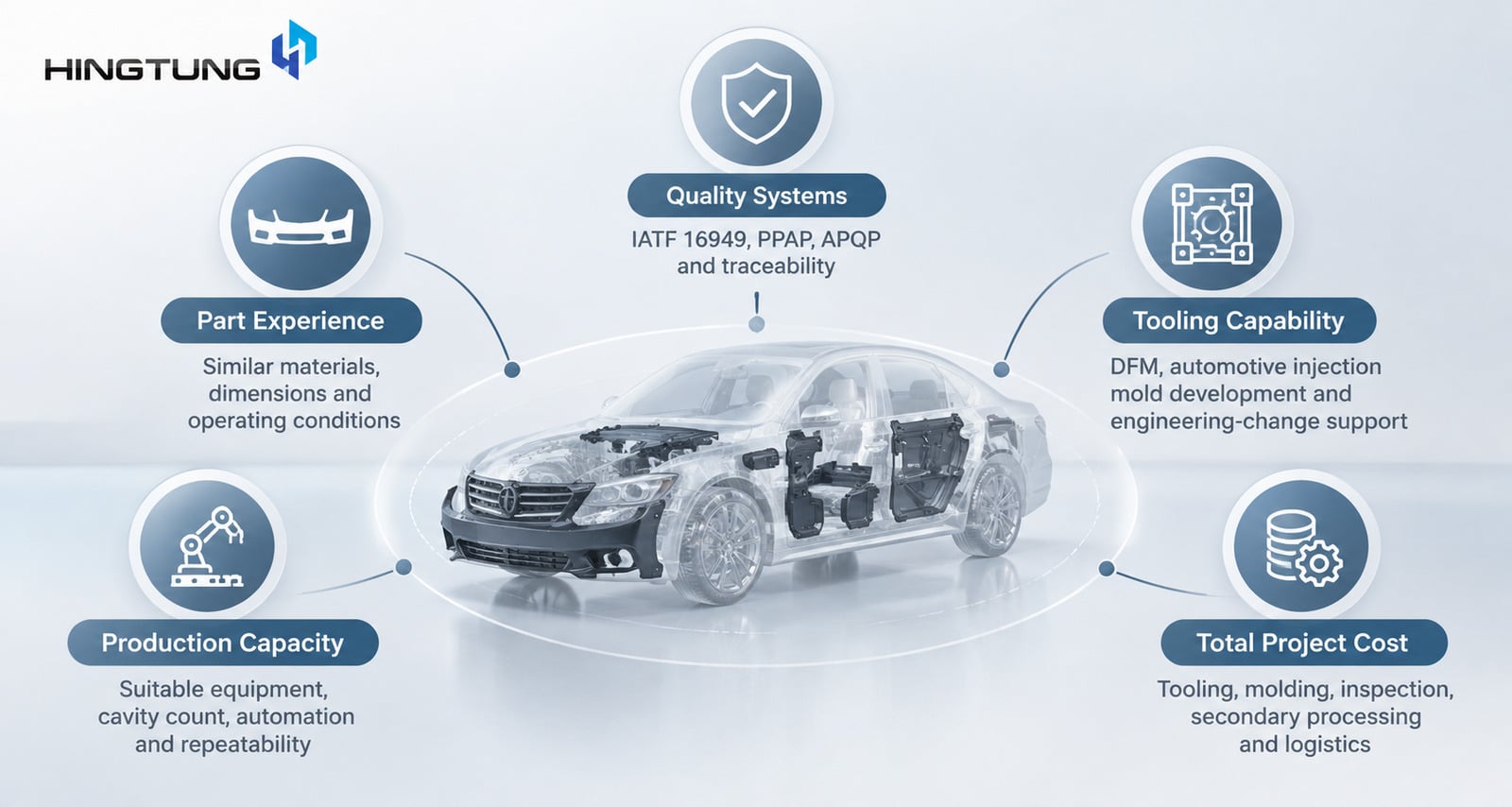
- Relevant part experience: Similar materials, dimensions, and operating conditions.
- Automotive quality systems: IATF 16949 certification, PPAP, APQP, and traceability where required.
- Tooling capability: DFM, automotive injection mold development, and engineering-change support.
- Production capacity: Suitable equipment, cavity count, automation, and repeatability.
- Total project cost: Tooling, molding, inspection, secondary processing, and logistics.
For example, automotive electronics may require tight dimensional control and electrical performance, while interior trim often places greater emphasis on appearance and texture. Under-hood components require additional evaluation of heat and chemical resistance.
Always verify that the supplier’s certifications cover the relevant manufacturing site and activities.
When Integrated Manufacturing in China Makes Sense
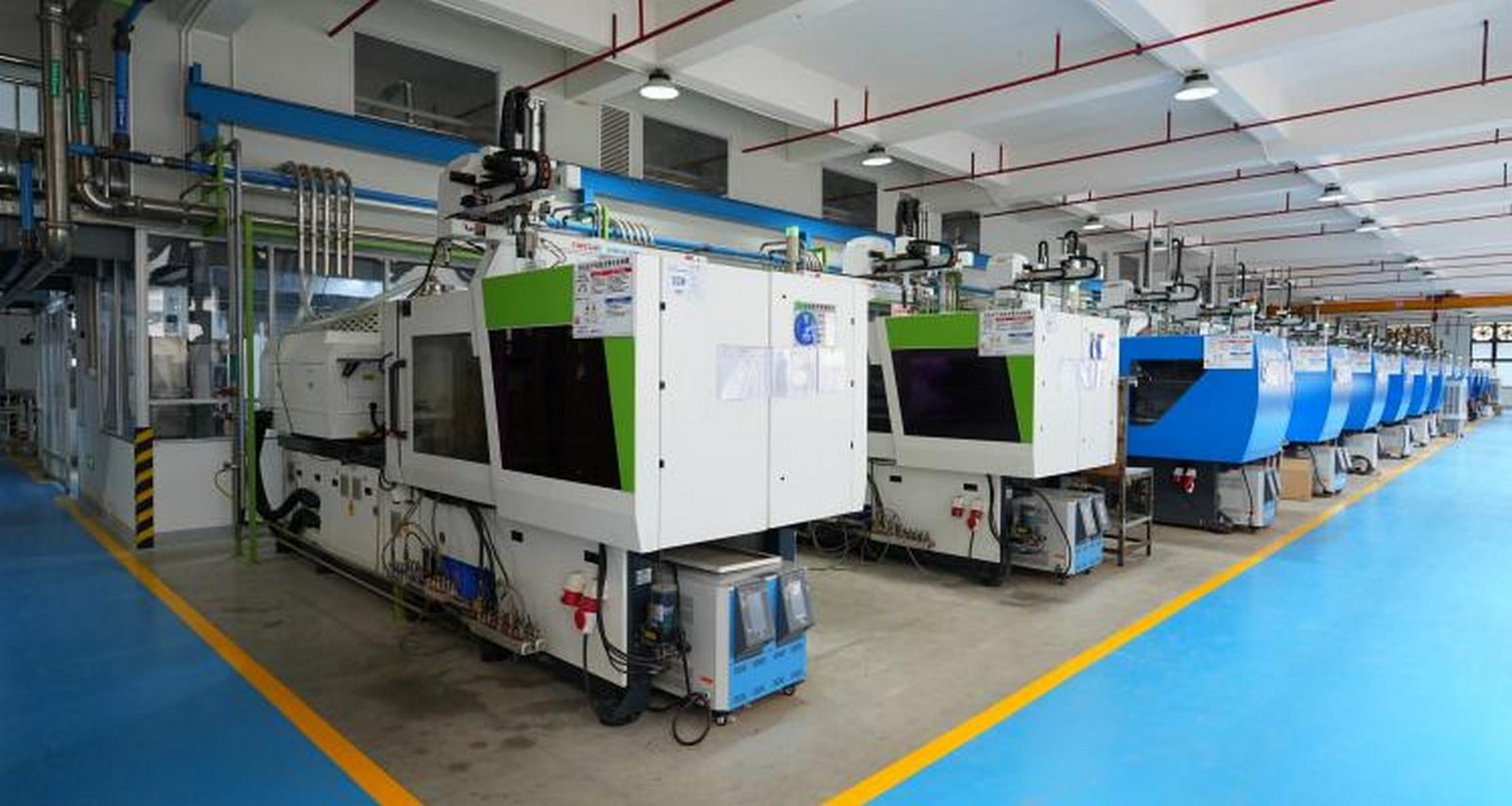 Some automotive plastic parts manufacturers specialize in molding alone, while others coordinate tooling, machining, assembly, and quality inspection. The second approach can reduce handoffs for projects involving new molds and multiple manufacturing processes.
For international OEM programs, integrated manufacturing offers several practical advantages:
- Tooling-to-production transition: Mold trials, corrections, and repeat production remain closely connected.
- Engineering coordination: DFM feedback and production requirements can be reviewed together.
- Secondary processing: Machining, assembly, and inspection can be coordinated before shipment.
- Total project cost: Fewer suppliers can reduce internal transportation, repeated inspections, and project-management work.
For projects requiring custom injection molding and additional manufacturing operations, HingTung’s plastic injection molding services provide this integrated approach.
Local production can still make more sense when frequent on-site collaboration, urgent replenishment, or regional sourcing requirements are the deciding factors.
FAQs
Can Recycled Plastics Be Used for Automotive Injection Molded Parts?
Yes, where the resin grade and component specifications permit it. Recycled materials must meet the applicable performance, traceability, and customer approval requirements. Material consistency and long-term behavior should be validated before production.
Can an Existing Automotive Injection Mold Be Transferred to Another Manufacturer?
Yes, subject to tooling ownership and transfer agreements. The receiving manufacturer should inspect the mold, confirm equipment compatibility, and conduct trial molding before restarting production.
How Are Engineering Changes Managed After Automotive Production Begins?
Changes normally require documented revision control, an assessment of their effects, and applicable customer approvals. Material, tooling, or process changes may also require additional testing or PPAP resubmission.
Conclusion
The right automotive injection molding companies combine suitable equipment, relevant component experience, and quality systems matched to the project. Supplier selection should account for tooling development, repeat production, and total manufacturing costs.
For OEM teams seeking integrated tooling and manufacturing in China, the company offers DFM, mold making, injection molding, and assembly support.