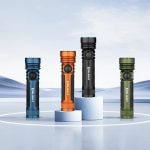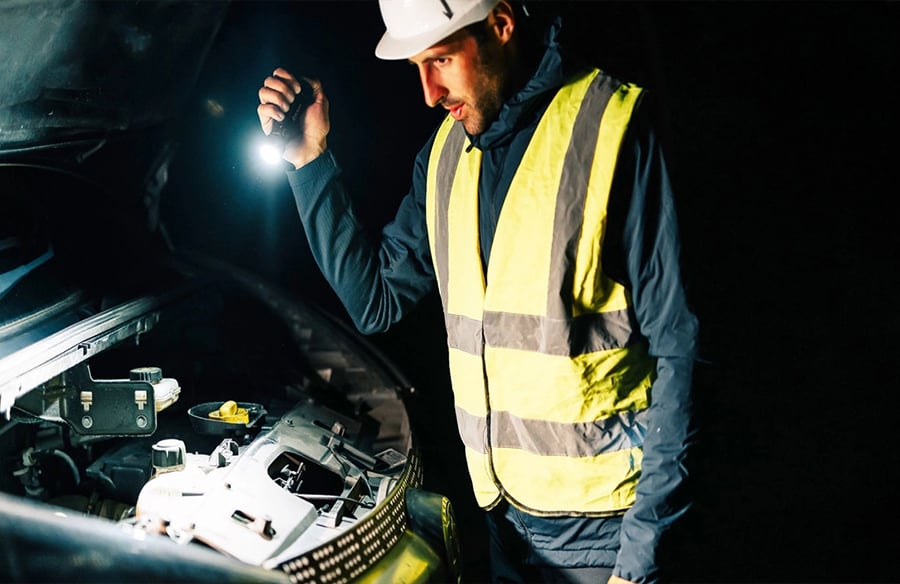
A professional flashlight has to do more than produce a powerful beam. Its physical construction determines how securely it can be held, its controls determine how quickly brightness can be adjusted, and its thermal and power systems determine how effectively that performance can be sustained. The Olight Seeker 4 Pro illustrates this approach by combining a metal-bodied construction, wrap-around tactile grip, high-output illumination, a rotary control system, and an integrated charging holster into one handheld platform.
The Intersection of Industrial Design and Tactical Utility
Elevating Handheld Tools Through Modern Aesthetic Standards
The Seeker 4 Pro is designed around a compact cylindrical body that keeps the light manageable while accommodating a high-capacity power source and high-output LED system. Rather than treating the flashlight as a simple metal tube, its exterior integrates the grip, control interface, indicator system, and charging architecture into the physical form.
The result is an example of industrial design in EDC tools where visual simplicity serves a practical purpose. The metal construction gives the product a professional appearance, while the enlarged side control provides a clearly defined point of interaction. At approximately 133 mm long and 35 mm in diameter, the body remains a handheld tool rather than becoming dependent on a large external lighting assembly. Olight lists the weight at approximately 205 g with the battery installed.
Materials and Surface Tactility: The Art of Grip and Durability
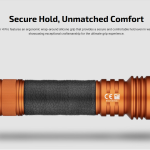
One of the more significant changes from a conventional smooth-bodied flashlight is the Seeker 4 Pro’s full wrap-around grip. Olight describes the grip as a silicone surface designed to improve comfort during extended handling. The dermatoglyph-style texturing gives the hand additional tactile contact rather than relying entirely on the friction of a smooth metal surface.
This matters when the light is being operated while walking, climbing, inspecting a structure, or wearing gloves. The user’s hand has to maintain control while another hand may be occupied with equipment or documentation. In that situation, ergonomic flashlight grip design is not simply an aesthetic detail; it becomes part of the interface between the operator and the tool.
Human-Centered Controls: Redefining User Experience in Hardware
From Push Buttons to a 360° Rotary Interface
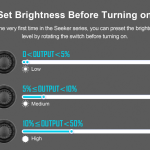
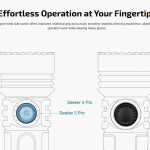
The Seeker 4 Pro’s enlarged metal side switch changes the way brightness is controlled. Instead of limiting adjustment to a series of predefined button presses, the switch can rotate through 360 degrees for stepless dimming. Olight also states that the control can be used for brightness adjustment before the light is switched on, providing a more direct way to select the required output.
That physical relationship between hand movement and light output is particularly useful when conditions change quickly. A user inspecting a dark recess may need a lower level to avoid excessive glare, while examining a large exterior area can require substantially more output. The rotary interface allows these changes without repeatedly cycling through fixed brightness levels.
Thermal Management and Structural Ergonomics
High-output flashlight places demands on the entire structure, not just the LEDs. The Seeker 4 Pro reaches a maximum output of 4,600 lumens, with Olight’s specifications listing a 2.5-minute Turbo duration at full output before the regulated output changes. This makes thermal and power management an important part of the engineering rather than an afterthought.
The metal body provides the physical structure needed for a powerful handheld light while keeping the overall package compact. This is where structural ergonomics becomes important: the product has to accommodate substantial electrical and thermal demands without becoming awkward to operate.
Case Study: Engineering Brilliance in the Olight Seeker 4 Pro
4,600-Lumen Performance and Spatial Illumination
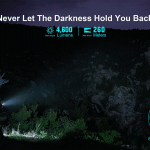
With a maximum output of 4,600 lumens and a beam distance of 260 meters, the Seeker 4 Pro is built for situations requiring substantial area illumination as well as distance. Its specifications also list 16,895 candela, while the available output levels extend from a 5-lumen Moonlight mode through 50-lumen Low, 300-lumen Medium, 1,200-lumen High, and Turbo.
For architectural work, this range is more useful than a single maximum-output figure. A professional inspecting a partially completed building may need moderate illumination for close structural details and significantly more light when examining a large open construction area. The ability to move between these levels makes the light adaptable to different spatial conditions.
The Hidden Metal Interface and Micro-Perforated Indicators
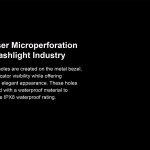
The control system is also notable for how information is integrated into the exterior. Olight uses micro-perforated laser technology to create a translucent dashboard beneath the metal surface. The indicator system communicates brightness and battery information while maintaining the visual continuity of the metal interface. Olight describes the design as using 1,200 micro holes to produce the visible indicator effect.
This is a clear example of hardware UX influencing industrial design. Instead of adding a conventional exposed screen, information is incorporated directly into the surface the user is already interacting with.
5000mAh Power and a Multifunctional Holster
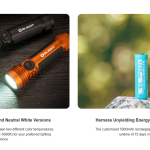
The Seeker 4 Pro uses a 5000mAh 3.6V 21700 rechargeable lithium-ion battery. Its Moonlight mode is rated for up to 15 days, while USB-C charging through the supplied holster provides a practical way to keep the light ready between uses.
The multifunctional holster extends this idea beyond simple storage. It can be mounted using a fixing bracket, while the holster itself supports charging and convenient access. The locking mechanism is designed to secure the flashlight when docked, reducing the likelihood of accidental activation.
Professional Applications: From Site Inspection to Architectural Photography
Precision Site Auditing and Structural Inspections
For nighttime construction inspections, the combination of high output and adjustable brightness can help illuminate concrete surfaces, recessed areas, unfinished interiors, and large workspaces. The 260-meter beam distance also provides useful reach when an inspector needs to examine an area before physically moving closer.
Light Painting and Architectural Photography
The same controllability can benefit architectural photography. During long exposures, photographers can use adjustable flashlight to selectively highlight facades, structural details, entrances, or interior spaces. A handheld light with multiple output levels gives the photographer more control over how much light reaches each part of a composition.
Conclusion
The Seeker 4 Pro demonstrates how portable illumination can become a study in industrial design rather than simply a specification sheet. Its wrap-around tactile grip, 360° rotary interface, hidden micro-perforated dashboard, 4,600-lumen output, 260-meter beam distance, 5000mAh battery, and multifunctional charging holster each address a specific part of the user’s interaction with the tool.
Together, these details show how material selection, interface design, power management, and illumination performance can be engineered as one system. To explore the complete specifications and available variants, visit the Olight Seeker 4 Pro.