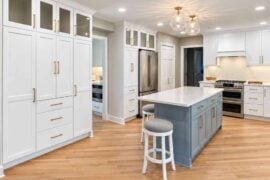
An architect I know redesigned a client’s kitchen last year and made one change that had nothing to do with aesthetics: she moved the fruit bowl to eye level on the counter and put the chips in a cabinet above the fridge, the kind you need a step stool to reach. Nobody in the house consciously decided to eat better. They just did, because the easy thing to grab was suddenly the apple instead of the bag of chips buried in a drawer at arm height.
That’s the part of home design most people miss. A house doesn’t just shelter your habits. It either sets them up to succeed or quietly sabotages them, one poorly placed light switch and one too-comfortable couch at a time.
The Kitchen Is Doing More Work Than People Realize
Kitchens got bigger over the last twenty years, mostly for entertaining. But something else happened alongside that: the layout started determining what people actually eat, not just what they could theoretically cook. A pantry organized so that whole foods are visible and processed snacks are tucked away changes behavior more reliably than willpower does. Counter space next to the stove instead of across the room means someone actually chops vegetables instead of ordering delivery because prepping feels like a project.
Lighting matters here too, more than people expect. Kitchens with warm, layered lighting instead of one harsh overhead fixture get used for actual cooking more often. Harsh light makes a kitchen feel clinical, and people linger less in spaces that feel clinical.
Bedrooms Are Finally Being Designed Around Sleep, Not Just Furniture
For most of the last few decades, bedroom design was about how a room looked in a photo. Now there’s real pressure toward how a room performs at 2 a.m. Blackout capability, temperature control, sound dampening — these used to be add-ons. Increasingly they’re the starting point of the design brief, not the afterthought.
Part of this comes from the sheer volume of research linking sleep quality to almost everything else in a person’s health, weight regulation included. It’s hard to overstate how much a dark, cool, quiet room changes sleep architecture compared to a bright, warm one with a TV humming across the room.
Bathrooms Have Quietly Become Health Infrastructure
This one surprises people. Bathrooms used to be the room nobody thought about beyond tile choices. Now they’re where a lot of daily health monitoring happens — a smart scale, a mirror with better lighting for skin checks, storage designed around the fact that a lot of households manage ongoing medication routines, sometimes ones that used to be inconvenient to fit into a morning schedule. A patient managing their weight with an oral weight loss medication, for instance, benefits from a bathroom cabinet that’s actually organized rather than a shoebox of expired prescriptions under the sink. Small design decision. Real behavioral consequence.
Living Rooms Are the Hardest Room to Redesign for Health
Here’s an uncomfortable truth: living rooms mostly haven’t changed, and that’s a problem. The couch is still positioned twelve feet from a screen, optimized for sitting still longer than any other room in the house. Some designers are pushing back — moving seating away from direct sightlines to the TV, adding a stretching mat’s worth of open floor space, putting a pull-up bar in a doorway instead of treating every inch as prime real estate for another cabinet.
It’s a slow shift, and honestly, most clients still ask for the sectional first and the open floor space second.
Small Apartments Have to Solve This Differently
Not everyone has square footage to spare, and design-for-health advice aimed at 3,000-square-foot houses is mostly useless to someone in a 600-square-foot apartment. The solutions there look different: a fold-down desk that forces standing breaks, a door-mounted rack that keeps walking shoes visible instead of buried in a closet, a single good lamp instead of overhead lighting that makes the whole apartment feel like an office at 9 p.m.
The house was never a neutral background to your habits. It was always nudging you somewhere, usually toward the path of least resistance. The real shift in home design isn’t a trend or a style. It’s an acknowledgment that the fruit bowl on the counter and the chips in the high cabinet were never just about tidiness — they were decisions about who you’d become, made months before you ever walked into the kitchen hungry.