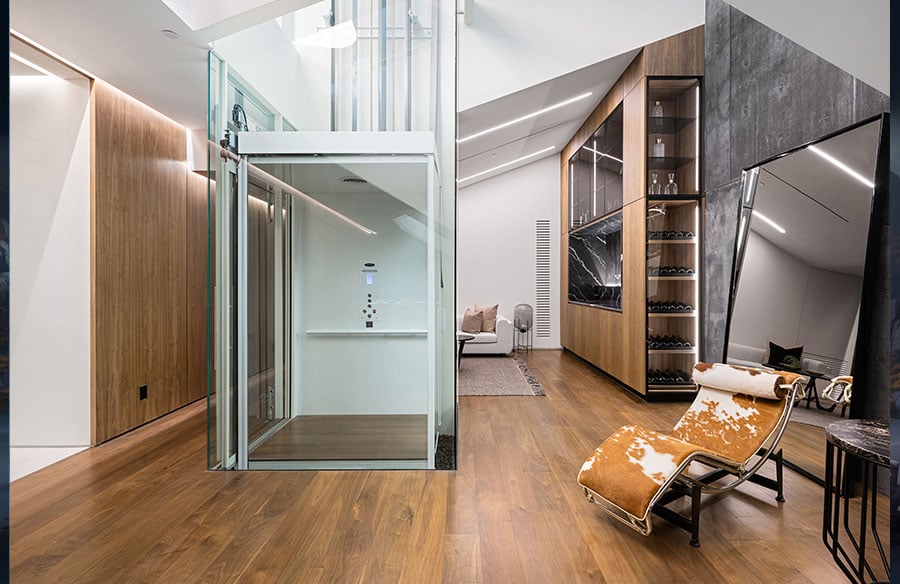
Architects and designers who follow re-thinkingthefuture.com are used to questioning defaults. Why does a staircase have to dominate the entry? Why should a home’s long-term livability be an afterthought bolted on decades later instead of designed in from the start? Home elevators sit right at that intersection of form and function, and they’re worth a serious look from anyone interested in where residential design is heading. This shift in how we think about home elevators reflects a broader rethinking of what modern residential design can be, moving beyond convention to embrace accessibility as a core design principle rather than an afterthought.
For readers who have never priced out a residential lift or thought much about vertical mobility, this guide starts at the beginning. We’ll cover what home elevators actually are, how accessibility codes shape their design, what a real installation involves, and how owners keep these systems running safely for decades. Think of it as a primer, not a sales pitch, though the practical realities of cost and planning deserve honest treatment too.
If you’re a homeowner in Southern California weighing whether a lift makes sense for a multi-story house, working with a regional specialist like California Mobility in Los Angeles is a reasonable first step, since local teams understand both the building codes and the seismic and space constraints unique to the area. That local knowledge matters more than it might seem. A lift designed for a flat, temperate climate elsewhere doesn’t automatically translate to the hillside lots and older housing stock common across Los Angeles.
What Are Home Elevators? Types and Basic Concepts
A home elevator is a small, permanently installed lift built to move people (and sometimes wheelchairs or mobility scooters) between floors inside a private residence. Unlike the elevators in office towers, residential units are compact, quieter, and designed to blend into a home’s interior rather than announce themselves. There are several mechanical approaches, and understanding the differences helps frame every other decision that follows.
Hydraulic elevators use a fluid-driven piston to lift the cab and are known for smooth rides, though they typically require a separate machine room. Traction elevators use cables and a counterweight system, offering energy efficiency but needing more overhead space. Pneumatic vacuum elevators use air pressure differentials to move a cylindrical cab and require minimal construction work, making them popular for retrofits. Shaftless or winding drum elevators have surged in popularity precisely because they skip the traditional shaft requirement, which is part of why this segment is growing so quickly; industry data pegs the shaftless home elevator market at roughly $2.23 billion in 2024, climbing to an estimated $3.84 billion by 2030 at a 9.34 percent annual growth rate. That’s a meaningful signal that homeowners increasingly want mobility solutions that don’t require gutting a house to install.
Understanding ADA Accessibility Standards and Compliance
Accessibility codes exist to make sure that a lift is actually safe and usable for the people who need it most, not just a novelty feature. While the Americans with Disabilities Act primarily governs public and commercial spaces, its technical guidance still informs how residential elevators are engineered, particularly around door clearances, control panel heights, and emergency communication systems. According to this article, private residence elevators must meet the ASME A17.1 Safety Code for Elevators and Escalators, which sets standards for weight limits, speed, and safety features to ensure safe operation in residential settings.
These standards matter beyond compliance checklists. They reflect decades of real-world data about how people, especially older adults and those with mobility limitations, actually use vertical transportation. A 2025 survey found that 84 percent of adults aged 50 and older consider aging in place important to their long-term plans, and a home elevator is often the single feature that makes staying in a multi-story house realistic. Falls remain a leading cause of injury-related hospitalizations among adults 65 and older according to CDC data, which is precisely the kind of risk a well-designed elevator is meant to reduce.
Space, Design, and Installation Essentials for Your Home
Every home elevator installation starts with a space assessment, since the mechanical type you choose depends heavily on available square footage, ceiling height, and whether the home was built with future vertical transportation in mind. A pneumatic vacuum elevator, for instance, can often be added to an existing home with minimal structural disruption because it doesn’t need a pit or a full shaft, while a traditional hydraulic system usually calls for more substantial construction. Homeowners should also think about where the elevator lands on each floor, since awkward placement can disrupt traffic flow just as much as a poorly placed staircase would.
Design has come a long way from the utilitarian, hospital-adjacent look older residential lifts once had. Cab interiors now come in wood veneers, glass panels, brushed metal, and custom lighting that can match a home’s existing aesthetic rather than fighting against it. Cost varies widely depending on these choices; a typical home elevator installation runs somewhere between $35,000 and $150,000 fully installed, with the range driven by cab size, number of stops, drive type, and finish level. That’s a wide spread, and it’s worth getting multiple quotes before assuming a project is out of reach.
Safety Features and Long-Term Maintenance Considerations
Modern home elevators come equipped with a range of built-in safety mechanisms, including battery backup systems that lower the cab to the nearest floor during a power outage, emergency phone lines, interlocking doors that won’t open unless the cab is properly aligned, and overspeed governors that prevent the cab from moving too quickly. These aren’t optional extras on a well-built system; they’re standard features that any reputable installer will include as a matter of course. Understanding what’s built in helps buyers ask better questions when comparing providers.
Ongoing maintenance is just as important as the initial installation, since a home elevator is a mechanical system with moving parts that wear over time. Most manufacturers recommend annual inspections at minimum, and homeowners should keep records of service visits the same way they would for an HVAC system. Skipping maintenance doesn’t just risk a breakdown at an inconvenient moment, it can also void warranties and, in worse cases, create genuine safety hazards for the people relying on the lift daily.
| Metric | Figure |
| Global Home Elevator Market Size (2026) | $3.8 billion USD |
| Shaftless Home Elevator Market Growth Rate | 9.34% CAGR (2024 to 2030), $2.23B to $3.84B |
| Seniors Prioritizing Aging in Place | 84% of adults 50+ (2025 survey) |
| Fall-Related Injury Risk, Adults 65+ | Leading cause of injury-related hospitalizations (CDC) |
| Typical Installation Cost | $35,000 to $150,000 installed |
Home elevators are no longer a luxury reserved for sprawling estates or a purely medical accommodation tacked onto a house as an afterthought. They’re becoming a legitimate design consideration for anyone planning a multi-story home meant to serve its occupants for decades, not just the next five years. As the market grows and the technology becomes less invasive to install, the barrier to entry keeps dropping, which means more homeowners can treat vertical mobility as part of the original design conversation rather than a retrofit born out of necessity.
For designers and homeowners alike, the real takeaway is that accessibility and good design were never actually in tension. A well-planned home elevator can be as much a statement piece as a functional necessity, proof that thinking ahead about mobility doesn’t mean compromising on how a home looks or feels.