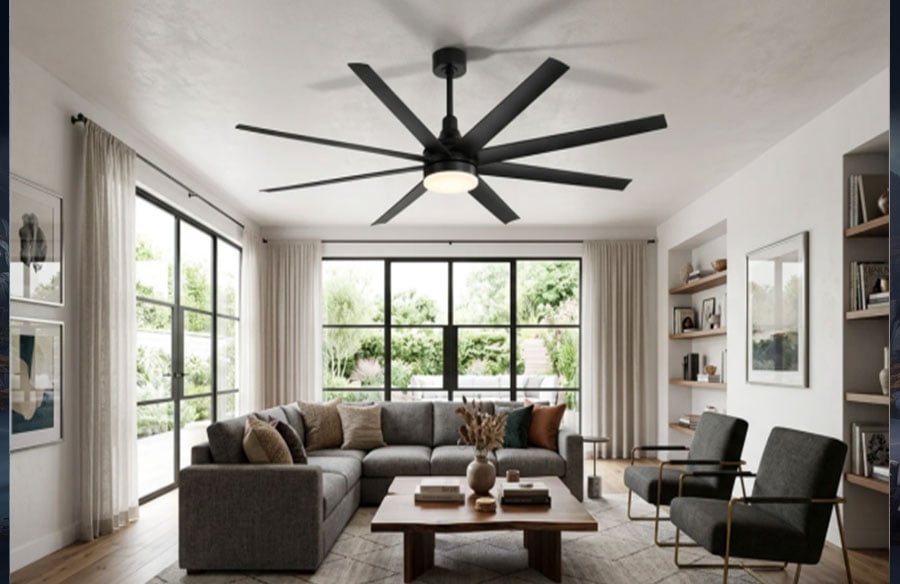
A good large ceiling fan with lights should do more than fill a big ceiling. It should move enough air for the intended space, provide useful illumination, operate with a motor suited to its blade span, and install correctly for the room’s ceiling height. Size matters, but so do airflow, lighting quality, controls, mounting configuration and location suitability. The best choice is the fan whose documented specifications work together for the actual room—not simply the widest model or the one with the longest feature list.
What Makes a Good Large Ceiling Fan With Lights?
There is no single specification that makes a large ceiling fan “good.” A well-matched fan is a complete system. When comparing large ceiling fans with lights, look at the relationship between the blade span, airflow, motor, light, controls and mounting setup rather than judging the fan by diameter or appearance alone.
- An appropriate blade span for the room and available ceiling area
- Documented airflow that suits the intended space
- A motor capable of supporting the fan’s size and speed range
- Lighting that is bright and flexible enough for the room’s purpose
- Controls that make everyday operation convenient
- A mounting configuration that suits the ceiling height and slope
- A location rating that matches indoor, damp or exposed conditions where applicable
Start With the Right Blade Span for the Room
Large ceiling fans are often marketed by blade span, but “larger” is not a quality rating. A 60-inch or 72-inch fan can be a strong fit for one room and an awkward choice for another. The room’s length and width, available ceiling area, wall clearance, furniture layout and ceiling height all affect whether the fan will feel properly scaled.
A 52-inch fan is a common residential size, while 60-inch and larger models are more often compared for larger bedrooms, living rooms, open layouts and great rooms. A 72-inch fan can make sense in a broad living area or a room with a higher ceiling, but the blade tips still need adequate clearance from walls, beams, cabinets and other fixtures.
Integrating a fan into a room’s design goes beyond mere functionality; it involves considering how the fixture contributes to the overall aesthetic and spatial harmony. Architects and interior designers often evaluate a fan’s visual weight, material finishes, and how its scale relates to other elements like furniture, windows, and ceiling treatments to ensure it enhances, rather than detracts from, the intended atmosphere.
The useful question is not “What is the biggest fan I can fit?” but “What blade span gives this room the right combination of clearance, airflow and visual scale?”
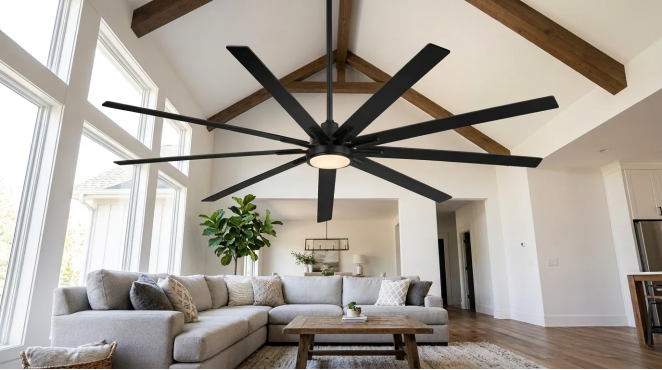 Does a Larger Ceiling Fan Actually Perform Better?
Sometimes, but not automatically. A wider fan sweeps a larger circle, which can help distribute air across a broad space. Performance still depends on the motor, blade geometry, blade pitch, operating speed, installation height and the way air can circulate through the room.
This is why a slightly smaller fan with well-documented airflow can be a better choice than an oversized fan that is poorly matched to the space. Blade span should be treated as one design variable, not a substitute for actual performance information.
How Important Is CFM for a Large Ceiling Fan?
CFM stands for cubic feet per minute and is commonly used to describe the volume of air a ceiling fan can move. For a large fan, documented airflow is an important comparison point because a wide blade span alone does not tell you how much air the fan will actually circulate.
Higher CFM can be useful in larger spaces, but the highest number is not automatically the best choice. Room size, speed settings, installation height, operating noise and energy use all matter. A fan should have enough airflow for the space without forcing the buyer to select a larger, louder or more complex model than the room requires.
| Specification | What It Tells You |
| Blade span | How wide an area the rotating blades cover |
| CFM | How much air the fan is documented to move |
| Speed settings | How much control the user has over airflow |
| Motor type | One factor influencing efficiency, control and operation |
| Installed height | How the fan is positioned within the room |
Look for an Efficient Motor
A large blade span places greater importance on the motor and control system. Many modern large ceiling fans use DC motors because they can support multiple speed settings and efficient operation. That does not mean every DC fan performs the same way, so the actual product specifications still matter.
Useful motor-related features may include several fan speeds, reversible operation, low-noise performance and compatibility with a remote or app. Buyers should compare the documented functions of the specific model instead of assuming that motor type alone guarantees better airflow or a longer service life.
Blade Count Is Not the Same as Airflow
Three-blade, four-blade, five-blade and multi-blade ceiling fans can all work well. More blades do not automatically mean more airflow, just as fewer blades do not automatically mean better efficiency. Blade shape, pitch, diameter, motor output and operating speed work together.
Blade count is therefore better treated as one part of the fan’s design and performance profile. If two fans look very different, compare their actual airflow and specifications rather than choosing one only because it has more blades.
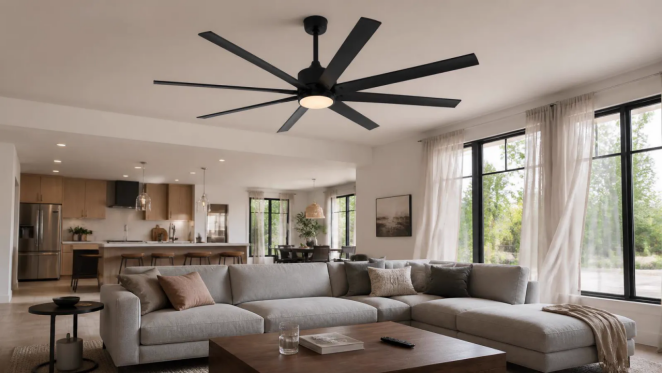 What Makes the Light on a Large Ceiling Fan Good?
The light is not a secondary detail. In a large room, a ceiling fan may also be expected to contribute meaningful ambient illumination, so the lighting system should be evaluated separately from the fan motor.
Integrated LED vs. Light Kit
Integrated LED modules can keep the fixture visually compact and may provide built-in dimming or color-temperature options. Replaceable light kits can offer different servicing or style options. Chandelier-style fixtures may make a stronger decorative statement. The better choice depends on how the room is used and what the specific fan supports.
Brightness
Look for documented lumen output when available instead of assuming a large light fixture will be brighter. A living room that already has recessed lights may need only comfortable ambient illumination, while a room relying heavily on the fan light may need a brighter source.
Dimming and Color Temperature
Dimming can make one fixture more useful throughout the day, and adjustable color temperature can help the light shift from warmer evening illumination to a cooler task-oriented setting. Memory functions can also be useful when they restore preferred settings after the light is switched on again.
Remote Controls and Smart Features Should Be Practical
Controls matter more in a large room because the fan may be installed higher or farther from the most convenient wall switch. In those situations, fans with remote control can make fan-speed and lighting adjustments easier from different parts of the room.
Useful controls can include fan speed, light on/off, dimming, color temperature, timer functions, reverse mode and memory settings. App control can add convenience, but a “smart” feature only improves the fan if it makes daily use simpler. A straightforward remote can be the better choice for users who do not need app integration.
Installation Height Matters as Much as Fan Size
A high-quality fan can still perform poorly if it is installed at the wrong height. Large fans need enough clearance below the ceiling and around the blade tips, while the overall drop of the motor and light fixture must also suit the room.
From an architectural perspective, the precise placement of a ceiling fan is critical for both its operational efficiency and its visual integration within the built environment. This involves careful consideration of ceiling planes, structural elements, and the flow of space, ensuring the fan complements the room’s design intent while optimizing air circulation and maintaining clear sightlines.
- Ceiling height and the fan’s installed distance from the floor
- Downrod length for taller ceilings
- Canopy and mounting compatibility
- Slope compatibility for vaulted ceilings
- Total fixture drop once the light is included
- Blade clearance from walls, beams and built-in furniture
What Makes a Good Large Ceiling Fan for High Ceilings?
High ceilings introduce an extra installation variable: the fan must be positioned far enough below the ceiling to work effectively without hanging too low into the occupied space. In vaulted or taller rooms, fans designed for high ceilings should be evaluated for both blade span and the mounting configuration required to position the fan appropriately.
A larger fan is not a substitute for the correct downrod. Buyers should check ceiling height, slope compatibility, installed height, airflow, blade clearance and the total vertical drop of the light fixture. The fan should also remain visually balanced with the scale of the room.
Flush Mount or Downrod: Which Is Better for a Large Fan?
Neither mounting style is automatically better. Flush-mount and low-profile fans reduce the distance between the ceiling and the motor housing, which can be useful when ceiling height is limited. However, a large blade span still needs adequate surrounding clearance and the fan must be approved for that mounting configuration.
Downrod-mounted fans are more common in taller rooms because the fan can be lowered into a more useful position. For vaulted ceilings, the canopy and mounting system must also support the ceiling angle. Always follow the specific installation requirements for the chosen model.
Indoor vs. Outdoor Large Ceiling Fans With Lights
A fan that works well in a living room is not automatically suitable for a covered patio or other outdoor area. Location suitability should be checked as part of the product specifications, particularly where humidity, moisture or direct exposure may be present.
Indoor-only, damp-location and wet-location products are designed for different conditions. The correct choice depends on the exact installation site, so buyers should verify the rating of the specific fan rather than relying on the style, finish or appearance.
Does Style Matter When Choosing a Large Ceiling Fan?
Yes, because a large fan becomes a prominent element in the room. Modern, farmhouse, wood-look, chandelier-style, black and white designs can all work, but style should come after the essential technical checks.
A visually striking fan that is the wrong size, hangs at the wrong height or provides inadequate lighting is not a good match. Start with room fit, airflow, installation and lighting; then choose the design that complements the interior.
Is a Good Large Ceiling Fan Always Expensive?
Price alone does not determine quality. The widest fan, the most expensive model and the product with the longest feature list are not automatically the best. A simpler fan can be a stronger choice if its documented specifications match the room more closely.
| Feature | What to Check |
| Size | Actual blade span and surrounding clearance |
| Airflow | Documented airflow or CFM |
| Motor | Motor type, speed settings and supported functions |
| Light | LED type, brightness, dimming and color settings |
| Installation | Mounting method, downrod and ceiling requirements |
| Controls | Remote, wall control or app functions actually supported |
| Location | Indoor, damp or wet suitability as documented |
| Warranty | Actual manufacturer terms for the specific model |
A Quick Checklist for Choosing a Good Large Ceiling Fan With Lights
- Does the blade span suit the room dimensions and available ceiling area?
- Is the documented airflow appropriate for the space?
- Does the motor support the fan size and needed speed range?
- Is the light bright and flexible enough for the room?
- Would dimming or adjustable color temperature be useful?
- Are remote or app controls genuinely helpful in this room?
- Does the mounting style suit the ceiling height and slope?
- Is the fan approved for the intended indoor or outdoor location?
- Are the installed dimensions and clearance requirements documented?
- Are warranty and product specifications clearly available?
The best large ceiling fan with lights is the one whose documented size, airflow, motor, lighting, controls and installation requirements match the actual room—not simply the largest or most feature-packed model.