
For twenty-five years, OFFF Barcelona has served as the definitive international gathering place for digital art, contemporary design and visual culture. Hosted at the iconic Disseny Hub Barcelona museum, the annual festival brings together over 10,000 creative visionaries, industry leaders, and global artists from more than 70 countries each year to explore the bleeding edge of visual expression.
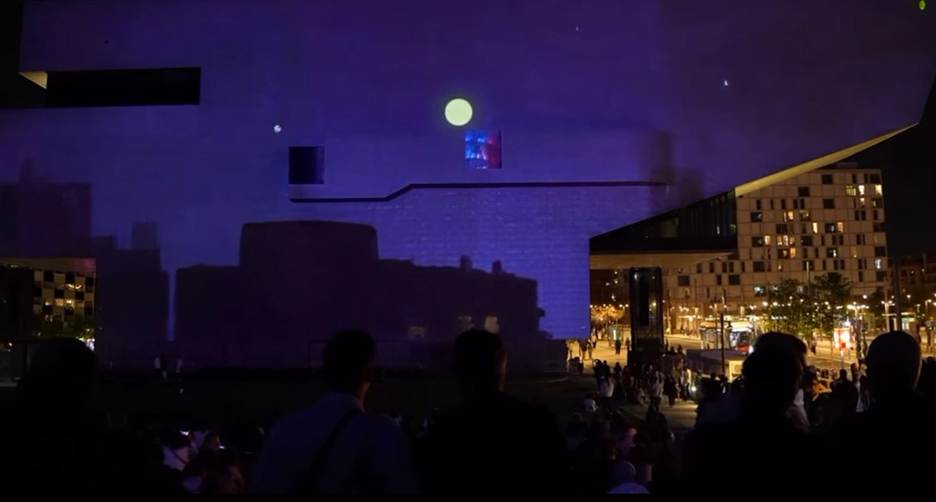
At this year’s festival, Los Angeles-based 2D animator, motion designer, and toolmaker Anna Huijun Wang captured international acclaim when her short film, Starry Night, was selected for “The Screen,” OFFF Barcelona’s celebrated public projection program which draws thousands of local guests who stand on the street and watch an enormous projected screen on the side of the museum.
Digital artists and animators dream of showing their work in this high-profile spot. Wang’s work was among this elite who made the cut to show their films, which were projected directly onto the sweeping geometric façade of the Disseny Hub in Barcelona across festival nights.
Wang’s international recognition at OFFF Barcelona underscores her standing as an influential creative voice in contemporary motion design. Holding a BFA in Film from NYU’s Tisch School of the Arts and an MFA in Animation from the University of Southern California’s School of Cinematic Arts, Wang maintains a distinguished professional career spanning commercial production and groundbreaking independent art.
A National Active member of the Television Academy’s Motion & Title Design peer group, she balances high-profile commercial projects with an internationally award-winning independent practice. While a significant portion of her commercial production, Wang’s public work highlights a deep mastery of cel 2D, 3D, procedural and spatial animation techniques.
 Redefining the Canvas: Architectural Scale and Environmental Design
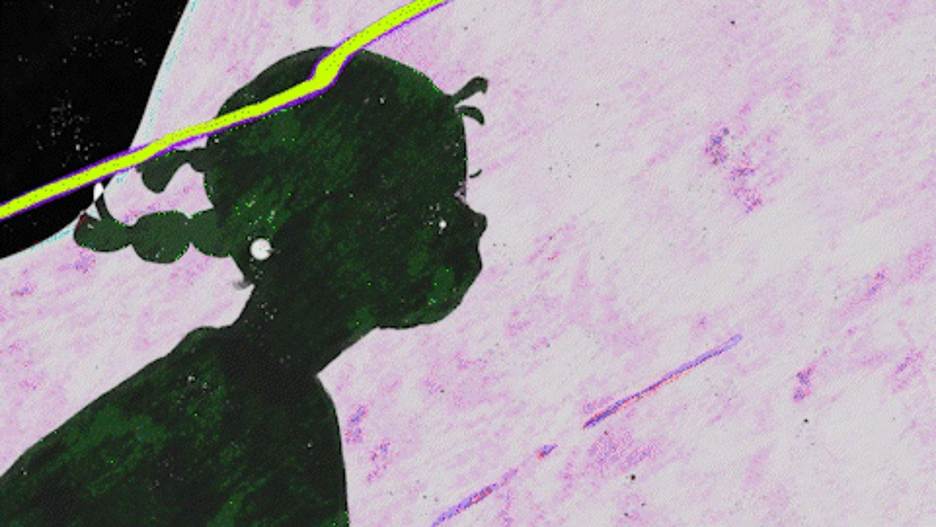
Starry Night, a 35-second painterly piece following a character’s journey through an inner landscape toward a poetic, cosmic unity, was presented as a deliberate silent film. Illuminated after dark, the piece transformed the Barcelona street into an ambient cinema, with the surrounding city providing its natural soundtrack.
Transforming an animated short into a large-scale architectural intervention requires a total departure from traditional screen-based compositing. A building is not a flat monitor; it possesses volume, hard edges, planes facing different directions and sections that catch ambient light uniquely.
“A building isn’t a screen; it has volume, edges, and planes that catch light differently, so adapting to it wasn’t a matter of resizing anything,” Wang explains. “I laid the animation out to work with the architecture, composing for the actual geometry so the imagery belongs to the surface.”
She explains: “On the building façade, the image is enormous, and the viewer’s eye can land anywhere, so I designed the transitions to carry attention deliberately from one region of the building to another. What I was really after was an illusion that this wasn’t a film being projected onto a building, but something happening organically in the Barcelona night.”
Wang’s expertise in large-scale visual design extends well beyond building façades. Her environmental installations include projecting spatial character animation onto university buildings for USC’s Rhythms + Visions public art project and directing an immersive 360-degree visual environment for Wired for Wonder: A Multisensory Maze at Kidspace Children’s Museum, presented in collaboration with the Getty Museum’s region-wide PST ART initiative.
When animation expands into public or museum spaces, the architecture itself becomes a primary collaborator. “In an immersive environment like an Infinity Room, you stop thinking about a rectangle and start thinking about a cube. You think about how each plane connects to the ones beside it, what happens at the corners, and how something moving across one wall continues onto the next,” Wang said. “Scale changes the craft too. You want a visitor to stop registering it as a piece of media and simply feel like they’re somewhere inside the work.”
 Cinematic Storytelling and Medium as Meaning
Wang’s transition between spatial public art and narrative filmmaking is anchored in her foundational film training. Her independent short film OROBORO—a cel 2D and 3D hybrid exploring themes of identity and transformation—garnered widespread international honors, including a MUSE Creative Awards Gold, a Telly Award, and Motion Design Awards’ Video of the Day.
Film training instills core story structure, while animation provides the mechanics to build a world frame by frame.
“Film taught me story: how to write it and how to structure it, while animation taught me how to build a world frame by frame,” Wang notes. “In live-action film, you learn camera language, but in animation, especially traditional hand-drawn animation, there is intention behind every frame and between every keyframe. Every camera move, every composition, every cut is a choice you make from nothing. I think constantly about how motion reads inside a frame, how one shot hands off to the next, and how movement itself carries meaning.”
In OROBORO, Wang utilized shifting visual mediums—ranging from traditional hand-drawn cel animation to 3D simulation—to embody the character’s internal evolution.
“The creative decision that shaped everything was treating medium as a state of being,” Wang says. “If the film is about the layers we accumulate and mistake for ourselves, then the material the film is made of should carry that idea rather than illustrate it. Moving between cel animation and 3D meant figuring out how motion in one medium could hand off to motion in the next so the eye follows through without stopping. The milestone I’m proudest of is that the technical execution and the core idea became the exact same thing.”
Technical Innovation and the Independent Practice
Besides directing narrative shorts, Wang is recognized within the animation community as a pioneer in pipeline development and toolmaking. Working across 2D, 3D, procedural graphics and generative AI, she frequently engineers proprietary software scripts and production plugins, such as the forward-thinking GlassFX, to solve complex visual challenges and streamline technical workflows for fellow animators.
While commercial client work focuses on solving specific production challenges with precision, for Wang, independent filmmaking provides the freedom to explore complex visual and philosophical questions.
“My technical range came directly from storytelling, not the other way around,” Wang notes. “I set out to make films about the layers of a self, and that idea demanded different materials for different states, which meant learning them.”
“Every tool I know, I learned because a story wouldn’t work without it,” she adds.
Whether she is projecting architectural-scale narratives across European landmarks or engineering new digital tools for the animation community, her goal is always the same. “I want to expand how digital art interacts with physical space and architectural forms, creating experiences that truly connect with global audiences,” she said.
By Penny Black
Published August 24, 2026