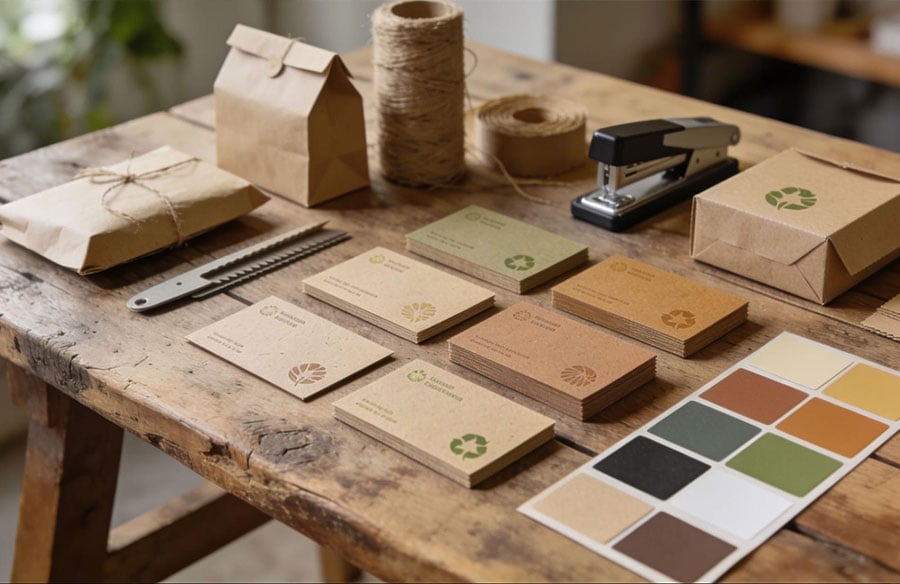
For greener business cards, pick a recycled or uncoated paper stock, skip plastic laminates and foil, and use a printer that ships in recyclable packaging. Adobe Express handles both steps: design your card, choose a paper and finish, and order prints that arrive in 100% recyclable packaging. You can also print greeting cards for clients there.
The careful selection of materials for business cards mirrors the foundational decisions in architectural design, where material choice impacts not only aesthetics and function but also environmental footprint. Just as architects consider the lifecycle of building materials, designers of professional collateral evaluate the sustainability of paper stocks and finishes.
Where Can You Print Recyclable Cards With Sustainable Packaging?
Look for a service that tells you two things up front: what the card stock is made of and what the box is made of. Many printers advertise one but not the other.
The app covers design and printing in one place. You start from a template or a blank canvas, add your logo, colors and fonts, then either order printed cards or download the file to print elsewhere. The service states that its business card orders ship in 100% recyclable packaging and that eco-friendly card stock options are available. Printing is fulfilled with Zazzle and is available in the US, UK, Australia and Canada.
If you live outside those four countries, you can still design in the app for free and send the downloaded file to a local printer that offers recycled stock.
What Does Plastic-Free, Recyclable Packaging Mean for Sustainability?
“Recyclable” and “plastic-free” are different promises. Recyclable means the material can go into a recycling stream. Plastic-free means there is no shrink wrap, poly bag, plastic window or plastic tape anywhere in the order.
A card box can be recyclable paperboard and still arrive inside a plastic mailer. When you compare printers, check three layers:
- The card box. Paperboard with no plastic window or film lining.
- The inner wrap. Paper bands or nothing, rather than shrink wrap around each stack.
- The outer mailer. A kraft or cardboard envelope or box, sealed with paper tape.
This layered approach to packaging design, considering each component’s environmental impact, reflects the holistic thinking applied in sustainable architecture. From structural elements to interior finishes, every material choice contributes to a project’s overall ecological profile, emphasizing the importance of transparency in material sourcing and end-of-life considerations.
Some printers publish details. MOO, for example, says its business card boxes are plastic-free, 100% recyclable and made with 60% recycled material. If a printer only says “eco-friendly packaging,” ask what each layer is made of before you order.
How Do Print Cards Compare on Paper Stock, Finish and Recycled Packaging?
The main platforms differ most in how specific they are about recycled content. Here is what each states on its own product pages.
| Platform | Best for | Paper stocks and finishes | Recycled or eco details |
| Adobe Express | Designing and ordering in one tool, with brand kit logos, fonts and colors | Signature Matte, Semi-gloss, UV Gloss, UV Matte, Cream, Premium Silk, Premium Linen, Premium Grey | Eco-friendly card stock options; orders arrive in 100% recyclable packaging |
| MOO | Special finishes on thick card | Original, Luxe, Cotton, Eco Signature; spot gloss, raised spot gloss, gold and silver foil, letterpress | Card boxes are plastic-free, 100% recyclable and made with 60% recycled material |
| Vistaprint | A clearly labeled 100% recycled stock | Recycled Matte, an uncoated 14 pt stock in the US | Paper is 100% post-consumer recycled |
For a standard US card (3.5 by 2 inches), these differences matter more than size. Your choice comes down to finish versus recycled content. The app offers the widest range of paper textures without a separate design tool. Vistaprint’s Recycled Matte is the most explicit about recycled fiber. MOO is the most detailed about packaging.
Which Paper Finish Suits Eco-Friendly Packaging and Cards?
Recyclable packaging helps less if the card itself is hard to recycle. The finish is usually what decides that.
- Plain or uncoated paper is the simplest to recycle and the easiest to write on. Recycled matte stocks fall here.
- Matte, cream and linen-textured papers keep a natural look without a plastic layer. In the app, Signature Matte, Signature Cream and Premium Linen fit this group.
- Coated finishes such as UV Gloss and UV Matte add a protective layer. They resist scuffs but have a smoother, less writable surface.
- Laminated stocks and foil look premium but bond a film or metal layer to the paper. The platform describes its Premium Silk as a laminated stock. Many local recycling programs treat laminated and foil-stamped paper differently, so check your local rules.
A practical rule: if the box is recyclable, choose an unlaminated paper so the cards can follow it into the same bin.
FAQ
Does recycled paper print photos well?
Recycled and uncoated stocks absorb more ink, so colors look softer and fine detail is less crisp. They suit logos, bold type and simple layouts. For photo-heavy cards, a smooth matte or coated stock will hold detail better.
Can I design in the app and print somewhere else?
Yes. The app lets you either order printed cards or download your design. A download is useful if you live outside the US, UK, Australia or Canada, or if a local printer offers a recycled stock you want.
Are cards on FSC-certified paper the same as recycled cards?
No. FSC certification means the fiber comes from responsibly managed sources, which can include recycled content. Recycled paper is made from used fiber. A card can be one, both or neither, so check the product description for each claim.