Productivity is often discussed in terms of software, management systems, deadlines, and employee motivation. The physical experience of doing the job receives less attention, even though workers spend hours interacting with chairs, screens, desks, tools, lighting, temperature, and the wider workplace environment.
Physical comfort does not mean creating a luxurious office where employees never experience fatigue. It means making it reasonably easy for people to perform their work without unnecessary physical strain or environmental distraction.
When that becomes difficult, some of a worker’s attention can shift from the task itself to managing discomfort.
Discomfort Competes for Attention
Consider trying to concentrate on a detailed spreadsheet while your neck feels increasingly stiff. Or spending a video meeting repeatedly adjusting a chair because the lower back feels uncomfortable.
The employee may still finish the task. The important question is how much additional effort the task required.
Research involving office workers has found associations between musculoskeletal pain and health-related productivity loss. One study indexed by PubMed examined individual and work-related factors among office employees and identified musculoskeletal pain among the factors associated with productivity loss.
This makes physical comfort relevant to organisations even when employees are still attending work and meeting basic expectations.
A worker does not have to be absent for a physical problem to influence the working day. Discomfort can coexist with normal attendance.
Ergonomics Is About Matching Work to People
Workplaces are sometimes described as ergonomic because they have purchased particular chairs or standing desks. Ergonomics is broader than a product category.
Cornell University’s ergonomics guidance describes ergonomics as fitting jobs to the people performing them through equipment and procedure design, with the aim of reducing fatigue and discomfort.
This distinction is useful because a premium chair cannot compensate for every feature of a poorly organised workstation.
Workers vary in height, body proportions, physical needs, and the tasks they perform. Someone who spends most of the day typing may need a different setup from an employee who alternates between paperwork, meetings, and handling equipment.
Adjustability matters because it allows the workplace to accommodate these differences.
Temperature Can Influence How Work Feels
Furniture is only one part of physical comfort. Room temperature can also affect the way people experience their workplace.
Anyone who has tried writing a detailed report in an overheated room or typing while feeling unusually cold will recognise that environmental conditions can compete with concentration.
The Canadian Centre for Occupational Health and Safety explains that thermal comfort is relevant to wellbeing and productivity, while also noting that individual temperature preferences vary.
This creates a practical challenge for shared offices. No single setting will satisfy every employee perfectly.
Organisations can still reduce unnecessary discomfort by maintaining reasonable and stable conditions, responding to recurring problems, and allowing practical adjustments where possible.
Noise, Lighting, and Air Quality Are Part of Comfort Too
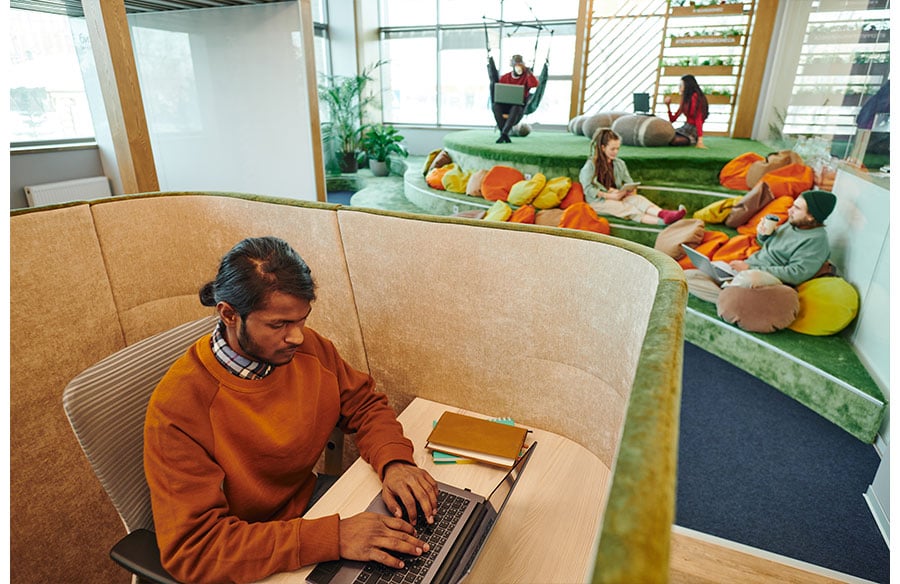
Physical comfort is often reduced to chairs and posture, but employees experience the whole workplace.
Distracting noise can interrupt concentration. Poor lighting can make visual tasks harder. Uncomfortable temperatures may increase fatigue. Employees who are repeatedly distracted by their surroundings have fewer mental resources available for the task in front of them.
A longitudinal study published in Applied Ergonomics examined office environmental factors including thermal comfort, lighting, and noise. The researchers found that environmental stressors were associated with reduced wellbeing and work performance.
These effects help explain why workplace design is not simply an aesthetic consideration. The surroundings can affect how easily people carry out their jobs.
Thoughtful architectural and interior design, from material selection to spatial planning, directly influences these environmental factors. Creating spaces that support focus and wellbeing requires a holistic approach that integrates ergonomics, acoustics, and lighting strategies into the core design brief.
The same applies to home offices. Someone working remotely may have control over some environmental conditions but lack access to an adjustable desk, appropriate chair, separate monitor, or dedicated workspace.
For residential architects and interior designers, this highlights the growing importance of integrating dedicated, ergonomically sound workspaces into home layouts. Designing adaptable rooms or bespoke furniture solutions can transform a temporary setup into a productive and comfortable long-term environment.
Physical Comfort Changes Across the Day
A workstation that feels comfortable at 9 a.m. may feel quite different by 3 p.m.
The body is not designed to remain in exactly the same position indefinitely. As time passes, workers may begin shifting in their chairs, stretching their shoulders, leaning toward the screen, or standing simply because they need a change of position.
This is one reason that workplace comfort should include the ability to move.
Research on sit-stand workstations has examined whether allowing employees to vary their working position can reduce discomfort without interfering with performance. A review in Applied Ergonomics reported that sit-stand workstations appeared capable of reducing perceived discomfort, while the included productivity findings generally did not suggest a negative effect.
The practical lesson is not that every company needs standing desks. It is that employees benefit when the way work is organised allows some variation.
That might involve adjustable equipment, brief walking breaks, changing tasks during the day, standing during certain calls, or holding occasional meetings away from the desk.
Recurring Pain Should Not Become Part of the Job Description
It is easy for workers to normalise discomfort when it develops gradually.
Someone who experiences neck stiffness every afternoon may begin treating it as an unavoidable consequence of computer work. Another person may expect lower back discomfort every time a major deadline requires longer hours at a desk.
Recurring symptoms can have many possible contributors, and assumptions about their cause are not always accurate.
Changing a workstation may be useful in some situations. In others, a person may benefit from assessment by an appropriate healthcare professional, particularly when symptoms persist, worsen, follow an injury, or interfere with normal activities.
Depending on the problem, this might involve a GP, physiotherapist, exercise physiologist, or another qualified practitioner. Someone seeking assessment for an appropriate musculoskeletal concern might also consider chiropractic care as one option.
The purpose of seeking care should be to understand the problem and identify an appropriate management approach rather than simply learning to work around persistent symptoms.
Comfort Can Support Performance Without Becoming a Productivity Gimmick
There is a risk in discussing employee comfort only in terms of how much additional output a business can extract from its workforce.
A healthy workplace has value beyond productivity statistics.
At the same time, employee wellbeing and organisational performance do interact. A worker who can focus on their task without repeatedly adjusting equipment, managing avoidable discomfort, or struggling with an unpleasant environment is generally in a better position to work effectively.
Research into office musculoskeletal problems has also examined the relationship between discomfort, fatigue, and productivity. One study available through PubMed Central found relationships between musculoskeletal problems, fatigue, and productivity among office personnel.
These findings support a wider view of workplace design. Physical working conditions are one part of creating an environment where people can perform their roles sustainably.
Employers and Employees Both Shape the Working Environment
Employers can provide adjustable equipment, review workstation layouts, address environmental issues, and design jobs that allow changes in position.
Employees also play a role by adjusting equipment appropriately, reporting problems early, making use of available breaks, and changing position during the working day.
Neither side can solve every issue independently.
A perfectly arranged workstation will have limited benefit if someone remains motionless for hours. Regular exercise cannot make poorly positioned equipment suitable for a full working day. Workplace comfort comes from combining appropriate equipment, reasonable job design, movement, and attention to individual needs.
Over time, these details shape how work feels.
For organisations trying to improve performance, physical comfort may not be as visible as a new software platform or workflow system. Yet the chair, desk, room, and physical demands of a job are experienced for hours every day. Making those conditions easier to work with can support employees in doing their jobs with fewer unnecessary physical distractions.