Picture your busiest hospital entrance at 8 am: cars stack three deep, shuttles idle, rideshares crowd the curb. Each lost minute ripples into late clinics and anxious families.
Memorial Healthcare System felt that pain. In July 2025, the system’s rebid exposed 3.7 million dollars in annual valet costs, flimsy metrics, and rigid staffing; the winning bidder cut the forecast to 3.1 million dollars.
Parking never appears on the Hospital CAHPS (HCAHPS) survey, yet first impressions still dictate punctuality and word-of-mouth. We break down the five Florida valet partners that can keep your curb clear and your CFO calm.
How we curated the shortlist
Choosing a valet partner is a supply-chain decision that affects money, liability, and patient trust, not a popularity vote. We treated it that way.
 We reviewed vendor websites, hospital press releases, public RFPs, job ads, and Florida corporate filings. Many “best of” lists echo marketing copy and skip state-specific proof, so we set tougher rules.
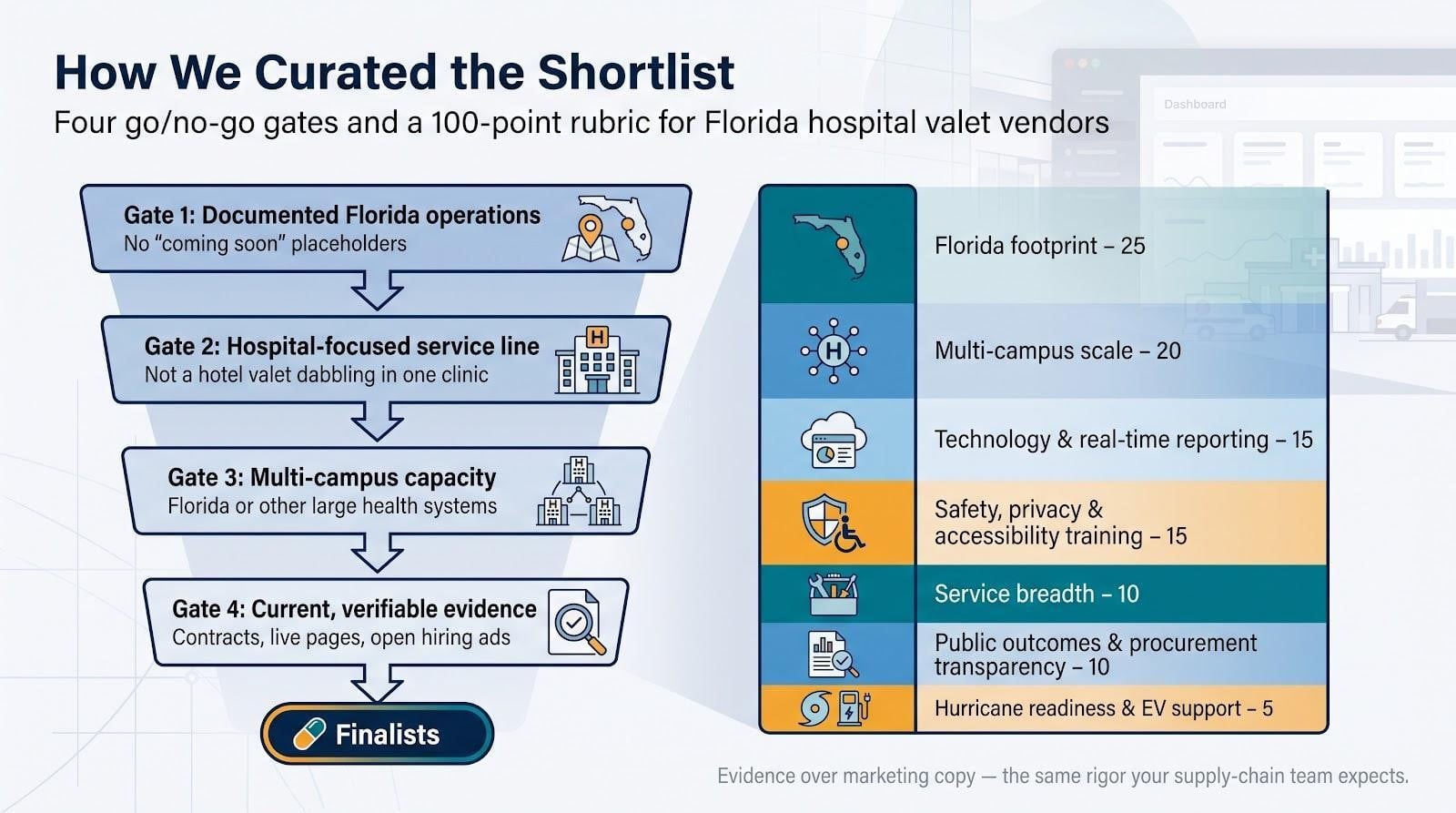
Four go/no-go gates
- A published Florida service line, with in-state client evidence noted separately where it exists.
- A hospital-focused service line, not a hotel valet serving one clinic.
- Demonstrated multi-campus capacity in Florida or another large health system.
- Current, verifiable evidence such as contracts, live hospital pages, or open hiring ads.
Only five companies met every gate. One, FC Parking, meets the service-line and multi-campus gates on national evidence rather than Florida evidence, and we flag that in its profile rather than hiding it.
What we scored
We ranked those finalists on a 100-point rubric:
- Florida footprint (25)
- Multi-campus scale (20)
- Technology and real-time reporting (15)
- Safety, privacy, and accessibility training (15)
- Service breadth (10)
- Public outcomes and procurement transparency (10)
- Hurricane readiness and EV support (5)
Operators that share live dashboards and case results rise in the rankings, while those that hide basic numbers fall. The result is a list grounded in the same evidence your supply-chain team expects, facts, not press-release shine.
Quick comparison at a glance
We promised a shortlist you could scan before your coffee cools. Here it is: five vendors, five distinct strengths.
| Provider | Best-for snapshot | Florida evidence found* | Signature tech | Biggest watch-out |
| FC Parking | Integrated valet, shuttle, and EV planning | Florida service page; national multi-campus case studies | GPS timeclock with 100% billable-hour transparency | No public list of current Florida hospitals |
| Hospital Parking Management | Deep Florida hospital heritage | Historical ties to Tampa General and St. Joseph’s | Concierge-trained greeters at every entrance | Some case material dates back a decade |
| Towne Park / Towne Health | Largest active statewide footprint | Recent hiring at UF Health sites and Sarasota Memorial | Contactless ticket, SMS retrieval, digital tips | Public KPIs still under wraps |
| SP+ Healthcare | Enterprise garage plus revenue control | Kendall Hospital valet hiring; University Hospital in Davie listed as an operated site | LPR-based self-park enforcement tied to valet metrics | Enforcement approach can feel heavy-handed |
| Fusion Parking | South Florida public-system win | Memorial Healthcare System award (2025) | Electronic intake with photo damage capture | Evidence concentrated in South Florida |
*Evidence verified from public sources available on August 4, 2026.
Use the grid as a reality check. If a vendor’s edge matches your biggest need (for example, revenue control across ten garages), add them to your shortlist. If the limitation is a deal-breaker, move on. Either way, you have a clear, side-by-side view before diving into the deeper profiles.
FC Parking, best for an integrated technology stack
FC Parking has spent more than two decades refining curb-to-curb hospitality, and its Florida valet services page lists hospital shuttles, patient transportation, hospital parking management and valet, and healthcare concierge services under one contract. FC reports that since it began working with Advocate Health Care in 2010 it has cut that system’s annual parking budget costs by 27 percent, and that Northwestern Medicine increased parking capacity by 8 percent and customer satisfaction by 20 percent.
Technology comes first. FC publishes digital valet tickets, mobile tap-to-retrieve, GPS-verified time and attendance tracking, real-time performance insights and revenue reporting, all cloud-based with no app required for guests. The GPS timeclock is the one facilities teams should ask about first, because FC states it “creates 100% transparency in billable hours”, which lets a hospital confirm the crew it paid for was actually on post.
The menu runs deep. Need greeters for a new cancer center? Add them. Rolling out paid visitor parking at a satellite? FC publishes revenue reports and forecasts in the same portal. FC also lists electric vehicle infrastructure planning among its services, though it publishes no detail on charger classes or siting, so ask for that scope in writing.
Caveat: FC does not publish a Florida client list. Ask for three in-state references, recent incident logs, and a written hurricane staffing plan before you sign.
If those answers satisfy you, the upside is clear. One vendor, one data stream, and fewer finger-pointing moments when the curb jams.
Hospital Parking Management, best for Florida hospital heritage
Hospital Parking Management has operated out of Tampa since 1995, with published case studies at Tampa General and St. Joseph’s.
Its advantage is muscle memory. Valets first master hospital etiquette (wheelchair handling, HIPAA-aware courtesy, pediatric-family sensitivity) and then refine parking skills. Greeters double as way-finders who escort first-time patients while keeping lines moving.
The playbook is simple. Traffic scouts radio ahead as garages fill, spotters shift staff before queues spike, and a regional supervisor visits every campus within a 90-minute drive, uniform in hand, ready to plug gaps.
Results tell the story. At St. Joseph’s, the company reports adding 150 self-park stalls and 300 valet spaces by moving employees to an off-site lot served by three 15-passenger shuttles, rerouting campus traffic, and reworking signage and staff training. A garage was under construction on the same campus at the time, so ask which gains came from which lever.
Age, however, can blur claims. Some reference letters date to the late 2000s, and the website’s tech section is thin. Before you approve a system-wide award, request live dashboards, current retrieval-time reports, and proof that each named hospital remains active. If the answers satisfy you, you gain a hometown team fluent in Florida humidity, hurricane drills, and patient expectations.
Towne Park, best for statewide scale right now
Towne Park’s healthcare jobs board shows recent hiring at UF Health Flagler in St. Augustine, UF Health Durbin Park in St. Johns in the Jacksonville metro, and Sarasota Memorial. No other reviewed provider shows as many active Florida hospitals, giving multi-region systems one playbook instead of three.
Technology matches the reach. Patients receive a text link rather than a paper ticket, tap once when ready, and watch a countdown as the car approaches. Digital tips flow straight to payroll, and 360-degree intake photos time-stamp every bumper to cut dispute time.
Size matters during storms. Florida systems run hurricane “ride out teams” who stay onsite around the clock from lockdown to all-clear, and Sarasota Memorial has prepared more than 2,500 staff to stay onsite for multiple nights. A vendor large enough to pull relief crews from unaffected regions is the one that can reopen a valet stand the morning after. Ask any bidder to put that relief pool in writing.
Caveat: Towne publishes no Florida-specific KPIs such as retrieval times, incident rates, or claim turnaround. Make those metrics non-negotiable in your RFP. If the numbers meet your thresholds, you gain a partner large enough to keep every campus on the same rhythm without juggling smaller regionals.
SP+ Healthcare, best for enterprise revenue control
SP+ Healthcare focuses on revenue-driven parking operations with valet service. Its platform links license-plate recognition at the garage gate to the valet podium, giving one dashboard that shows occupancy, queue length, and payment flows in real time. Finance teams can filter revenue by entrance, clinic, or hour instead of waiting for a month-end batch.
Florida proof is modest but current: recent hiring lists valet drivers at Kendall Hospital in Miami at 11.75 dollars an hour plus tips, and SP+ lists University Hospital in Davie among the sites it operates. Both sit inside a network of more than 300 U.S. healthcare locations.
Common hospital pain points get priority here. Need night-shift enforcement to keep staff out of patient levels? SP+ issues the citations. Want prepaid, plate-based visitor passes that work across three campuses? The LPR backbone already handles that logic. Hospitals that switch between free and paid parking during construction phases value this flexibility
Caveat: A strict enforcement culture can feel punitive. Lock governance into the contract: ticket thresholds, appeal routes, and pricing authority should be crystal clear before the first citation prints. Also confirm the exact contracting entity: SP Plus was acquired by Metropolis Technologies in May 2024 and now trades as “SP+, a Metropolis Company”, so the name on the certificate of insurance may not be the name on the proposal.
When set up correctly, SP+ turns curb service, garage revenue, and enforcement into one data loop you can measure every hour. Skip the alignment and you may end up fielding angry calls about a thirty-five-dollar ticket on discharge day.
Fusion Parking, best for South Florida public-system evidence
A large public system reviewed a dozen national contenders and still chose a regional player. In July 2025, Memorial Healthcare System awarded its valet and parking-management contract to Fusion Parking, replacing incumbent Premier Parking of South Florida. The board file puts the negotiated projected annual cost at 3,100,968 dollars over three years, against the incumbent’s 3,686,272 dollars annually, for stated cost savings of 622,744 dollars.¹
Fusion’s home field is South Florida. Headquarters sit in North Lauderdale; recruiters post year-round for Memorial Regional Hospital; managers know Broward traffic patterns the way locals monitor hurricane cones. That local knowledge speeds mobilization when staffing gaps appear or a tropical storm shifts volume.
The tech is solid, if less glossy than national chains. Each hand-off records a photo plus mileage, limiting “that dent wasn’t there” disputes. Lot dashboards alert supervisors when self-park capacity nears the edge, prompting a quick shift to overflow valet before patients start circling.
Pricing transparency is the standout. Because Memorial is tax-supported, every labor rate and management fee lives in a public PDF, giving other administrators a head start on negotiations.
Mind these flags. Fusion’s hospital roster beyond Broward and Miami-Dade is thin, so campuses in Orlando or Pensacola will need a clear expansion plan. Also verify the savings math: the figure in Memorial’s summary blends scope changes and may not equal simple subtraction, so check the baseline assumptions before citing it to your board.
Handle those gaps and you gain a partner with public-record proof, local hurricane readiness, and a cost model your finance team can review today without a lengthy NDA process.
¹Memorial Healthcare System Board of Commissioners, awarded RFP summary for parking management and valet services, award date July 15, 2025, published in the August 19, 2025 contracts binder.
Side-by-side comparison
Use this one-page matrix to spot strengths and gaps before you dive into pricing and RFP tactics.
| Capability | FC Parking | Hospital Parking Management | Towne Park / Towne Health | SP+ Healthcare | Fusion Parking |
| Florida hospital sites found* | None public | Tampa General, St. Joseph’s† | UF Health Flagler, UF Health Durbin Park, Sarasota Memorial | Kendall Hospital, University Hospital (Davie) | Memorial Healthcare System, Joe DiMaggio Children’s |
| Multi-campus scale outside FL | Advocate, Northwestern, Essentia | About 70 hospitals | More than 300 institutions | More than 300 locations | Primarily South Florida |
| Ticketless / SMS retrieval | Yes | Partial (confirm) | Yes | Yes | Yes |
| LPR or damage-capture tech | Not published, confirm in RFP | Manual photo (confirm) | 360-camera survey | LPR plus cameras | Photo intake |
| Shuttle and patient transport | Yes | Yes | Yes | Yes | Yes |
| Revenue-control capability | Limited | Consulting only | Basic | Full garage plus enforcement | Basic |
| EV-charger workflow | Planning listed, no detail published | Not stated | Digital-ticket flags | Not stated | Not stated |
| Public pricing or contract data | None | None | None | None | Memorial PDF |
| Hurricane staffing plan | Not published, request in RFP | Local heritage | Cross-regional pool | Corporate policy | South Florida focus |
| Primary limitation | No Florida client list | Older case studies | KPI transparency | Enforcement optics | Limited statewide reach |
*Public sources verified as of August 4, 2026.
†Confirm current status during due diligence.
Match the capabilities to your must-haves, then probe any “confirm” or “none” cells in your RFP.
Build a valet RFP that survives the CFO and the C-suite
A glossy demo means nothing if the contract has no teeth. Turn your wish list into a document that finance, risk, and patient-experience leaders can all sign without room for vendor tap-dancing.
-
Scope and scale
- List daily vehicles by entrance and hour (9 am cardiology rush, midnight ED surge).
- Exact counts prevent low-ball labor bids and overtime surprises.
-
Service-level agreements
- Median drop-off time.
- Ninety-fifth-percentile retrieval time tied to penalties; the tail is what patients remember.
-
Safety metrics
- Collision, injury, and lost-key rates per 10,000 vehicles.
- One-hour claim acknowledgment.
- Photo intake on every hand-off.
-
Accessibility
- ADA-compliant loading zone.
- Reserved self-parking for hand-control vehicles.
- Wheelchair-assistance training.
- Ask how SMS retrieval works with screen readers.
-
Technology
- Ticketless check-in, text retrieval, real-time dashboards, open APIs.
- No protected health information stored without a Business Associate Agreement.
- If Epic integration is advertised, insist on a live demo.
-
Hurricane continuity
- Written plan with wind and lightning shutdown thresholds, key security, and a relief pool deployable within 24 hours.
-
Pricing transparency
Pick the model (management fee, fixed fee, or subsidy plus patient charge), then demand apples-to-apples detail: productive labor hours, wage escalation, insurance limits, shuttle fuel, and equipment.
Wrap these points into a no-exceptions template. Good vendors lean in; pretenders fade fast, saving you months of email threads.
Florida trends and regulations you cannot ignore
Valet parking sits at the crossroads of hospitality, healthcare, and public policy, and Florida keeps that intersection busy.
- Contactless is baseline.
Patients expect a text link, not a paper ticket. Providers without live dashboards face “lost-car” complaints that stem from stalled manual queues. - Reporting gaps trigger rebids.
Memorial Healthcare System’s 2025 switch was not about price alone; board minutes cite missing metrics and outdated tech as top failures. Live performance data now rank alongside vital signs. - Accessibility oversight is tightening.
A Florida statute taking effect July 1, 2026 (chapter 2025-125) eases disabled-parking permit renewal, but only for drivers with a permanent dismemberment or amputation; the broader lifetime-permit bill did not pass. ADA guidance separately requires hospitals to retain self-parking for hand-control vehicles even when valet is mandatory. - Local permits add hidden costs.
Fort Lauderdale requires a right-of-way valet permit plus at least 500,000 dollars in garage-keepers liability per location, on top of its separate bodily injury and property damage limits; Miami and Orlando have their own playbooks. - Hurricane readiness separates pros from placeholders.
Top operators lock keys in hardened boxes, top off shuttle fuel, and redeploy staff from safer regions within hours of an all-clear. - EV adoption is the quiet curveball.
Rapid chargers introduce fire-risk protocols, ADA charger-access rules, and idle-fee enforcement. Few valet teams have drill-tested procedures; get proof before the first lithium-ion flare-up scorches your budget.
FAQs hospitals ask before signing the contract
How much will valet service cost us?
Expect a multi-campus program to land in the low seven figures. Memorial Healthcare System’s public board file lists a projected annual cost of 3,100,968 dollars across its hospitals after switching vendors.¹ Your figure will vary with labor rates, service hours, and patient-charge policy, but the Memorial number gives your finance team a Florida anchor.
Should patients pay or park free?
Either model works. Complimentary valet lifts arrival satisfaction and levels the field for mobility-impaired guests; a 5-dollar fee, which is Sarasota Memorial’s rate at its Waldemere medical plaza while valet at the main entrance and emergency department stays free, helps offset payroll. Decide early, post it everywhere, and keep staff from improvising at the curb.
Do we need to tip?
Hospital policy rules here. Some campuses ban tips for equity, while others allow cash or digital gratuities. Whatever you choose, post clear signage so patients are not left guessing.
Does valet improve HCAHPS scores?
Parking is not on the HCAHPS survey.² What valet can influence are internal arrival surveys, late-arrival counts, and the overall rating question. Track those instead of promising a CMS bump.
Who pays if a car is damaged?
The contractor’s garage-keepers policy covers repairs if intake photos prove the damage happened on their watch. Build photo documentation and a one-hour claim acknowledgment rule into the contract.
Can we integrate with Epic or MyChart?
Possibly, through APIs or secure web links, but no Florida vendor in this list publishes a live production integration. Make EHR connectivity a requirement in your RFP, not an assumed feature.
What happens when hurricanes threaten?
Operations pause at set wind and lightning thresholds. Keys lock in hardened cabinets, vehicles move off flood-prone lots, and relief staff roll in from safer regions. Demand the plan in writing and drill it before June.
If your board asks another question, fold it into the RFP so every bidder answers under the same light.
¹ Memorial Healthcare System Board of Commissioners, awarded RFP summary for parking management and valet services, award date July 15, 2025, published in the August 19, 2025 contracts binder.
² CMS Hospital CAHPS (HCAHPS) overview, accessed August 4, 2026.
Conclusion: match the vendor to the pain point and act
Valet parking shapes first impressions, appointment punctuality, and even emergency-lane safety. Florida’s leading operators solve those stakes in different ways:
- FC Parking bundles valet, shuttles, and EV planning under one tech roof.
- Hospital Parking Management brings deep local roots and hospital-first training.
- Towne Park scales statewide with cross-regional staffing muscle.
- SP+ Healthcare ties curb service to garage revenue and enforcement data.
- Fusion Parking offers public-contract transparency and South Florida agility.
Pick the strength that solves your biggest gap, then move:
- Shortlist two or three providers, based on your must-haves.
- Send the standardized RFP, including metrics, tech, hurricane plan, and pricing template.
- Ask for live dashboards, plus three current Florida references.
- Visit a campus they already serve; watch the curb at shift change.
- Negotiate penalties and bonuses around the ninety-fifth-percentile retrieval time, not the average.
Follow these steps and your next board slide should show fewer late arrivals, tighter cost control, and a lobby free of honking horns, proof that parking has become a strategic asset.